

Marionette lines are the vertical creases that run downward from the corners of the mouth toward the chin, giving the lower face a drawn or downturned appearance. They are a normal part of facial ageing, but their depth and timing vary considerably between individuals. Understanding what causes them — and which factors accelerate their development — can help you make more informed decisions about prevention, skincare, and whether a clinical assessment might be worthwhile.
Key Takeaways
- Marionette lines develop primarily because of collagen and elastin loss, fat pad redistribution, and the cumulative effect of gravity on facial soft tissue over time.
- Genetics, sun exposure, smoking, and significant weight fluctuations can all accelerate or deepen these lines beyond what age alone would produce.
- Repeated facial muscle activity around the mouth contributes to crease formation, though marionette lines are driven more by structural volume changes than by muscle movement alone.
- Lifestyle modifications and consistent sun protection may slow progression, while clinical treatments can address existing lines depending on their depth and the underlying cause.
- A qualified practitioner can assess which factors are most relevant for an individual and discuss realistic options accordingly.
What Are Marionette Lines?
Marionette lines take their name from the hinged wooden puppets whose lower jaws are articulated by strings — the facial crease resembles the line that separates the puppet’s jaw from its face. In anatomical terms, these lines form along and below the oral commissures (the corners of the mouth), extending vertically downward toward the jawline. They are distinct from nasolabial folds, which run diagonally from the sides of the nose to the corners of the mouth, though both features often develop together and are sometimes confused with each other.
At their mildest, marionette lines appear as subtle surface creases visible mainly when the face is at rest. As they deepen, they can create a shadow effect that makes the lower face look heavier or the expression appear sad or stern even when the person is relaxed. The depth and prominence of these lines depend on a combination of structural, biological, and environmental factors — none of which acts in isolation.
The Primary Biological Causes
Collagen and Elastin Decline
The skin’s structural integrity depends on collagen and elastin fibres produced by fibroblast cells in the dermis. Collagen provides tensile strength, while elastin allows the skin to recoil after movement. From the mid-twenties onward, collagen production gradually slows, and the quality of existing collagen fibres deteriorates. Elastin fibres become less resilient. The result is skin that is thinner, less firm, and less able to spring back after repeated folding — which is precisely what happens at the corners of the mouth with every smile, chew, and expression.
This progressive loss of dermal support means that creases which once disappeared when the face relaxed begin to remain visible at rest. Over time, as the dermis continues to thin, these static lines deepen into the more pronounced grooves recognised as marionette lines. The rate of collagen decline is influenced by genetics, hormonal changes, and cumulative environmental damage — particularly ultraviolet radiation.
Fat Pad Redistribution and Volume Loss
The face contains multiple discrete compartments of subcutaneous fat that provide volume, contour, and support to the overlying skin. With age, these fat pads do not simply shrink uniformly — they shift, deflate unevenly, and in some areas descend due to gravity and ligament laxity. The malar fat pad, which sits over the cheekbone, tends to descend over time, reducing mid-face volume and allowing the tissue above the oral commissure to sag downward. This descent places increased mechanical stress on the skin at the corner of the mouth, contributing directly to the formation and deepening of marionette lines.
Simultaneously, volume loss in the chin and prejowl area reduces the structural support beneath the line, making the crease appear more pronounced. This is why marionette lines are often associated with early jowl formation — both reflect the same underlying process of fat pad descent and soft tissue laxity in the lower face.
Bone Resorption
The facial skeleton is not static. Research in facial anatomy has demonstrated that the bones of the face — including the mandible (lower jaw) and maxilla — undergo gradual resorption with age. The mandible loses height and projection, and the angle of the jaw changes. This skeletal remodelling reduces the bony foundation that supports the overlying soft tissue, effectively creating excess skin and soft tissue relative to the underlying structure. The lower face, including the area around the mouth and chin, is particularly affected, and this contributes to the sagging and folding that produces marionette lines.
Ligament Laxity and Facial Support Structures
Retaining ligaments are fibrous structures that anchor the skin and soft tissue to the underlying bone and muscle. In the lower face, the mandibular ligament and the platysma-auricular ligament play important roles in maintaining the position of facial soft tissue. With age, these ligaments stretch and weaken, reducing their ability to hold tissue in its youthful position. As support diminishes, the soft tissue of the cheek and lower face descends, and the skin at the oral commissure is pulled downward, reinforcing the marionette crease.
How Facial Muscle Activity Contributes
The depressor anguli oris (DAO) is a triangular muscle that originates along the lower border of the mandible and inserts at the corner of the mouth. Its primary action is to pull the oral commissure downward and outward — the movement associated with frowning or expressing displeasure. Repeated contraction of the DAO over many years contributes to the downward displacement of the mouth corners and reinforces the crease that forms below them.
Unlike the glabellar lines between the eyebrows or forehead lines, which are driven predominantly by muscle movement, marionette lines are more significantly influenced by structural volume changes and tissue descent. However, the DAO does play a supporting role, particularly in individuals who habitually hold tension in the lower face or who have a naturally strong or overactive DAO muscle. This is why relaxing the DAO with botulinum toxin is sometimes considered as part of a broader treatment approach, though it addresses only one component of the overall picture.
Accelerating Factors: What Makes Marionette Lines Worse
Sun Exposure and Ultraviolet Damage
Chronic ultraviolet (UV) radiation is one of the most significant accelerators of skin ageing. UV-A rays penetrate deeply into the dermis and directly damage collagen and elastin fibres through a process involving reactive oxygen species and the upregulation of matrix metalloproteinases (MMPs) — enzymes that break down structural proteins. UV-B rays damage the outer layers of the skin and impair the skin’s repair mechanisms. The cumulative effect of years of unprotected sun exposure is a measurable reduction in dermal collagen density and skin elasticity, which accelerates the development of all static facial lines, including marionette lines.
Individuals with a history of significant sun exposure — particularly those who spent extended time outdoors without adequate sun protection — often develop more pronounced marionette lines at an earlier age than those with comparable genetics but lower UV exposure. Daily broad-spectrum SPF use is consistently supported by dermatological evidence as the most effective topical measure for slowing photoageing.
Smoking
Smoking accelerates skin ageing through several mechanisms. Nicotine causes vasoconstriction, reducing blood flow to the skin and limiting the delivery of oxygen and nutrients to dermal cells. The chemicals in tobacco smoke increase oxidative stress and promote the breakdown of collagen and elastin. Smoking also reduces the skin’s ability to synthesise new collagen in response to damage. Additionally, the repeated pursing of the lips associated with smoking contributes to perioral lines, and the overall reduction in skin quality makes marionette lines more visible and deeper than they might otherwise be.
Studies have consistently shown that smokers display more pronounced facial ageing than non-smokers of the same age, and the lower face — including the area around the mouth — is particularly affected. Cessation of smoking can slow further deterioration, though it cannot reverse existing structural changes.
Significant Weight Fluctuations
Substantial weight gain followed by weight loss can have a notable effect on facial ageing. When weight is gained, the face accumulates additional volume, which stretches the skin. When weight is subsequently lost, the skin may not fully retract — particularly in older individuals whose skin has reduced elasticity — leaving excess, looser skin that accentuates folds and creases. Repeated cycles of weight gain and loss compound this effect. Conversely, being significantly underweight can reduce facial fat volume to a degree that makes structural lines and hollows more apparent, including marionette lines.
Genetics and Skin Type
Genetic factors influence the rate of collagen decline, the distribution and behaviour of facial fat pads, the strength of retaining ligaments, and the inherent thickness and quality of the skin. Individuals with thinner skin or a family history of early facial ageing may develop marionette lines earlier or more deeply than others. Skin phototype also plays a role: lighter skin types (Fitzpatrick I–II) tend to show UV-related collagen damage more readily, while darker skin types generally have more melanin protection and often display slower photoageing, though they are not immune to structural ageing changes.
Sleep Position
Sleeping consistently on one side of the face presses the skin against a pillow for hours each night, creating mechanical compression and shear forces on the skin. Over years, this can contribute to the formation or deepening of facial creases, including those around the mouth. While sleep position is unlikely to be a primary cause of marionette lines, it may be a contributing factor in individuals who already have other risk factors. Sleeping on the back or using a supportive pillow designed to reduce facial compression is sometimes suggested, though evidence for this as a meaningful intervention remains limited.
Hormonal Changes
Oestrogen plays a role in maintaining skin thickness, moisture, and collagen content. The decline in oestrogen associated with the menopause is linked to a measurable reduction in skin collagen — some research suggests that skin collagen content may decline by approximately 30% in the first five years following menopause, though individual variation is considerable. This accelerated collagen loss during the perimenopausal and postmenopausal period can make facial lines, including marionette lines, more apparent over a relatively short timeframe. Hormonal changes in men are more gradual and less dramatic, which may partly explain why women often notice more rapid facial ageing changes around this life stage.
The Role of Facial Anatomy and Individual Variation
Not everyone develops prominent marionette lines at the same age or to the same degree, even with similar lifestyle histories. Individual facial anatomy plays a significant role. People with naturally strong bony support in the lower face, well-positioned fat compartments, and thicker skin may show minimal marionette lines well into their fifties or sixties. Those with a naturally downturned oral commissure, a shorter lower face, or less robust soft tissue support may notice these lines earlier.
The position of the oral commissure itself is partly determined by the balance of muscles around the mouth. A relatively dominant DAO compared to the muscles that elevate the corners of the mouth (such as the zygomaticus minor and levator anguli oris) can create a naturally downturned appearance that predisposes an individual to earlier or more pronounced marionette line formation. This is an anatomical characteristic rather than a lifestyle factor, and it underscores why two people of the same age with similar habits can have noticeably different lower face appearances.
How Marionette Lines Differ From Nasolabial Folds
Marionette lines and nasolabial folds are both lower-face creases associated with ageing, and they often develop together, but they have distinct anatomical origins and slightly different treatment considerations. Nasolabial folds run from the sides of the nose diagonally to the corners of the mouth and are influenced heavily by mid-face volume loss and cheek descent. Marionette lines begin at the corners of the mouth and extend downward toward the chin, and are more closely associated with lower-face volume loss, DAO activity, and mandibular ligament laxity.
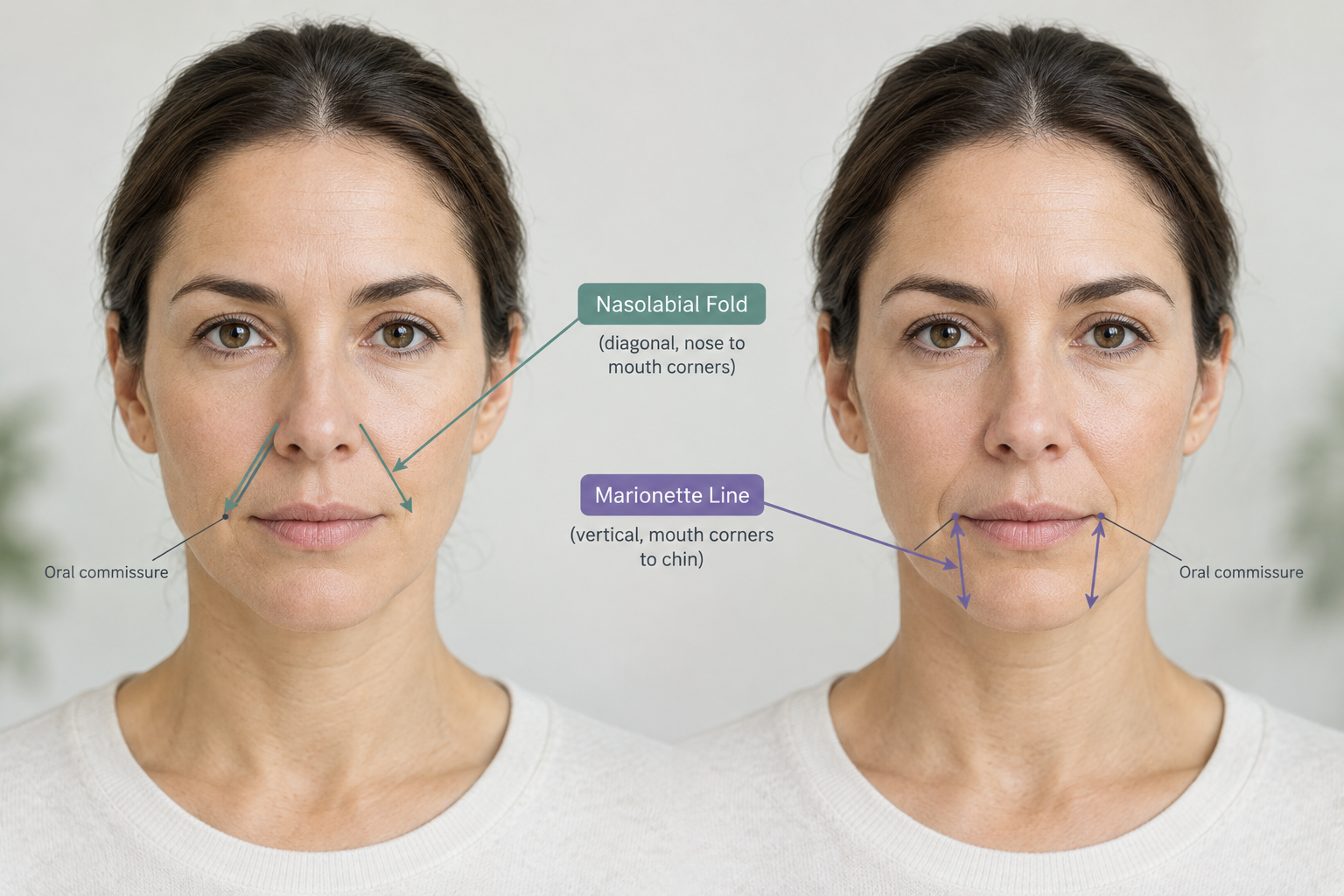
Distinguishing between these two features matters clinically because the most effective approach to each may differ. Addressing mid-face volume loss may improve nasolabial folds significantly, while marionette lines may require more targeted treatment of the lower face, chin, or prejowl area. A practitioner assessing the lower face will typically consider both features together as part of the overall facial ageing picture.
Can Marionette Lines Be Prevented or Slowed?
While the structural changes that cause marionette lines cannot be entirely prevented, there is reasonable evidence that certain measures can slow their progression. Daily broad-spectrum sun protection with an SPF of 30 or higher is the most consistently supported topical intervention for reducing photoageing. Avoiding smoking, maintaining a stable and healthy body weight, and following a skincare routine that includes evidence-supported ingredients such as retinoids and antioxidants may also contribute to maintaining skin quality over time.
Retinoids — derivatives of vitamin A — have the most robust evidence base among topical skincare ingredients for stimulating collagen synthesis and improving skin texture. Prescription-strength tretinoin has the strongest evidence, while over-the-counter retinol products vary considerably in concentration and formulation. Results from topical retinoids are gradual and require consistent long-term use; they are unlikely to reverse established deep marionette lines but may help maintain skin quality and slow further deterioration.
Hydration, both through topical moisturisers and adequate fluid intake, supports the skin barrier and may reduce the appearance of fine surface lines, though it does not address the deeper structural causes of marionette lines. A balanced diet with adequate protein, vitamins C and E, and other antioxidants supports general skin health, though the direct evidence for specific dietary interventions on facial ageing is less robust than for sun protection and retinoids.
Clinical Assessment and Treatment Options
When marionette lines are already established and causing concern, a range of clinical approaches may be considered depending on their depth, the underlying cause, and the individual’s overall facial anatomy. A thorough assessment by a qualified aesthetic practitioner is necessary before any treatment decision, as the most appropriate approach depends on which factors are most prominent in a given individual.
Dermal fillers — typically hyaluronic acid-based products — are commonly used to restore volume in the prejowl and lower face area, softening the appearance of marionette lines by addressing the structural deficit beneath them. Results are temporary, generally lasting several months to over a year depending on the product used, the area treated, and individual factors. Botulinum toxin injections targeting the DAO muscle may be considered to reduce the downward pull on the oral commissure, though this addresses only the muscular component and is often used alongside other treatments rather than as a standalone approach.
Skin-tightening treatments such as radiofrequency, ultrasound-based devices, or thread lifts may be discussed for individuals where tissue laxity is a primary concern. These approaches aim to stimulate collagen production or mechanically reposition tissue, and results vary depending on the degree of laxity, skin quality, and the specific technology used. Evidence for these treatments continues to develop, and realistic expectations are important. Surgical options such as a lower face lift address the structural causes more directly and may be appropriate for individuals with significant tissue descent, though they carry greater risks and recovery requirements than non-surgical approaches.
No single treatment is universally appropriate, and the most effective plans are often tailored to the individual’s specific anatomy, the depth of the lines, and their goals. A qualified practitioner will assess the face as a whole rather than treating marionette lines in isolation.
Frequently Asked Questions
At what age do marionette lines typically appear?
Marionette lines can begin to appear as early as the mid-thirties in some individuals, though they are more commonly noticed from the forties onward. The timing depends on genetics, lifestyle factors, and the rate of collagen and volume loss. Sun damage and smoking can cause them to appear earlier than they otherwise would.
Are marionette lines the same as smile lines?
No. Smile lines typically refer to nasolabial folds — the diagonal creases from the nose to the corners of the mouth. Marionette lines run vertically downward from the corners of the mouth toward the chin. Both are associated with facial ageing but have different anatomical origins and may respond differently to treatment.
Can facial exercises reduce marionette lines?
The evidence for facial exercises as a meaningful intervention for established marionette lines is limited. Some small studies suggest that targeted facial exercises may modestly improve facial muscle tone and fullness, but marionette lines are driven primarily by structural volume loss and tissue descent rather than muscle weakness. Exercises are unlikely to reverse existing deep lines, though they are generally low-risk to try.
Does losing weight make marionette lines worse?
Significant weight loss can make marionette lines more apparent, particularly if the skin has reduced elasticity and cannot fully retract after the loss of facial volume. This effect is more pronounced with rapid or substantial weight loss and in older individuals. Gradual weight management is generally preferable from a skin perspective.
Is there a difference between marionette lines in men and women?
Men tend to have thicker skin and a denser collagen network than women, which can delay the visible appearance of marionette lines. However, men are not immune to these changes, and factors such as sun exposure, smoking, and genetics affect both sexes. Women may notice accelerated lower-face ageing around the menopause due to the decline in oestrogen and its effect on skin collagen.
Can skincare alone get rid of marionette lines?
Topical skincare — including retinoids, antioxidants, and sun protection — can support skin quality and may slow the progression of fine lines, but it is unlikely to significantly reduce established deep marionette lines. These lines reflect structural changes beneath the skin surface that topical products cannot fully address. Clinical treatments are generally required for meaningful improvement of moderate to deep lines.
Understanding Your Marionette Lines Before Seeking Treatment
Marionette lines are the result of multiple overlapping processes — collagen and elastin decline, fat pad descent, bone resorption, ligament laxity, and in some cases habitual muscle activity — rather than a single cause. Environmental factors such as UV exposure and smoking can significantly accelerate these changes, while genetics and individual anatomy determine the baseline rate and pattern of development. Recognising which factors are most relevant to your own situation is a useful starting point, both for considering preventive measures and for having a more informed conversation with a practitioner if treatment is something you are considering.
If marionette lines are causing you concern, a consultation with a qualified aesthetic practitioner or dermatologist can provide a personalised assessment of the contributing factors and realistic options. The most appropriate approach will depend on the depth of the lines, the degree of volume loss, the extent of tissue laxity, and your overall goals — all of which require individual evaluation rather than a one-size-fits-all answer.