

A lash lift typically takes between 45 minutes and 75 minutes from start to finish, though the exact duration depends on several factors including the length and thickness of your natural lashes, the technique used by your technician, and whether any additional treatments such as a lash tint are included in the same appointment. Understanding what happens during each stage of the process can help you plan your visit and set realistic expectations for the results.
Key Takeaways
- A standard lash lift appointment usually takes between 45 and 75 minutes, with most sessions completed within an hour.
- The treatment uses a chemical perming solution to curl natural lashes upward from the root, creating a lifted, open-eyed appearance without extensions.
- Results typically last between six and eight weeks, depending on your natural lash growth cycle and aftercare habits.
- Adding a lash tint to the same appointment extends the total time by approximately 10 to 15 minutes.
- Lash lifts are generally considered low-maintenance, but they are not suitable for everyone, and a patch test or consultation may be recommended before treatment.
What Is a Lash Lift?
A lash lift is a semi-permanent cosmetic treatment that uses a chemical solution to reshape and curl natural eyelashes upward from the base. Unlike eyelash extensions, which attach synthetic fibres to existing lashes, a lash lift works entirely with your own lashes. The result is a more open, wide-awake appearance that can make lashes look longer and more defined without the need for daily curling or heavy mascara use.
The treatment is sometimes described as a perm for eyelashes. A silicone rod or shield is placed on the eyelid, and the natural lashes are adhered to it in an upward position. A lifting solution is then applied to soften the internal structure of each lash, followed by a setting solution that locks the new curl in place. The lashes are then released from the rod, leaving them with a lasting upward curl that follows the natural lash line.
Lash lifts have become a popular alternative to lash extensions for people who prefer a lower-maintenance routine or who want a more natural-looking result. They are widely available at beauty salons, aesthetic clinics, and specialist lash studios.
How Long Does a Lash Lift Take? A Step-by-Step Breakdown
The total appointment time for a lash lift is usually between 45 and 75 minutes. This includes preparation, the chemical processing stages, and the finishing steps. Breaking the appointment into its individual stages helps explain where the time is spent and why rushing any part of the process can affect the outcome.
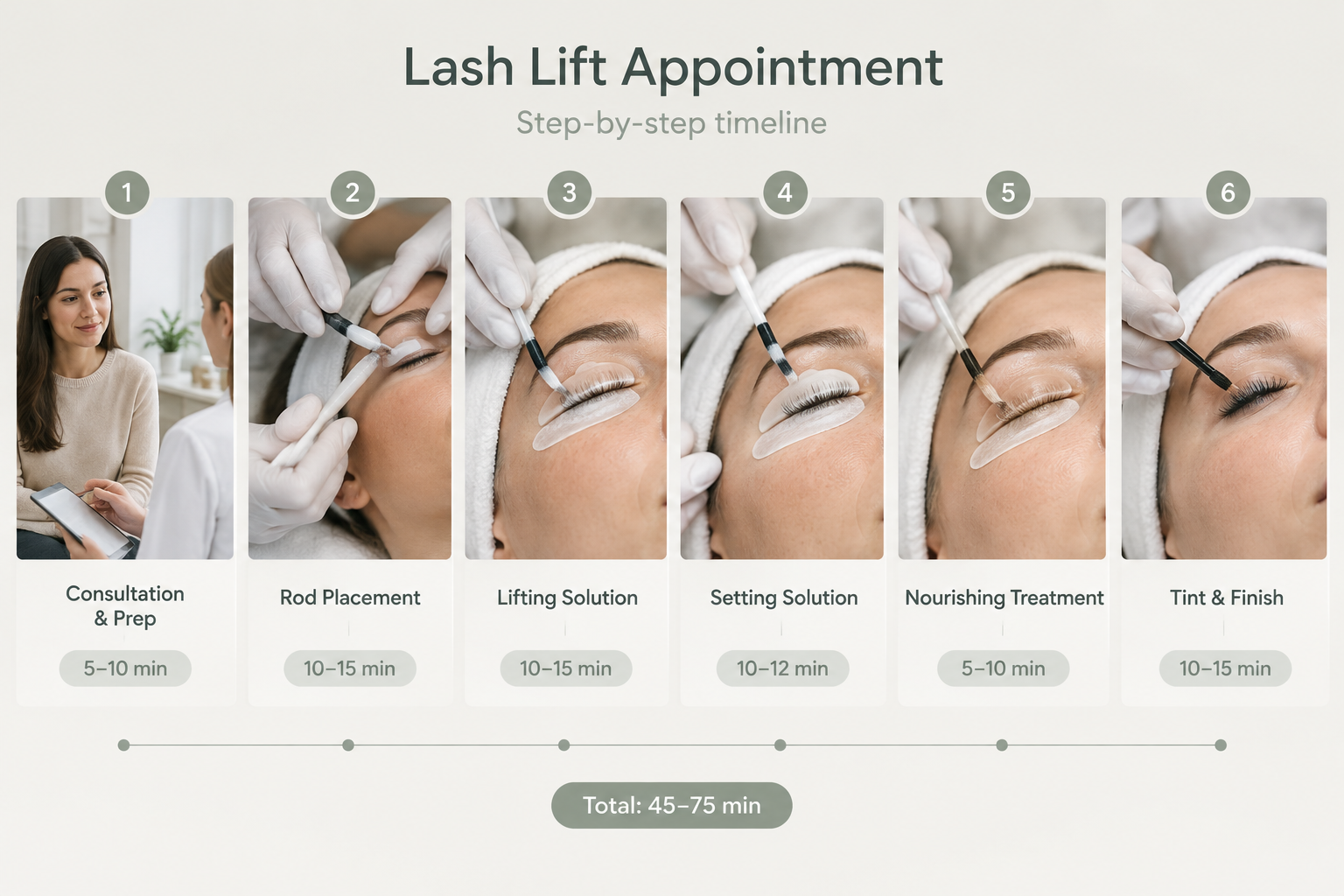
Consultation and Preparation (5–10 minutes)
Before the treatment begins, your technician will assess your natural lashes to determine the most appropriate rod or shield size. The size of the silicone rod used directly influences the degree of curl achieved: a smaller rod produces a tighter, more dramatic curl, while a larger rod creates a softer, more natural lift. Your technician may also ask about any previous lash treatments, sensitivities, or eye conditions at this stage. Eye makeup is removed, and the eye area is cleaned and dried thoroughly, as any residual oils or product can interfere with how well the solutions adhere to the lashes.
Rod Placement and Lash Adhesion (10–15 minutes)
The silicone rod or shield is secured to the eyelid using a gentle adhesive. Each individual lash is then carefully combed upward and adhered to the rod in a smooth, even position. This stage requires precision and patience, as unevenly placed lashes can result in an inconsistent curl pattern. Technicians typically work on one eye at a time to maintain control over the placement. This step is one of the most time-consuming parts of the appointment and should not be rushed.
Lifting Solution Application (10–15 minutes)
Once the lashes are secured to the rod, the lifting solution is applied to the mid-section and tips of the lashes, avoiding the root area and the skin. This solution contains ingredients that break down the disulfide bonds within the hair shaft, softening the internal structure of each lash so it can be reshaped. The solution is left on for a set processing time, which typically ranges from 8 to 12 minutes depending on the natural lash type. Finer or more delicate lashes generally require a shorter processing time to avoid over-processing, while thicker or more resistant lashes may need slightly longer. Your technician should monitor the processing carefully during this stage.
Setting Solution Application (10–12 minutes)
After the lifting solution is removed, a setting or fixing solution is applied. This solution works by reforming the bonds within the lash in their new curled position, locking the shape in place. The setting solution is left on for a similar duration to the lifting solution. Skipping or shortening this stage can result in lashes that do not hold their curl as effectively or that drop more quickly than expected.
Nourishing Treatment (Optional, 5–10 minutes)
Many lash lift treatments now include a conditioning or nourishing step as part of the standard protocol. A keratin or protein-based serum is applied to the lashes after the setting solution is removed. This step is intended to help restore moisture and strengthen the lash structure following chemical processing. Some formulations are marketed as keratin lash lifts, where the conditioning agent is incorporated into the lifting process itself. Whether this step meaningfully improves lash health compared to a standard lift is not conclusively established, but it is generally considered a low-risk addition.
Lash Tint (Optional, 10–15 minutes)
A lash tint is frequently offered as an add-on treatment during the same appointment. Tinting uses a semi-permanent dye to darken the lashes, which can enhance the visual effect of the lift, particularly for people with naturally fair or light-coloured lashes. Adding a tint extends the total appointment time by approximately 10 to 15 minutes. If a tint is included, it is usually applied after the lifting and setting solutions have been removed and the lashes have been cleaned.
Final Clean and Review (5 minutes)
The adhesive and any remaining solution residue are gently removed, the silicone rod is taken off, and the lashes are carefully separated and combed through. Your technician will review the result and provide aftercare instructions before you leave.
How Long Do Lash Lift Results Last?
Lash lift results typically last between six and eight weeks, though some people find their results persist for up to ten weeks and others notice the curl beginning to relax after four to five weeks. The longevity of a lash lift is closely tied to the natural eyelash growth cycle. Eyelashes grow in phases and are continuously shed and replaced, so as new lashes grow in and older lifted lashes reach the end of their cycle and fall out, the overall effect gradually diminishes.
Several factors can influence how long a lash lift lasts. Exposure to steam, heat, and moisture in the first 24 to 48 hours after treatment is one of the most significant variables, as the lash structure continues to set during this period and premature exposure to water or humidity can cause the curl to relax more quickly. Sleeping face-down, rubbing the eyes, and using oil-based eye products can also shorten the duration of results. People who use eyelash serums containing prostaglandin analogues may find that their lash growth cycle is accelerated, which can affect how long the lifted lashes remain visible before being replaced by new, unlifted growth.
Most practitioners recommend waiting at least six weeks between lash lift appointments to allow sufficient time for the lashes to recover from chemical processing. Repeating the treatment too frequently may increase the risk of lash damage, dryness, or breakage.
What Affects the Total Appointment Time?
While 45 to 75 minutes is the typical range, several factors can cause an appointment to run shorter or longer than average.
- Natural lash length and density: Longer or denser lashes may take more time to adhere evenly to the rod, extending the preparation stage.
- Lash type and processing time: Fine, delicate lashes process more quickly than thick or coarse lashes, which can affect the total chemical processing duration.
- Technician experience: An experienced lash technician will typically complete each stage more efficiently without compromising precision.
- Rod or shield size selection: Choosing the correct rod size for the desired result may involve a brief assessment period, particularly for first-time clients.
- Add-on treatments: A lash tint, brow treatment, or conditioning step will add time to the appointment.
- Client sensitivity or discomfort: If a client needs breaks or experiences any discomfort during the process, the appointment may take longer.
Aftercare and the 24-Hour Rule
Aftercare in the first 24 to 48 hours after a lash lift is important for preserving the result. During this period, the lash structure is still stabilising in its new shape, and exposure to moisture, heat, or friction can interfere with the setting process.
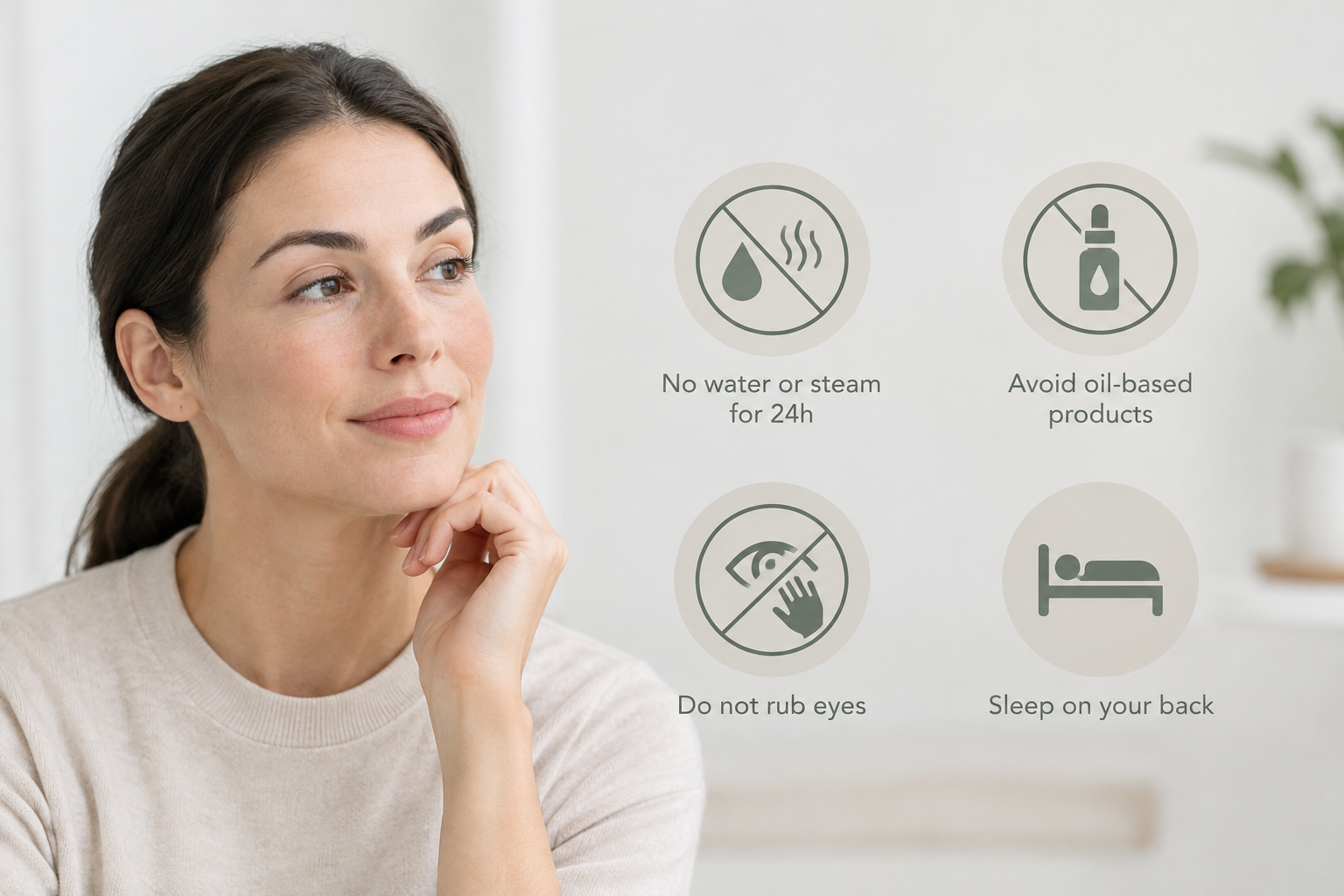
Standard aftercare guidance typically includes avoiding water, steam, and sweat around the eye area for at least 24 hours, refraining from using oil-based makeup removers or eye creams near the lashes, avoiding rubbing or touching the eye area, and sleeping on your back where possible to prevent the lashes from being pressed flat against a pillow. After the initial 48-hour period, most people can return to their normal routine, including wearing mascara, though water-based formulas are generally preferred over waterproof versions as they are easier to remove without tugging.
Using a lash conditioning serum or a small amount of castor oil on the lashes after the initial setting period has passed is sometimes recommended to help maintain lash health between appointments, though the evidence for specific products is largely anecdotal.
Risks, Side Effects, and Limitations
A lash lift is generally considered a low-risk cosmetic treatment when performed by a trained and experienced technician using appropriate products. However, as with any treatment involving chemical solutions applied near the eyes, there are potential risks and limitations that are worth understanding before booking an appointment.
The most commonly reported side effects include temporary redness or irritation around the eye area, mild sensitivity during or after the treatment, and occasional stinging if any solution comes into contact with the eye itself. These effects are usually short-lived and resolve without intervention. More significant reactions, including allergic contact dermatitis, are less common but possible, particularly in people with a history of skin sensitivities or allergies to cosmetic products. A patch test before the first treatment is advisable and is offered as standard practice by many reputable practitioners.
Over-processing is a meaningful risk if the lifting solution is left on for too long or if the treatment is repeated too frequently. Over-processed lashes may become dry, brittle, or prone to breakage. In some cases, lashes may appear over-curled or kinked rather than smoothly lifted. Choosing a qualified and experienced technician who uses professional-grade products and follows appropriate processing times is one of the most important factors in reducing this risk.
A lash lift is not suitable for everyone. People with very short natural lashes may not achieve a visible result, as there may be insufficient lash length to wrap around the rod effectively. Those with certain eye conditions, recent eye surgery, or active infections around the eye area should not undergo the treatment until they have been assessed by an appropriate healthcare professional. Lash lifts are generally not recommended during pregnancy, though this is a precautionary recommendation rather than an established contraindication, and individual advice from a healthcare provider is appropriate.
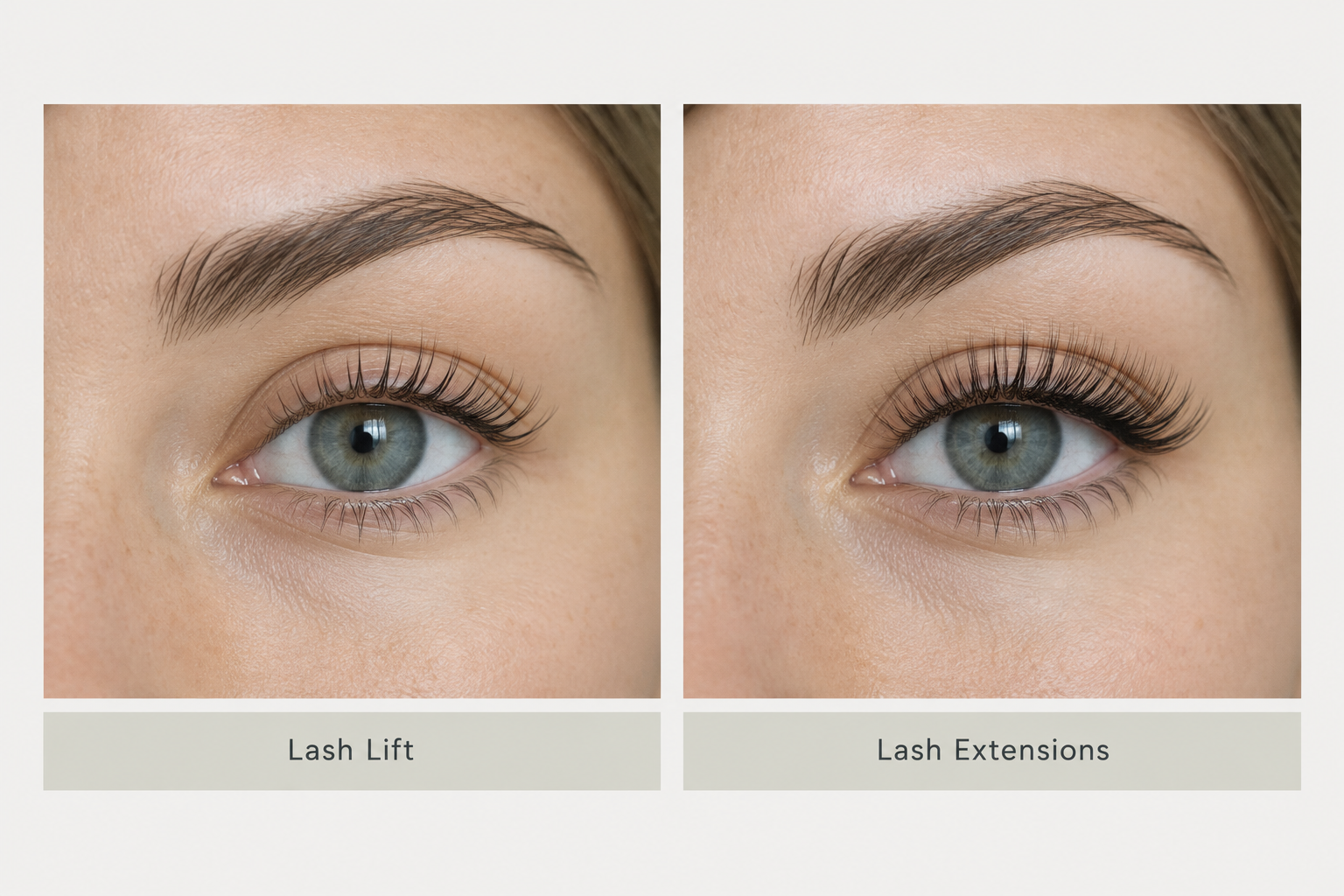
Lash Lift vs Lash Extensions: Key Differences
Lash lifts and lash extensions are both popular treatments for enhancing the appearance of natural lashes, but they work in fundamentally different ways and suit different preferences and lifestyles.
| Characteristic | Lash Lift | Lash Extensions |
|---|---|---|
| Treatment type | Chemical reshaping of natural lashes | Application of synthetic fibres to natural lashes |
| Appointment time | 45–75 minutes | 90–180 minutes (initial set) |
| Results duration | 6–8 weeks | 2–4 weeks before infill required |
| Maintenance required | Low; no infills needed | High; regular infills every 2–4 weeks |
| Natural appearance | Natural to moderately enhanced | Variable; can be natural or dramatic |
| Effect on natural lashes | Chemical processing; risk of over-processing | Weight and adhesive; risk of traction damage |
| Suitable for short lashes | Limited benefit for very short lashes | Can add length regardless of natural lash length |
| Cost per appointment | Generally lower | Generally higher, especially with infills |
A lash lift may be a more practical choice for people who want a low-maintenance enhancement that works with their natural lashes. Lash extensions offer greater flexibility in terms of length, volume, and style, but require more frequent appointments and ongoing maintenance. Neither treatment is universally superior; the right choice depends on individual lash characteristics, lifestyle, budget, and aesthetic goals.
Who May Be a Suitable Candidate for a Lash Lift?
A lash lift may be worth considering for people who have a reasonable length of natural lashes, typically at least 4 to 5 millimetres, and who want to enhance their appearance without the commitment of extensions or the daily use of a lash curler. It tends to suit people who prefer a natural-looking result, those with a busy lifestyle who want a low-maintenance beauty routine, and those who find lash extensions uncomfortable or impractical.
People with naturally straight or downward-pointing lashes often see the most noticeable improvement from a lash lift, as the treatment creates a visible upward curl that can make the eyes appear more open. Those with lashes that already have a natural curl may see a more subtle result.
A lash lift is generally not recommended for people with very short or sparse lashes, active eye infections or conditions such as blepharitis, a known allergy to perming or chemical solutions, or those who have recently undergone eye surgery. A consultation with a qualified technician before booking is the most reliable way to assess individual suitability.
Frequently Asked Questions
Can I wear mascara after a lash lift?
Yes, mascara can be worn after a lash lift once the initial 24 to 48-hour aftercare period has passed. Water-based mascaras are generally preferred as they are easier to remove without rubbing or tugging, which can stress the lashes. Waterproof mascara is not usually recommended as a daily choice following a lash lift, as removing it typically requires more friction and oil-based products that may affect the curl over time.
Does a lash lift hurt?
A lash lift is not typically painful. Most people find the treatment comfortable, though some describe a mild sensation of pressure on the eyelids during the rod placement stage. The eyes remain closed throughout the treatment. Occasional mild stinging can occur if any solution comes into contact with the eye, and a well-trained technician will take precautions to prevent this. If you experience significant discomfort at any point, you should let your technician know immediately.
How soon can I have another lash lift?
Most practitioners recommend waiting at least six to eight weeks between lash lift treatments. This allows time for the natural lash growth cycle to progress and for the lashes to recover from chemical processing. Repeating the treatment too soon increases the risk of over-processing, which can lead to dryness, brittleness, or lash breakage.
Will a lash lift work on very short lashes?
A lash lift requires sufficient lash length to wrap around the silicone rod effectively. Very short lashes, generally under 4 millimetres, may not produce a visible result, and the treatment may not be recommended in these cases. A consultation with an experienced technician is the best way to assess whether your natural lash length is suitable.
Can I get a lash lift if I wear contact lenses?
Contact lenses should be removed before a lash lift appointment, as the eyes are closed throughout the treatment and the solutions used should not come into contact with lenses. You can reinsert your lenses after the appointment once the area has been cleaned and any residual product has been removed. It is advisable to bring your lens case and solution to your appointment.
Is a patch test necessary before a lash lift?
A patch test is advisable before your first lash lift, particularly if you have a history of skin sensitivities, allergies, or reactions to cosmetic products. Many reputable salons and clinics offer or require a patch test 24 to 48 hours before the appointment. Even if you have had a lash lift previously, a patch test may be recommended if you are trying a new product or if significant time has passed since your last treatment, as sensitivities can develop over time.
What happens if I get my lashes wet too soon after a lash lift?
Getting the lashes wet within the first 24 hours after a lash lift can interfere with the setting process and may cause the curl to relax or drop prematurely. This is one of the most common reasons people find their results do not last as long as expected. Avoiding water, steam, swimming, and heavy sweating during this initial period gives the lash structure the best chance to fully set in its new shape.
Planning Your Lash Lift Appointment: What to Consider
A lash lift is a relatively straightforward cosmetic treatment with a predictable appointment time and a well-established aftercare routine. For most people, setting aside approximately 60 to 90 minutes for the appointment, including any add-on treatments and a brief consultation, is a reasonable approach. Arriving with clean, makeup-free eyes and removing contact lenses beforehand will help the appointment run smoothly and efficiently.
Choosing a qualified and experienced technician is one of the most important decisions you can make. The outcome of a lash lift depends significantly on the skill of the person performing it, including their ability to select the correct rod size, apply the solutions evenly, and monitor processing times carefully. Checking for relevant training qualifications, reading verified reviews, and asking about the products used are all reasonable steps before booking.
If you are considering a lash lift for the first time, a brief consultation before the appointment can help clarify whether the treatment is appropriate for your lash type and the result you are hoping to achieve. A realistic expectation is a natural-looking upward curl that enhances your existing lashes for six to eight weeks, with minimal daily maintenance required during that time.