

The lip flip is one of the most searched non-surgical lip treatments, largely because it promises a subtle enhancement without the volume associated with traditional lip filler. Understanding what the before and after results actually look like — and why they vary between patients — is essential before deciding whether this treatment is right for you.
Key Takeaways
- A lip flip uses a small amount of botulinum toxin injected into the upper lip muscle to gently roll the lip outward, creating the appearance of a fuller upper lip without adding volume.
- Results are subtle and typically become visible within five to ten days, lasting approximately six to eight weeks in most patients.
- The lip flip does not add volume; patients seeking significant size increase may be better suited to lip filler.
- Temporary side effects such as difficulty pronouncing certain sounds or drinking through a straw are possible and usually resolve as the treatment wears off.
- Suitability depends on individual lip anatomy, goals, and medical history, and a qualified practitioner assessment is required before treatment.
What Is a Lip Flip?
A lip flip is a cosmetic treatment that uses botulinum toxin — the same active ingredient found in brands such as Botox — injected in small amounts into the orbicularis oris muscle surrounding the upper lip. By partially relaxing this muscle, the upper lip rolls slightly outward and upward, revealing more of the pink lip tissue (the vermilion) that may otherwise be hidden when the lip is in a resting or smiling position. The result is the appearance of a more defined, slightly fuller upper lip without the addition of dermal filler.
Unlike lip filler, which physically adds volume using hyaluronic acid, the lip flip works entirely through muscle relaxation. This distinction is clinically important because it determines both what the treatment can and cannot achieve. Patients who want a dramatic size increase will not achieve that outcome with a lip flip alone. Those who feel their upper lip disappears when they smile, or who want a more defined cupid’s bow without added bulk, may find the lip flip more aligned with their goals.
How the Lip Flip Works: The Mechanism
Botulinum toxin works by temporarily blocking the release of acetylcholine at the neuromuscular junction, which prevents the targeted muscle from contracting with its usual force. When applied to the orbicularis oris — the circular muscle that controls lip movement — a carefully placed small dose reduces the muscle’s ability to curl the upper lip inward. This allows the natural tissue of the upper lip to evert slightly, sitting in a more outward position at rest and during movement.
The amount of botulinum toxin used in a lip flip is considerably smaller than the doses used for areas such as the forehead or glabellar lines. Because the orbicularis oris is involved in many everyday functions including speaking, drinking, and eating, the dose must be carefully calibrated. Too much relaxation can impair these functions noticeably, which is why practitioner experience and precise technique are particularly important for this treatment area.
Lip Flip Before and After: What the Results Look Like
Before treatment, patients typically present with an upper lip that appears thin at rest, curls inward when smiling, or lacks definition along the vermilion border. Some patients describe their upper lip as seeming to disappear in photographs, particularly when smiling broadly. The before state is often characterized by a flat or inward-rolling upper lip rather than an absence of lip tissue.
After a lip flip, the upper lip sits in a slightly more everted position. The change is intentionally subtle — the lip appears marginally fuller and more defined, and the cupid’s bow may look more pronounced. In patients whose upper lip rolls inward significantly when smiling, the after result can include a more consistently visible upper lip throughout facial expressions. The overall effect is often described as a natural-looking refinement rather than an obvious cosmetic change.
It is important to set realistic expectations: lip flip before and after comparisons from clinical settings consistently show modest improvements. The treatment does not create the plump, projected appearance associated with hyaluronic acid lip filler. Patients who compare their results to heavily filled lips seen on social media may be disappointed, which is why a thorough pre-treatment consultation is essential for aligning expectations with what the procedure can deliver.
How Results Differ Between Patients
Individual anatomy plays a significant role in how noticeable lip flip results appear. Patients with a naturally thin upper lip and strong orbicularis oris muscle activity — particularly those whose lip curls inward dramatically when smiling — tend to see a more visible change. Patients who already have reasonable upper lip volume at rest may notice a more subtle difference. Skin thickness, lip shape, and the degree of muscle activity all influence the outcome, which is why results vary and cannot be guaranteed.
When Do Lip Flip Results Appear?
Botulinum toxin does not produce immediate results. Following a lip flip treatment, most patients begin to notice early changes within three to five days as the toxin starts to take effect. The full result is generally visible by ten to fourteen days after the appointment. Practitioners typically recommend a review appointment at two weeks to assess the outcome and determine whether any refinement is appropriate.
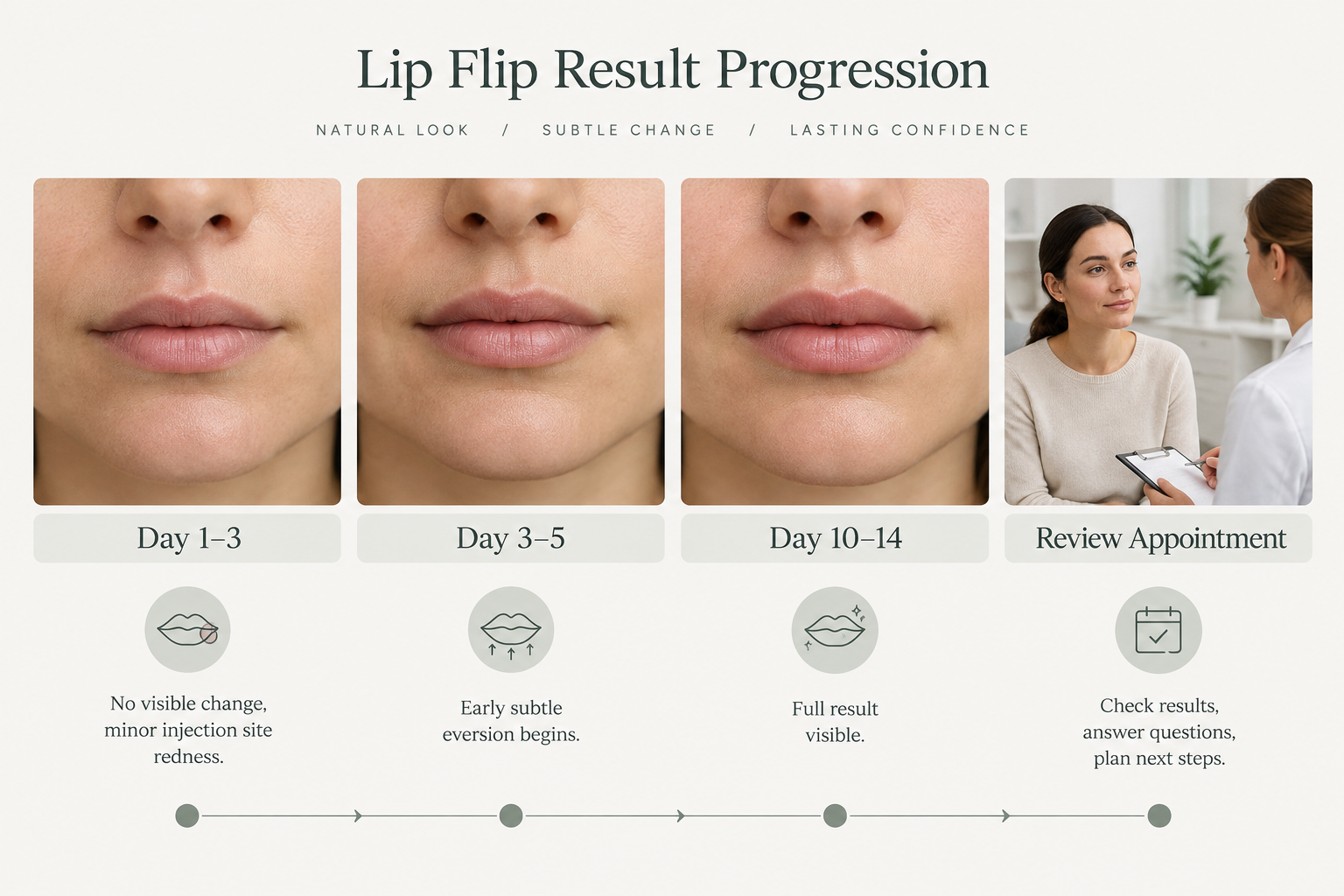
During the first few days after treatment, the lip may look unchanged or very slightly different. Some patients experience minor swelling or redness at the injection sites, which can temporarily obscure the final result. Patience during this early period is important, as judging the outcome too soon may lead to unnecessary concern or premature requests for additional treatment.
How Long Do Lip Flip Results Last?
Lip flip results are temporary. Most patients find that the effects last approximately six to eight weeks, though individual variation means some patients may notice results fading sooner or lasting slightly longer. The shorter duration compared to other botulinum toxin treatments — such as forehead lines, which may last three to four months — is related to the high level of muscle activity in the lip area. Frequent movement accelerates the metabolism of the toxin at this site.
Because the duration is relatively short, patients who wish to maintain the effect will need repeat treatments more frequently than they might for other botulinum toxin areas. This is a meaningful practical consideration when weighing the lip flip against alternatives such as lip filler, which typically lasts six to twelve months or longer depending on the product used and individual metabolism.
The Treatment Experience: What to Expect at Your Appointment
A lip flip appointment is typically brief, often taking fifteen to thirty minutes including the consultation component. The practitioner will assess the lip anatomy, discuss the patient’s goals, review medical history, and explain what the treatment can realistically achieve. Photographs are usually taken before treatment to allow comparison at the review appointment.
The injections themselves involve a small number of carefully placed points along the upper lip border. A topical numbing cream may be applied beforehand to improve comfort, though many patients find the discomfort minimal given the small needle size and limited number of injection points. Some patients report a brief stinging or pressure sensation during the injection.
After the appointment, patients can generally return to normal activities. Practitioners typically advise avoiding vigorous exercise, excessive heat such as saunas, and lying face-down for the remainder of the day. Applying pressure to the treated area is also usually discouraged in the immediate post-treatment period.
Possible Side Effects and Risks
The lip flip carries a specific risk profile that patients should understand before proceeding. Because the orbicularis oris muscle is involved in speech, drinking, and eating, temporary functional changes are possible when this muscle is partially relaxed.
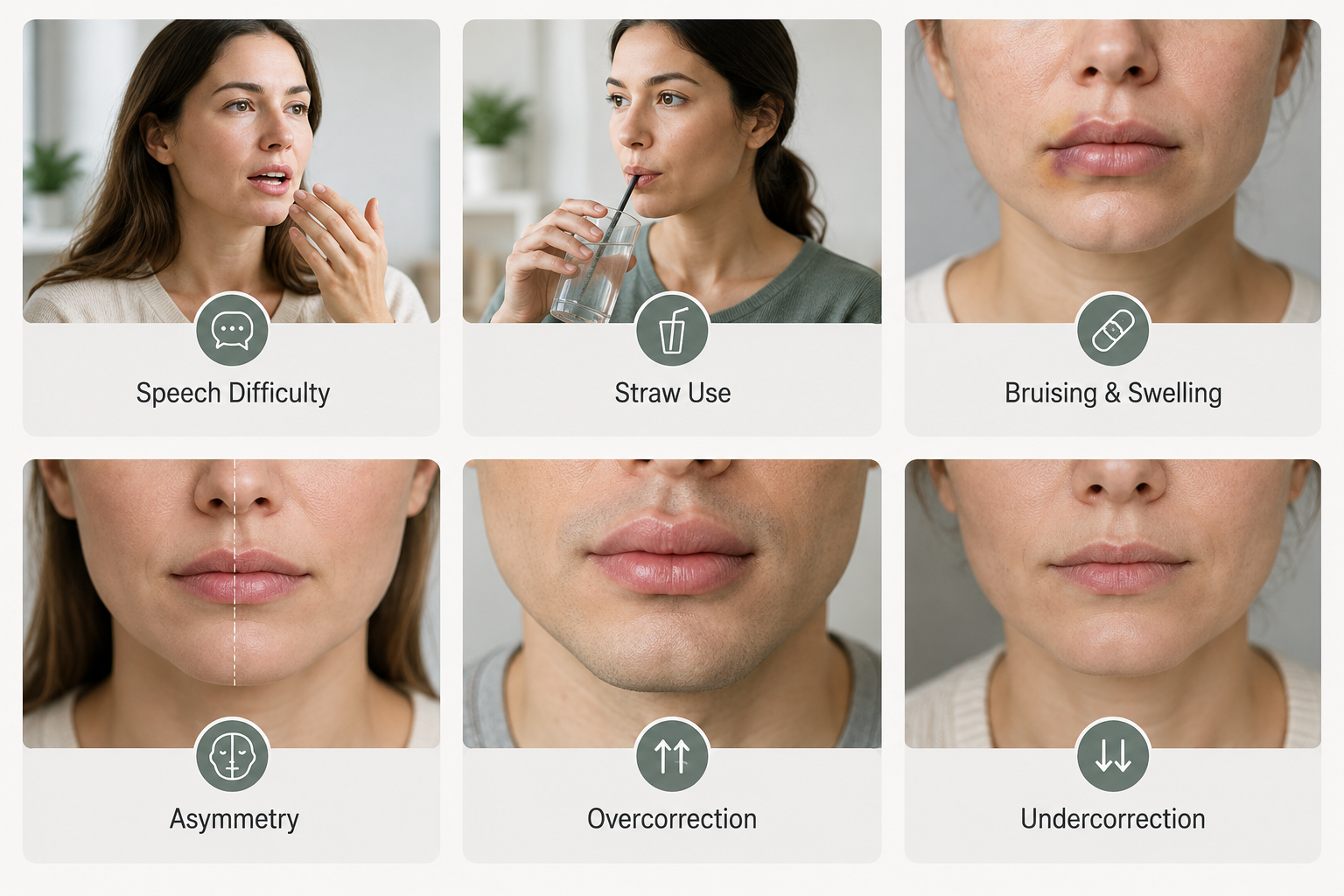
- Difficulty with certain sounds: Some patients notice temporary difficulty pronouncing sounds that require the lips to press together firmly, such as ‘p’, ‘b’, and ‘m’. This typically resolves as the treatment wears off.
- Difficulty drinking through a straw: The reduced muscle strength in the upper lip can make it harder to create a seal around a straw. This is temporary but can be inconvenient.
- Asymmetry: Uneven relaxation of the muscle can result in temporary asymmetry of the upper lip. This may improve as the toxin distributes, or it may require assessment at the review appointment.
- Bruising and swelling: Minor bruising or swelling at injection sites is common and usually resolves within a few days.
- Overcorrection: Excessive relaxation of the orbicularis oris can cause the upper lip to evert too much, creating an unnatural appearance. This underscores the importance of conservative dosing and experienced technique.
- Undercorrection: Insufficient effect may occur, particularly in patients with strong muscle activity. A review appointment allows the practitioner to assess whether a small additional dose is appropriate.
Serious complications from lip flip treatment are uncommon when performed by a qualified and experienced practitioner using appropriate technique and dosing. However, as with any injectable treatment, infection, allergic reaction, and vascular complications are theoretically possible and should be discussed during the pre-treatment consultation.
Who May Be Suitable for a Lip Flip
The lip flip may be worth discussing with a qualified practitioner if you:
- have an upper lip that appears to roll inward or disappear when smiling;
- want a subtle enhancement of the upper lip without added volume;
- are looking for a more defined cupid’s bow or vermilion border;
- prefer a less permanent or less invasive option before committing to lip filler;
- have previously had lip filler and want to complement the result with improved lip position.
A clinical assessment is required to determine individual suitability. Anatomy, skin quality, existing lip volume, and personal goals all influence whether the lip flip is the most appropriate option.
Who May Not Be Suitable
The lip flip may not be appropriate for everyone. Patients who may not be suitable include those who:
- are pregnant or breastfeeding, as botulinum toxin is generally avoided during these periods;
- have a known allergy or sensitivity to botulinum toxin or any of its components;
- have a neuromuscular condition such as myasthenia gravis or Lambert-Eaton syndrome, which may be contraindicated with botulinum toxin use;
- are taking certain medications that may interact with botulinum toxin, including some antibiotics and muscle relaxants;
- have an active infection or skin condition in the treatment area;
- have unrealistic expectations about the degree of change the treatment can produce.
Patients whose primary concern is lack of volume rather than lip position are unlikely to achieve their desired outcome with a lip flip alone and may be better served by a discussion about lip filler or a combination approach.
Lip Flip vs Lip Filler: Understanding the Difference
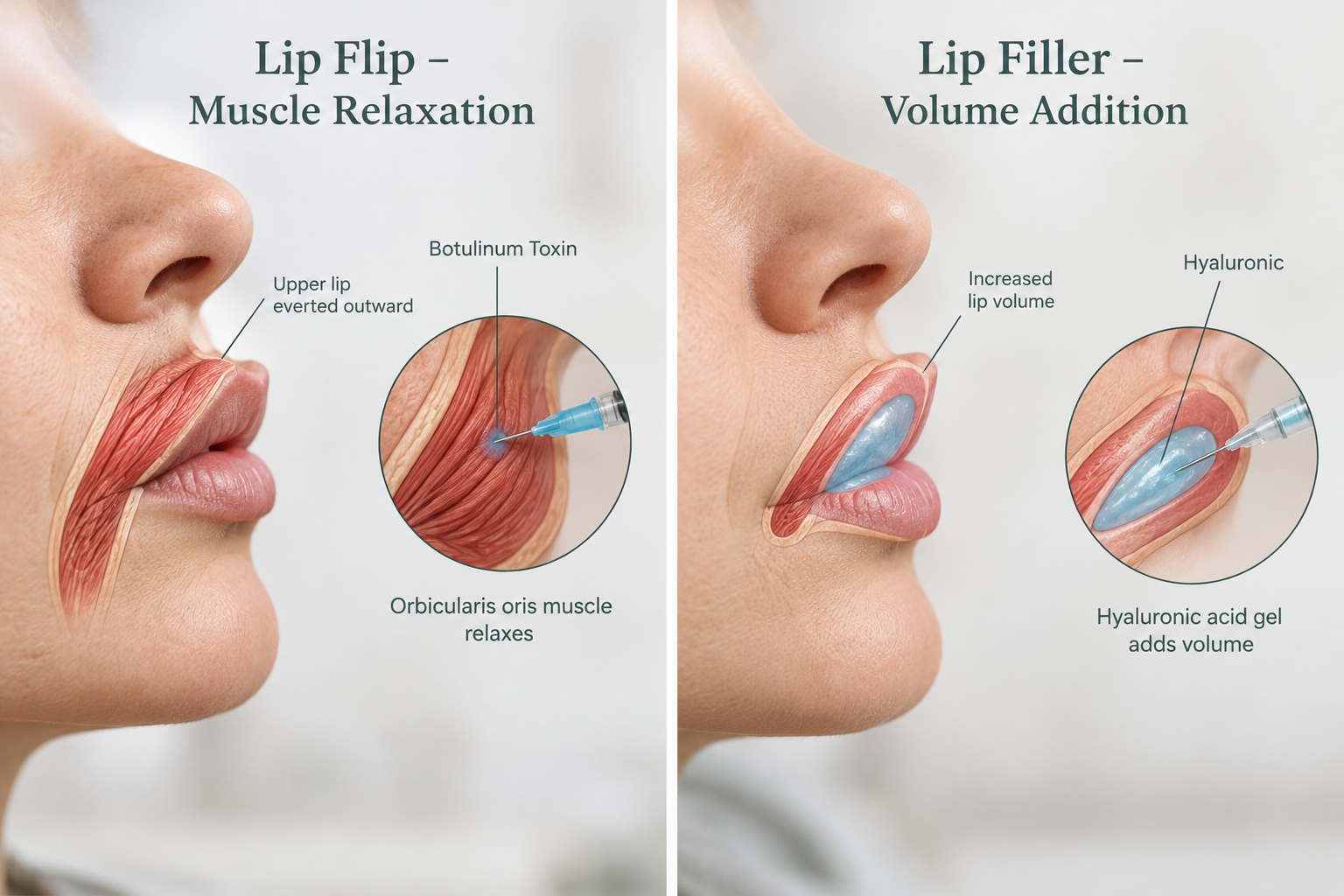
The lip flip and lip filler are frequently compared because both address the appearance of the lips, but they work through entirely different mechanisms and produce different outcomes. Understanding this distinction is important when reviewing before and after results, as the two treatments are not interchangeable.
| Characteristic | Lip Flip | Lip Filler |
|---|---|---|
| Active ingredient | Botulinum toxin | Hyaluronic acid (typically) |
| Mechanism | Muscle relaxation causing lip eversion | Volume addition via injectable gel |
| Primary effect | Improved lip position and definition | Increased lip volume and projection |
| Visible change | Subtle | Moderate to significant depending on dose |
| Duration | Approximately 6–8 weeks | Approximately 6–12+ months |
| Reversibility | Wears off naturally | Can be dissolved with hyaluronidase |
| Downtime | Minimal | Minimal to mild (swelling common) |
| Functional side effects | Possible (speech, drinking) | Less common |
| Best suited for | Lip rolling inward, subtle definition | Volume increase, projection, symmetry |
Some patients choose to combine both treatments: lip filler to add volume and the lip flip to refine the position of the upper lip border. Whether a combined approach is appropriate depends on individual anatomy and goals and should be discussed with a qualified practitioner.
Alternatives to the Lip Flip
For patients who are not suitable for the lip flip, or who want to explore other options, several alternatives may be worth discussing during a consultation.
Hyaluronic acid lip filler remains the most widely used non-surgical lip enhancement treatment. It adds physical volume and can be used to reshape the lip border, improve symmetry, and increase projection. Results typically last longer than a lip flip, and the treatment is reversible using hyaluronidase if the patient is unhappy with the outcome.
Lip liner and makeup techniques can create the visual impression of a fuller or more defined upper lip without any injectable treatment. While not a clinical alternative, this is a useful option for patients who want to assess how a more defined lip border might look before committing to a procedure.
Surgical lip lift is a permanent surgical option that shortens the distance between the base of the nose and the upper lip, increasing the amount of upper lip tissue visible at rest. This is a more invasive procedure with a longer recovery period and is typically considered when non-surgical options have not achieved the desired result or when a permanent change is preferred.
Combination treatments involving both botulinum toxin and hyaluronic acid filler may offer a more comprehensive result for some patients, addressing both lip position and volume in a single treatment plan.
Frequently Asked Questions
Does a lip flip make your lips look bigger?
A lip flip does not add volume, so it does not make the lips physically larger. It creates the appearance of a slightly fuller upper lip by rolling the lip outward, which reveals more of the existing lip tissue. Patients seeking a noticeable increase in lip size are more likely to achieve that goal with hyaluronic acid lip filler.
Is the lip flip painful?
Most patients describe the lip flip as mildly uncomfortable rather than painful. The injections involve a fine needle and a small number of points along the upper lip border. Topical numbing cream can be applied beforehand to reduce discomfort. Individual pain tolerance varies, and some patients find the area more sensitive than others.
Can I eat and drink normally after a lip flip?
Most patients can eat and drink normally after a lip flip, though some temporary difficulty drinking through a straw or eating foods that require a firm lip seal may occur as the treatment takes effect. These functional changes are temporary and resolve as the botulinum toxin wears off.
How soon can I wear lipstick after a lip flip?
Most practitioners advise avoiding applying pressure or products to the treated area for the remainder of the day following treatment. After this initial period, lipstick and lip products can generally be used normally. Your practitioner will provide specific aftercare guidance based on your treatment.
Will my lips look unnatural after a lip flip?
When performed by an experienced practitioner using an appropriate dose, the lip flip is designed to produce a natural-looking result. Overcorrection — where the lip everts too much — can create an unnatural appearance, which is why conservative dosing and a review appointment are important parts of the treatment process.
Can I have a lip flip if I already have lip filler?
In many cases, yes. Some patients combine lip filler with a lip flip to address both volume and lip position. However, the presence of existing filler affects the assessment, and a qualified practitioner will need to evaluate the current state of the lips before recommending any additional treatment.
What happens when the lip flip wears off?
As the botulinum toxin gradually metabolizes, the orbicularis oris muscle regains its normal activity and the lip returns to its pre-treatment position. There is no rebound effect or worsening of the original appearance. Patients who wish to maintain the result can discuss repeat treatment timing with their practitioner.
Is a Lip Flip the Right Choice for Your Lip Goals?
The lip flip is a well-defined treatment with a specific and limited scope. Before and after results consistently show subtle improvements in upper lip position and definition — particularly in patients whose upper lip rolls inward when smiling — rather than dramatic volume changes. For patients whose goals align with what the treatment can realistically deliver, it may be a useful and relatively low-commitment option.
The short duration of results — typically six to eight weeks — means the lip flip requires more frequent maintenance than lip filler, which is a practical factor worth weighing against the lower degree of change it produces. Patients who want a longer-lasting or more visible enhancement are likely to find lip filler a more suitable option, either alone or in combination with a lip flip.
Because individual anatomy, muscle activity, and personal goals vary considerably, a consultation with a qualified and experienced aesthetic practitioner is the most reliable way to determine whether the lip flip is appropriate for you, what results you might reasonably expect, and whether an alternative or combined approach would better serve your objectives. A practitioner who takes time to understand your goals and explain the realistic range of outcomes is best placed to help you make an informed decision.