

Chin filler is a non-surgical injectable treatment that uses hyaluronic acid dermal filler to reshape or project the chin, with the goal of improving the overall balance of the facial profile. For patients who feel their chin is recessed, asymmetrical, or lacks definition, a small volume of filler placed precisely in the chin area can meaningfully alter the relationship between the chin, jawline, and nose — without surgery. This article explains how chin filler works, what it can realistically achieve, who may be a suitable candidate, what the treatment involves, and what limitations and risks to consider before booking a consultation.
Key Takeaways
- Chin filler uses hyaluronic acid gel to add projection, length, or definition to the chin, helping to improve the balance between facial features when viewed from the side or front.
- Results are temporary, typically lasting between 12 and 18 months depending on the product used, the volume placed, and individual metabolism.
- The treatment is not suitable for everyone; a thorough clinical assessment of facial anatomy, skin quality, and medical history is essential before proceeding.
- Risks exist and include bruising, swelling, asymmetry, and rare but serious vascular complications; choosing a qualified and experienced practitioner is critical.
- Chin filler is one option among several, including surgical chin implants and jaw contouring with botulinum toxin, and the most appropriate approach depends on individual anatomy and goals.
What Is Chin Filler and How Does It Work?
Chin filler refers to the injection of a dermal filler product — most commonly a hyaluronic acid-based gel — into the soft tissue of the chin to alter its shape, size, or projection. Hyaluronic acid is a naturally occurring substance found in the skin and connective tissue; when formulated as a cross-linked gel and injected, it adds volume and structure that can be sculpted to achieve a specific aesthetic outcome. The chin is a three-dimensional structure, and practitioners can use filler to address different concerns depending on where and how the product is placed: adding forward projection to a recessed chin, elongating a short chin vertically, improving symmetry, or refining the chin point.
The mechanism is straightforward: the filler physically occupies space within the tissue, pushing the overlying skin outward and creating a new contour. Unlike botulinum toxin, which works by relaxing muscles, hyaluronic acid filler is a structural treatment — it provides immediate mechanical support. Because hyaluronic acid is gradually broken down by the body’s own enzymes over time, the results are not permanent. This temporary nature is considered both a benefit and a limitation depending on the patient’s perspective.
Thicker, more cohesive hyaluronic acid formulations are generally preferred for the chin because they provide better structural support and resist migration more effectively than softer, more fluid products designed for superficial skin hydration. The specific product selected is a clinical decision made by the practitioner based on the patient’s anatomy and the desired outcome.
Why Profile Balance Matters in Facial Aesthetics
Facial profile balance refers to the proportional relationship between the forehead, nose, lips, and chin when the face is viewed from the side. In aesthetic medicine, practitioners often assess the profile using reference points and angles to understand how individual features relate to one another. A chin that sits significantly behind the vertical line dropped from the base of the nose — sometimes described as a retruded or recessed chin — can make the nose appear larger than it is, the neck appear shorter, and the lower face appear less defined. Conversely, a chin that projects too far forward can create a different imbalance.
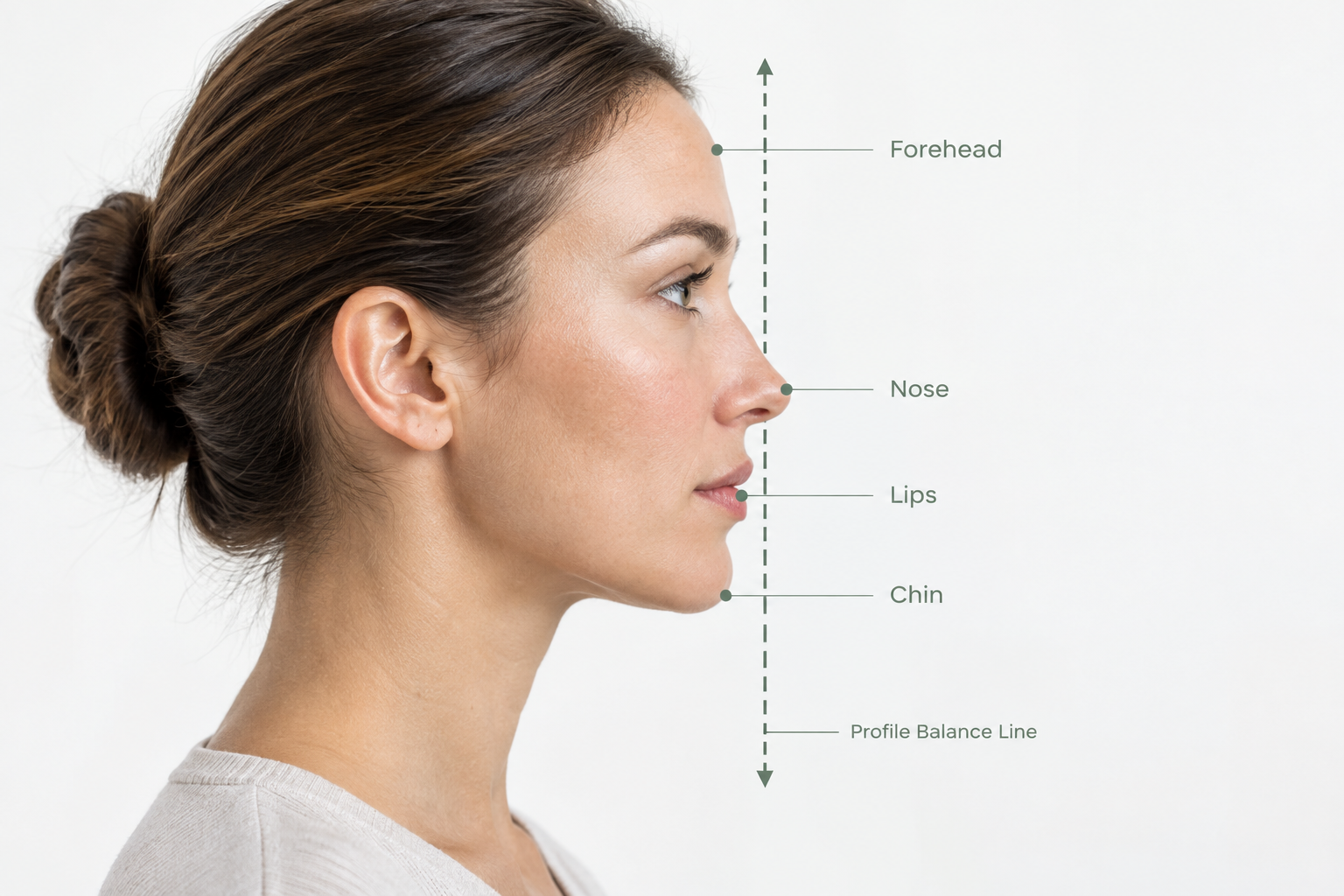
The concept of the “golden ratio” or ideal facial proportions is frequently referenced in aesthetic consultations, though it is important to understand that these are guidelines rather than universal standards. Facial attractiveness is subjective and culturally influenced, and the goal of chin filler is not to impose a single ideal but to address a specific concern that is bothering the patient and that can be meaningfully improved with the treatment. A well-conducted consultation will assess the patient’s existing proportions, their specific concern, and whether chin filler is likely to produce a result that aligns with their expectations.
From a profile perspective, chin filler is particularly relevant for patients who feel their lower face lacks definition or that their chin “disappears” when viewed from the side. It is also used to improve the cervicomental angle — the angle between the neck and the underside of the chin — which can contribute to the appearance of a more defined jawline and neck profile, though the degree of improvement depends heavily on individual anatomy including the amount of submental fat present.
Who May Be a Suitable Candidate for Chin Filler?
Chin filler may be worth discussing with a qualified practitioner if you have a chin that appears recessed, short, or asymmetrical and you are looking for a non-surgical option to improve lower facial balance. Suitable candidates are generally adults in good general health who have realistic expectations about what a non-surgical treatment can achieve. The treatment tends to work best in patients who have mild to moderate chin recession or asymmetry, adequate overlying skin quality, and no significant excess submental fat that would obscure the result.
Patients who are considering rhinoplasty — surgical nose reshaping — sometimes explore chin filler first, because improving chin projection can alter the perceived size and shape of the nose without any nasal intervention. This is sometimes referred to as a “non-surgical rhinoplasty complement” and can be a useful way to assess how improved chin projection changes the overall profile before committing to surgery.
Chin filler is generally not recommended for patients who are pregnant or breastfeeding, have active skin infections or inflammation in the treatment area, have a known allergy to hyaluronic acid or any filler component, are taking certain blood-thinning medications without medical clearance, or have had previous chin implant surgery without appropriate assessment. Patients with significant chin recession that would require a large volume of filler to correct may find that a surgical chin implant provides a more proportionate and longer-lasting result, and this should be discussed openly during consultation.
What Happens During a Chin Filler Appointment?
A chin filler appointment typically begins with a detailed consultation, which may take place at the same visit or as a separate session depending on the clinic’s protocol. During the consultation, the practitioner will assess your facial anatomy, discuss your concerns and goals, review your medical history, and explain the treatment options, risks, and expected outcomes. Photographs are usually taken to document the baseline appearance and to assist with treatment planning.
Before the injections begin, a topical anaesthetic cream is often applied to the chin area to reduce discomfort. Many hyaluronic acid filler products used in the chin also contain lidocaine — a local anaesthetic — within the formulation, which helps to manage discomfort during and after injection. The practitioner will clean the skin and may mark the injection points. The filler is then injected using a fine needle or a blunt-tipped cannula, depending on the technique preferred by the practitioner and the specific area being treated. A cannula approach may reduce the risk of bruising in some cases, though both techniques are used clinically.
The practitioner will typically massage and mould the filler during and after injection to achieve the desired shape and to ensure even distribution. The entire treatment usually takes between 20 and 45 minutes, including preparation. Patients can generally return to normal daily activities immediately after the appointment, though some temporary restrictions apply during the initial recovery period.
Recovery, Downtime, and What to Expect After Treatment
Chin filler has minimal downtime compared to surgical alternatives. The most common immediate effects are mild swelling, redness, and tenderness at the injection sites, which typically resolve within a few days. Bruising is possible and may take up to one to two weeks to fully fade, depending on the individual’s skin and the technique used. Applying a cold compress gently to the area in the hours following treatment can help to reduce swelling.
Practitioners generally advise patients to avoid strenuous exercise, alcohol, and significant heat exposure — such as saunas or hot baths — for 24 to 48 hours after treatment, as these can increase swelling and bruising. Sleeping with the head slightly elevated on the first night may also help to minimise swelling. Patients are usually advised to avoid pressing or massaging the treated area for at least a week unless specifically instructed to do so by their practitioner.
Initial swelling can temporarily make the result appear more pronounced than the final outcome. The filler settles over approximately two weeks, after which the result becomes more stable and representative of the longer-term appearance. A follow-up appointment is often recommended at two to four weeks to assess the result and determine whether any refinement is needed.
How Long Does Chin Filler Last?
The longevity of chin filler varies between individuals and depends on several factors, including the specific product used, the volume injected, the patient’s metabolism, and their lifestyle. In general, hyaluronic acid chin filler tends to last between 12 and 18 months, with some patients reporting results that persist for up to two years. The chin is a relatively low-movement area compared to the lips or nasolabial folds, which means filler placed here is subject to less mechanical stress and may last longer than in more dynamic facial regions.
Over time, the hyaluronic acid is gradually broken down by the body’s hyaluronidase enzyme, and the volume slowly diminishes. Patients who wish to maintain their result will need repeat treatments. Some practitioners suggest that repeated treatments over time may have a cumulative effect on the surrounding tissue, though this is not universally established and should be discussed individually.
One practical advantage of hyaluronic acid filler over permanent or semi-permanent alternatives is that it can be dissolved using an enzyme called hyaluronidase if the result is unsatisfactory, asymmetrical, or if a complication arises. This reversibility is considered an important safety feature and is one reason why hyaluronic acid remains the most widely used filler type for facial contouring.
Risks and Side Effects of Chin Filler
Chin filler carries risks that every patient should understand before proceeding. Common side effects include temporary swelling, bruising, redness, and tenderness at the injection site. These are expected and typically resolve within one to two weeks. Mild asymmetry immediately after treatment is also common due to uneven swelling and usually improves as the filler settles.

Less common but more significant risks include persistent asymmetry, nodule formation (where the filler becomes palpable or visible as a lump), infection, and skin necrosis caused by inadvertent injection into or compression of a blood vessel. Vascular occlusion — where filler blocks a blood vessel — is a rare but serious complication that can lead to tissue damage or, in very rare cases, vision changes if filler migrates to vessels connected to the eye. The chin area has a relatively lower vascular risk profile compared to some other facial regions, but the risk is not zero, and it underscores the importance of treatment by a practitioner with thorough knowledge of facial anatomy and vascular emergency protocols.
Patients should be aware of the signs of a vascular complication, which can include sudden severe pain, skin colour changes (blanching or mottling), and prolonged swelling. These require immediate medical attention. Choosing a practitioner who carries hyaluronidase on-site and is trained to manage complications is an important safety consideration.
Chin Filler vs. Surgical Chin Implant: Key Differences
For patients considering longer-term chin enhancement, a surgical chin implant is the main alternative to injectable filler. A chin implant is a solid silicone prosthesis placed through a small incision either under the chin or inside the mouth, positioned over the chin bone to add permanent projection. The key differences between the two approaches relate to longevity, degree of correction, recovery, reversibility, and cost.
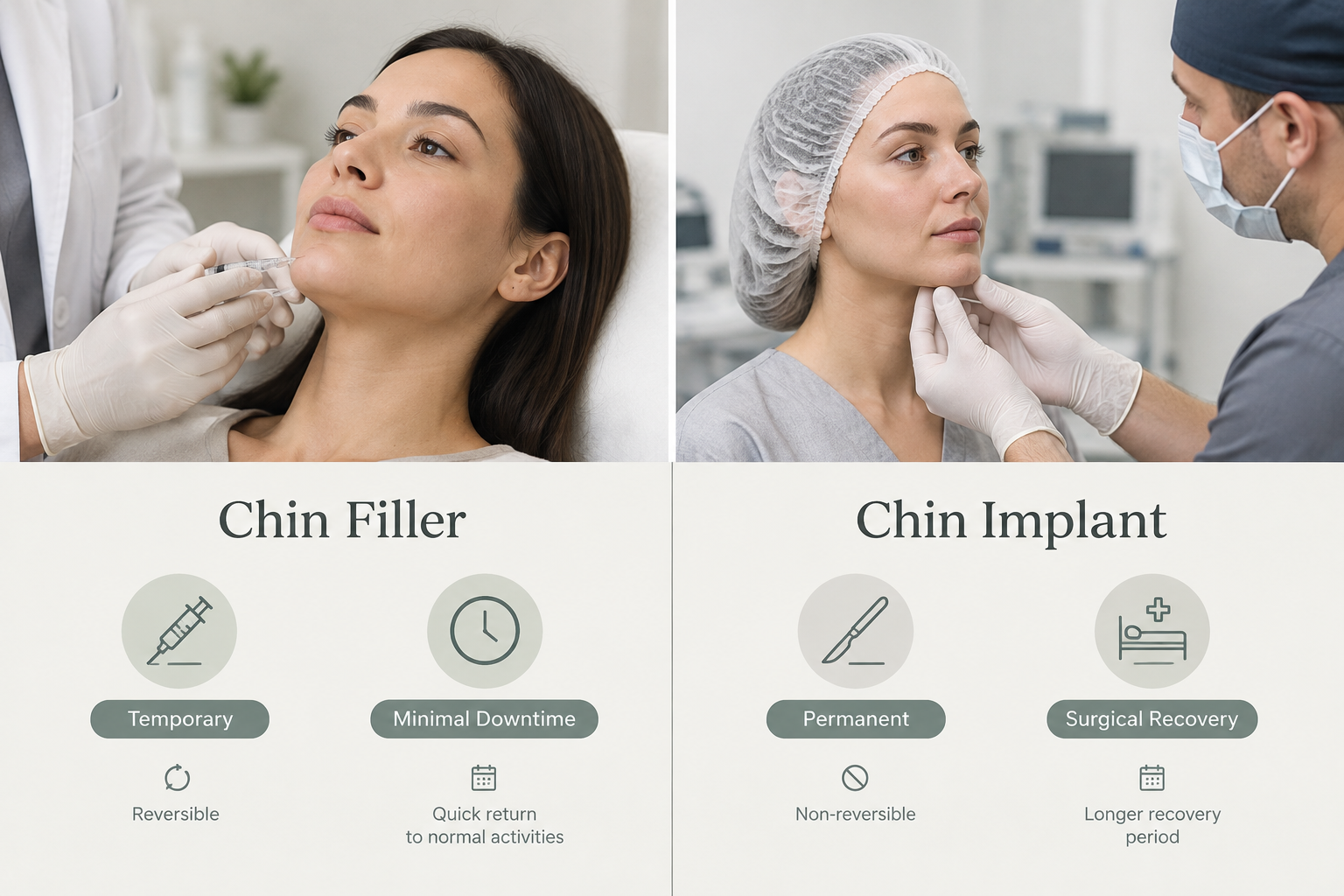
Chin filler is non-surgical, requires no anaesthesia beyond topical or local numbing, involves minimal downtime, and is reversible. However, the results are temporary and the degree of projection achievable is limited by the volume of filler that can safely be placed. A surgical implant provides permanent results and can achieve a greater degree of structural change, but it carries the risks associated with surgery including anaesthesia, infection, implant displacement, and a longer recovery period. The choice between the two depends on the degree of correction needed, the patient’s preference for permanence versus reversibility, and their tolerance for surgical risk and recovery.
Some patients use chin filler as a “trial” to assess how improved chin projection changes their appearance before deciding whether to pursue a surgical implant. This is a clinically reasonable approach, provided the patient understands that filler and an implant do not produce identical results and that the filler result is not a perfect preview of surgical outcomes.
Chin Filler and Jawline Contouring: How They Relate
Chin filler is often discussed alongside jawline contouring, and the two treatments are sometimes combined in the same appointment. Jawline contouring with dermal filler involves placing product along the mandibular border to create a more defined, angular jaw shape. When combined with chin filler, the effect can be a more comprehensive reshaping of the lower face, improving both the profile and the frontal appearance of the jawline.
Botulinum toxin injected into the masseter muscles — the large chewing muscles at the sides of the jaw — is another complementary treatment. Masseter reduction with botulinum toxin can slim the lower face in patients with a wide or square jaw caused by muscle bulk, and when combined with chin filler, the overall effect on lower facial proportions can be significant. These treatments address different anatomical structures and work through different mechanisms, so they are not interchangeable but may be complementary depending on the patient’s anatomy and goals.
A thorough facial assessment is essential before combining treatments, as adding volume in one area while reducing it in another requires careful planning to avoid an unnatural or disproportionate result.
Questions to Ask Your Practitioner Before Chin Filler
- What specific changes to my chin anatomy do you think filler can realistically achieve?
- Which filler product do you plan to use, and why is it appropriate for the chin area?
- Will you use a needle or a cannula, and what are the reasons for that choice in my case?
- How much product do you anticipate using, and what is the cost?
- What are the most likely side effects I should expect, and how long will they last?
- Do you carry hyaluronidase on-site, and are you trained to manage vascular complications?
- What would happen if I am unhappy with the result?
- Are there any aspects of my anatomy or medical history that make me a higher-risk candidate?
- Would a surgical chin implant be a more appropriate option for my degree of concern?
Frequently Asked Questions
Can chin filler make my nose look smaller?
Improving chin projection can alter the perceived proportions of the face in profile, which may make the nose appear less prominent relative to the rest of the face. This is a genuine optical effect related to improved lower facial balance rather than any change to the nose itself. However, the degree of change depends on individual anatomy, and chin filler is not a substitute for rhinoplasty in patients with significant nasal concerns.
Is chin filler painful?
Most patients describe the discomfort as mild to moderate. Topical anaesthetic cream applied before treatment and lidocaine within the filler formulation help to manage pain during the procedure. Some patients experience tenderness in the area for a day or two after treatment, which is normal and usually manageable with over-the-counter pain relief if needed.
How much chin filler is typically needed?
The volume required varies considerably between individuals depending on the degree of recession or asymmetry being addressed. Many patients achieve a meaningful improvement with one to two millilitres of filler, though some may require more or less. Your practitioner should discuss the anticipated volume and associated cost during the consultation. Overfilling the chin can produce an unnatural appearance, so a conservative approach with the option to add more at a follow-up is often preferable.
Can chin filler migrate or move?
Filler migration — where the product moves away from the intended placement area — is possible but less common in the chin than in more mobile facial areas. Using a thicker, more cohesive filler product and placing it at the appropriate tissue depth reduces this risk. Avoiding pressure or massage of the area in the days following treatment also helps the filler to remain in position as it integrates with the surrounding tissue.
How soon will I see results from chin filler?
Results are visible immediately after treatment, though initial swelling means the appearance at day one is not representative of the final outcome. The filler settles and swelling resolves over approximately two weeks, after which the result is more stable. A review appointment at two to four weeks allows the practitioner to assess the settled result and make any minor adjustments if needed.
Can chin filler be dissolved if I do not like the result?
Yes. Hyaluronic acid filler can be dissolved using an enzyme called hyaluronidase, which breaks down the hyaluronic acid relatively quickly. Dissolution is not always complete in a single session and may require more than one treatment, but it is an important safety option that distinguishes hyaluronic acid fillers from permanent or semi-permanent alternatives.
Is Chin Filler the Right Approach for Your Profile Concerns?
Chin filler is a well-established non-surgical option for patients who want to improve lower facial balance and profile definition without committing to surgery. When performed by a qualified and experienced practitioner using an appropriate product and technique, it can produce a meaningful and natural-looking improvement in chin projection, symmetry, and the overall relationship between the chin, jawline, and nose. The treatment is temporary, which is both a practical limitation and a useful safety feature, and results typically last between 12 and 18 months before a maintenance appointment is needed.
The treatment is not suitable for everyone. Patients with significant chin recession, those who want a permanent result, or those whose anatomy is better served by a surgical approach should discuss all available options openly with their practitioner. The degree of improvement achievable with filler is limited by the volume that can safely be placed, and managing expectations honestly is an important part of a responsible consultation.
If you are considering chin filler for profile balance, the most important first step is a thorough in-person consultation with a qualified medical professional who can assess your individual anatomy, explain what the treatment can and cannot achieve in your specific case, and help you decide whether chin filler, an alternative treatment, or a combination approach is most likely to meet your goals safely and effectively.