

Baby Botox refers to an approach that uses lower doses of botulinum toxin than a standard treatment, with the aim of softening facial lines while preserving natural movement and expression. It has become increasingly popular among people who want a refreshed appearance without the frozen or heavily treated look that can sometimes result from higher-dose injections. Understanding what this approach actually involves, who it may suit, and what its realistic limitations are can help you decide whether it is worth discussing with a qualified practitioner.
Key Takeaways
- Baby Botox uses reduced doses of botulinum toxin to soften lines while maintaining more natural facial movement than a standard treatment.
- Results are typically subtler and may not last as long as conventional botulinum toxin treatment, often requiring more frequent maintenance appointments.
- The approach may suit first-time patients, those with mild lines, or anyone who prefers a conservative aesthetic outcome.
- Suitability depends on individual anatomy, muscle strength, skin quality, and personal goals, and should be assessed by a qualified practitioner.
- Risks are similar to standard botulinum toxin treatment, though the lower dose may reduce the likelihood of certain unwanted effects such as brow heaviness.
What Is Baby Botox?
Baby Botox is not a separate product or a different formulation of botulinum toxin. The term describes a technique in which a practitioner administers smaller amounts of botulinum toxin across treatment areas, often using more injection points to distribute the product more evenly. The word “baby” refers to the reduced dose rather than any difference in the toxin itself. The same licensed botulinum toxin products used in standard treatments — such as those containing onabotulinumtoxinA or abobotulinumtoxinA — are used in this approach.
The goal is a more conservative outcome: lines and dynamic wrinkles are softened rather than fully relaxed, and the muscles retain enough movement to allow natural facial expressions. This contrasts with a conventional approach where higher doses are used to achieve more complete muscle relaxation and a smoother, though sometimes less animated, result. Baby Botox is sometimes described as a preventative or maintenance strategy, particularly among younger patients who want to address early signs of ageing before deeper lines become established.
How Does Botulinum Toxin Work at Lower Doses?
Botulinum toxin works by temporarily blocking the nerve signals that cause specific facial muscles to contract. When a muscle cannot contract fully, the overlying skin is not repeatedly folded, which reduces the appearance of dynamic wrinkles — lines that form during movement such as frowning, squinting, or smiling. At standard doses, this effect is pronounced and the muscle may be largely immobilised in the treated area. At the lower doses used in a baby Botox approach, the nerve signal is partially rather than fully inhibited, allowing the muscle to move but with reduced force.
The practical result is that expression lines become less visible during movement without disappearing entirely. Deep static lines — those present even when the face is at rest — are less likely to be significantly improved by a low-dose approach, because they often reflect cumulative skin changes, collagen loss, and volume depletion that botulinum toxin alone cannot address. This is an important limitation to understand before treatment.
Common Treatment Areas
The areas most commonly treated with a baby Botox approach are broadly the same as those addressed in standard botulinum toxin treatment. These include the forehead lines that form during brow raising, the glabellar lines between the eyebrows that appear during frowning, and the lateral canthal lines — commonly called crow’s feet — that develop around the outer corners of the eyes during smiling or squinting.
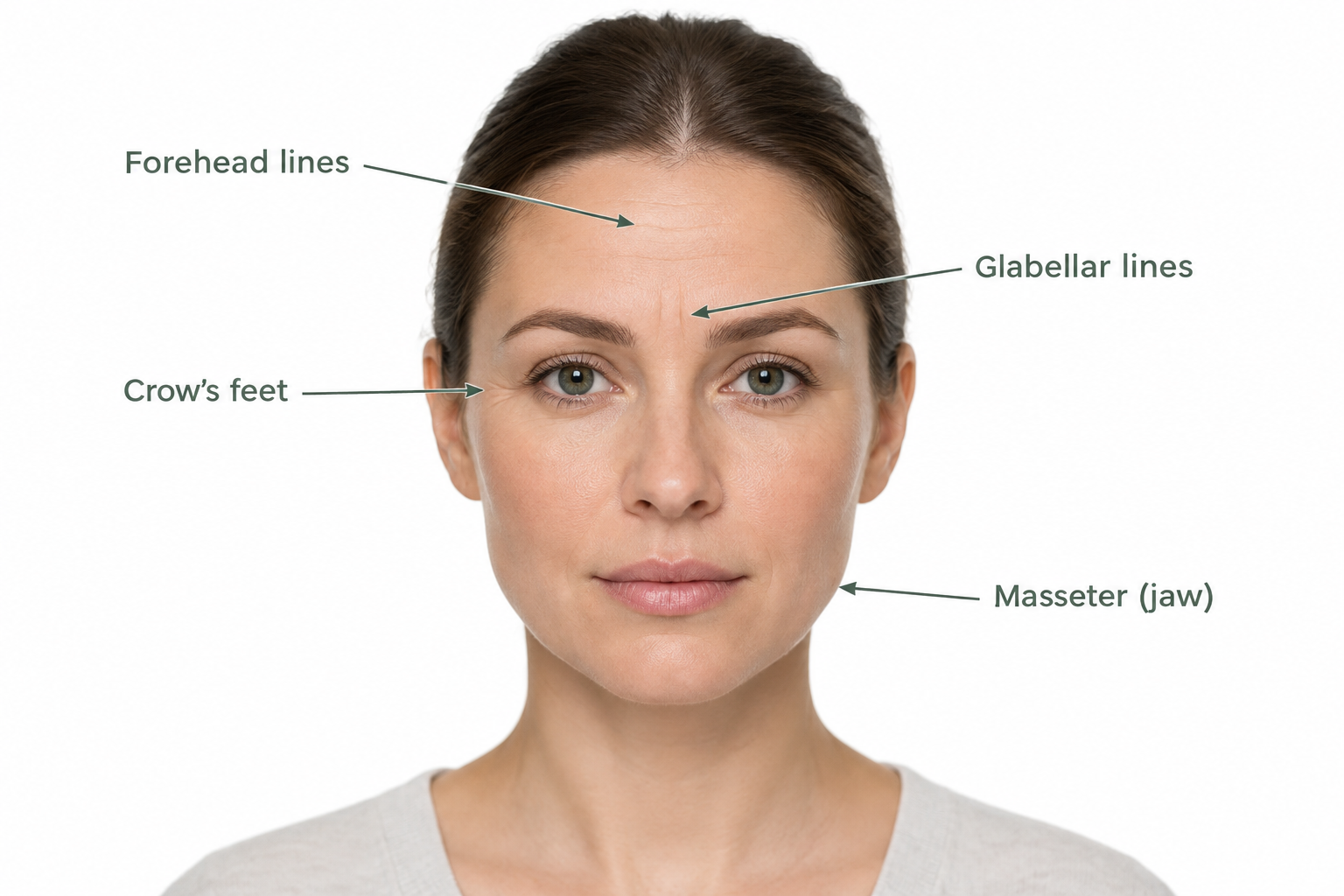
Some practitioners also use a low-dose approach around the mouth, along the lip border, or in the neck for platysmal bands, though these areas require particular care and clinical experience. The masseter muscle, which can be treated with botulinum toxin to slim the lower face or address teeth grinding, may also be approached conservatively in patients who want a subtle jaw-slimming effect without significant changes to facial shape. The suitability of each area depends on individual anatomy and the practitioner’s assessment.
Who May Be Suitable for a Baby Botox Approach?
A baby Botox approach may be worth discussing with a practitioner in several situations. People who are considering botulinum toxin treatment for the first time and are uncertain about how they will respond to the treatment may benefit from starting conservatively. A lower dose allows both the patient and the practitioner to assess the individual response before committing to a fuller treatment.
Patients with mild to moderate dynamic lines who want to soften their appearance without a dramatic change may find that reduced doses achieve their aesthetic goal. Those with naturally expressive faces who rely on facial movement for professional or personal reasons — such as performers or public speakers — may prefer an outcome that preserves more animation. Younger patients in their mid-to-late twenties or early thirties who are beginning to notice early expression lines sometimes choose a low-dose preventative approach, though the long-term evidence for preventative botulinum toxin use remains limited and this decision should be made carefully with a qualified practitioner.
People with smaller or weaker facial muscles may also respond well to lower doses, as the same degree of relaxation can sometimes be achieved with less product. Conversely, individuals with strong, well-developed facial muscles may find that a baby Botox dose produces minimal visible effect, making a standard dose more appropriate for their anatomy.
Who May Not Be Suitable
Botulinum toxin treatment in any dose is not appropriate for everyone. Pregnancy and breastfeeding are generally considered contraindications, as the safety of botulinum toxin in these situations has not been established. People with certain neuromuscular conditions, such as myasthenia gravis or Lambert-Eaton syndrome, should not receive botulinum toxin injections, as these conditions affect the neuromuscular junction and the toxin may cause unpredictable or serious effects.
Known allergy to botulinum toxin or to any component of the specific product being used is a contraindication. Active infection or inflammation at the intended injection site should be resolved before treatment. Certain medications, including some antibiotics and muscle relaxants, may interact with botulinum toxin and should be discussed with the practitioner before treatment. People taking blood-thinning medications may have an increased risk of bruising at injection sites.
Individuals with deep static lines, significant volume loss, or skin laxity are unlikely to achieve their goals through a low-dose botulinum toxin approach alone. In these cases, a practitioner may recommend combining treatment with dermal fillers, skin-quality treatments, or other modalities, or may suggest that a different approach is more appropriate.
What to Expect During a Baby Botox Appointment
A baby Botox appointment typically begins with a consultation in which the practitioner assesses the treatment areas, discusses the patient’s goals, reviews medical history, and explains what the treatment can and cannot achieve. Photographs may be taken for reference. The practitioner will observe facial movement and muscle activity to plan the injection pattern and determine an appropriate dose.
The injections themselves are administered using a fine needle. Most patients describe the sensation as a brief sharp sting at each injection point, which passes quickly. Topical anaesthetic cream is not always required but may be offered. A baby Botox session may involve more injection points than a standard treatment, as the lower dose is often distributed across a wider area to achieve an even result. The appointment typically takes between fifteen and thirty minutes, though this varies depending on the number of areas treated.
After the injections, patients are usually advised to remain upright for a few hours, avoid vigorous exercise for the remainder of the day, and refrain from rubbing or massaging the treated areas. These instructions are intended to reduce the risk of the product migrating to unintended muscles. Normal activities can generally be resumed the same day.
Results: What to Realistically Expect
The onset of visible results from botulinum toxin treatment typically occurs within two to five days, with the full effect usually apparent by two weeks. This timeline applies to a baby Botox approach as well, though the final result will be more subtle than with a standard dose. At the two-week mark, many practitioners offer a review appointment to assess the outcome and determine whether any additional product is needed to refine the result.
With a baby Botox approach, the expected outcome is a softening of dynamic lines rather than their elimination. Expression lines will still be visible during movement, but they should appear less pronounced. The face should retain natural movement and a more animated appearance than a fully treated result. Patients who expect complete line elimination from a low-dose approach are likely to be disappointed, and clear communication about realistic outcomes before treatment is essential.
Individual response to botulinum toxin varies considerably. Factors including muscle mass, metabolism, skin thickness, and the specific product used can all influence how visible and how long-lasting the result is. Some patients find that a low dose produces a satisfying outcome; others find it insufficient and prefer a higher dose at subsequent appointments.
How Long Do Baby Botox Results Last?
One of the most important practical considerations with a baby Botox approach is that results may not last as long as those from a standard treatment. Botulinum toxin results from a conventional dose typically last between three and six months, depending on the individual, the area treated, and the product used. With a lower dose, the duration of effect may be shorter — often in the range of six to ten weeks for some patients, though this varies.

This shorter duration means that more frequent maintenance appointments may be needed to sustain the result, which has implications for both cost and convenience. Some patients find that with repeated treatments over time, the muscles in treated areas gradually weaken and the interval between appointments can be extended. However, this is not guaranteed and depends on individual factors. The cumulative cost of more frequent low-dose treatments should be considered alongside the cost of less frequent standard treatments when making a decision.
Risks and Side Effects
The risks associated with a baby Botox approach are broadly similar to those of standard botulinum toxin treatment, though the lower dose may reduce the likelihood of some unwanted effects. Common side effects include temporary redness, swelling, and minor bruising at injection sites, which typically resolve within a few days. Headache is occasionally reported after forehead treatment and usually resolves without intervention.
Asymmetry is a possible outcome if the product does not distribute evenly or if the two sides of the face respond differently. Ptosis — drooping of the upper eyelid — is a recognised but uncommon complication of botulinum toxin treatment near the eye area. It occurs when the product affects the levator palpebrae muscle, which controls eyelid elevation. The risk may be lower with a baby Botox approach due to the reduced dose, but it is not eliminated. Brow heaviness or a lowered brow position can occur with forehead treatment if the frontalis muscle, which lifts the brow, is over-relaxed relative to the muscles that pull the brow downward.
Serious adverse events from botulinum toxin treatment are rare when the treatment is performed by a qualified and experienced practitioner using a licensed product. Choosing an appropriately trained and regulated practitioner is one of the most important safety factors. Unlicensed or counterfeit products and treatment by unqualified individuals carry significantly higher risks.
Baby Botox Compared to Standard Botulinum Toxin Treatment
The key difference between a baby Botox approach and a standard botulinum toxin treatment is the dose and the intended aesthetic outcome. A standard treatment uses doses calibrated to achieve more complete muscle relaxation, producing a smoother result that is more visible at rest and during movement. A baby Botox approach uses lower doses to produce a subtler effect with more preserved movement.
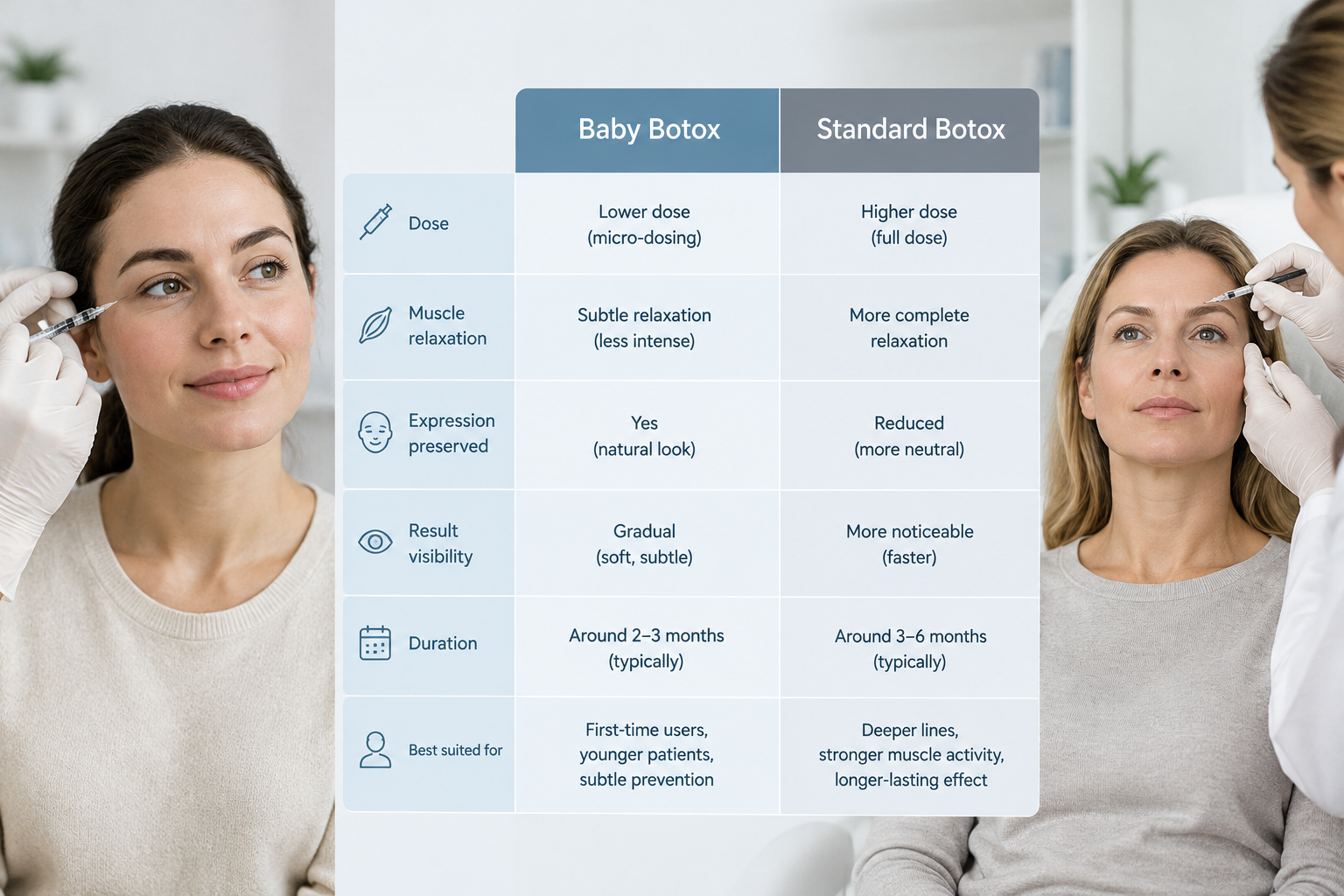
Neither approach is universally superior. The right choice depends on the individual’s anatomy, the severity of the lines being addressed, and their aesthetic preferences. Someone with strong forehead muscles and deep dynamic lines may find that a baby Botox dose produces little visible improvement, while someone with mild lines and a preference for a natural look may find it ideal. A practitioner who takes time to understand the patient’s goals and assess their anatomy is best placed to recommend an appropriate dose.
Alternatives to Baby Botox
For patients who want to address early or mild facial lines without botulinum toxin, several alternatives may be worth discussing with a practitioner. Skin-quality treatments such as medical-grade chemical peels, microneedling, and laser resurfacing can improve skin texture and reduce the appearance of fine lines by stimulating collagen production and accelerating skin cell turnover. These treatments address the skin itself rather than the underlying muscle activity, making them complementary to rather than direct replacements for botulinum toxin in most cases.
Polynucleotide treatments and certain biostimulator injections aim to improve skin hydration, elasticity, and overall quality, which may reduce the visibility of fine lines over time. Topical skincare containing retinoids, antioxidants, and broad-spectrum sun protection remains one of the most evidence-supported approaches to slowing the progression of age-related skin changes and may reduce the rate at which dynamic lines deepen into static ones.
Dermal fillers address volume loss and static lines rather than dynamic wrinkles, and are often used alongside botulinum toxin rather than as a direct alternative. A practitioner can help identify which combination of treatments, if any, is most likely to address a specific concern effectively.
Frequently Asked Questions
Is baby Botox a different product from regular Botox?
No. Baby Botox uses the same licensed botulinum toxin products as a standard treatment. The difference is in the dose administered and the technique used, not the product itself. The term describes an approach rather than a distinct formulation.
Will I still be able to move my face normally after baby Botox?
The aim of a baby Botox approach is to preserve natural facial movement while softening the appearance of dynamic lines. Most patients retain the ability to express emotions through facial movement, though the degree of movement preserved depends on the dose used, the areas treated, and individual anatomy. Results vary between patients.
How soon will I see results, and how long will they last?
Initial changes may become visible within two to five days, with the full result typically apparent at around two weeks. With a lower dose, results may last a shorter time than a standard treatment — often in the range of six to ten weeks for some patients, though individual variation is significant. A review appointment at two weeks allows the practitioner to assess the outcome.
Is baby Botox suitable as a preventative treatment?
Some practitioners and patients use a low-dose botulinum toxin approach with the intention of slowing the development of deeper lines by reducing repetitive muscle movement over time. The evidence for long-term preventative benefit is limited, and this use should be discussed carefully with a qualified practitioner who can assess whether it is appropriate for an individual’s age, skin condition, and goals.
Can baby Botox treat deep or static lines?
Botulinum toxin, including at lower doses, primarily addresses dynamic lines — those caused by muscle movement. Deep static lines that are visible at rest are less likely to respond significantly to a baby Botox approach. These lines may require dermal fillers, skin-resurfacing treatments, or a combination approach, depending on their cause and severity.
How do I find a qualified practitioner for baby Botox?
Botulinum toxin injections should be performed by a qualified and regulated healthcare professional with appropriate training in facial anatomy and injectable treatments. In the United Kingdom, regulations around who may administer botulinum toxin have been strengthened, and patients should verify that their practitioner holds the relevant qualifications and works within a regulated clinical environment. Choosing a practitioner based on price alone carries significant safety risks.
What should I tell my practitioner before treatment?
You should inform your practitioner of any medical conditions, current medications (including supplements and over-the-counter medicines), previous botulinum toxin treatments, known allergies, and whether you are pregnant or breastfeeding. This information is essential for assessing suitability and minimising risk.
Is a Baby Botox Approach Worth Considering for Your Goals?
A baby Botox approach can be a reasonable option for people who want a subtle, natural-looking improvement in the appearance of dynamic facial lines without the more pronounced relaxation associated with standard doses. It may be particularly worth discussing with a practitioner if you are new to botulinum toxin treatment, have mild lines, prefer to preserve facial expressiveness, or want to explore a conservative starting point before deciding on a higher dose.
The approach has meaningful limitations. Results are subtler and may not last as long as a standard treatment, potentially requiring more frequent appointments. It is unlikely to significantly improve deep static lines or address concerns related to volume loss or skin laxity. Individuals with strong facial muscles may find that a low dose produces insufficient effect for their anatomy.
The most important step is a thorough consultation with a qualified practitioner who can assess your facial anatomy, understand your aesthetic goals, and recommend a dose and technique that is appropriate for you as an individual. A practitioner who takes a conservative, patient-centred approach and is willing to discuss realistic outcomes honestly is better placed to help you achieve a result you are satisfied with than one who applies a one-size-fits-all protocol. If you are considering baby Botox, seeking a consultation with a regulated and experienced professional is the appropriate starting point.