

Fat dissolving injections are a category of non-surgical body contouring treatments designed to reduce localised pockets of fat by triggering a controlled breakdown of fat cells. Understanding the biological mechanism behind these injections helps prospective patients set realistic expectations, ask better questions at consultation, and make more informed decisions about whether this approach may be appropriate for their goals.
Key Takeaways
- Fat dissolving injections work by disrupting the membrane of fat cells, triggering a process called lipolysis that leads to the gradual elimination of fat from treated areas.
- The most widely used active ingredients are deoxycholic acid and phosphatidylcholine, which act on adipocyte cell membranes rather than on overall body weight.
- These treatments are intended for localised fat reduction, not weight loss, and are most appropriate for small, stubborn fat deposits that are resistant to diet and exercise.
- Multiple treatment sessions are typically required, and results develop gradually over several weeks as the body processes and eliminates disrupted fat cells.
- Side effects including swelling, bruising, and tenderness are common; serious complications are less frequent but possible, and suitability depends on individual clinical assessment.
What Are Fat Dissolving Injections?
Fat dissolving injections are injectable solutions administered directly into subcutaneous fat tissue — the layer of fat that sits beneath the skin but above the muscle. The term covers several formulations, but the underlying goal is consistent: to chemically disrupt fat cells in a targeted area so that the body can gradually clear them through its natural metabolic processes. This is distinct from weight loss, which involves reducing the size of fat cells throughout the body. Fat dissolving treatments aim to reduce the number of fat cells in a specific location, which is why they are classified as a body contouring intervention rather than a weight management strategy.
The two most clinically discussed active ingredients in this category are deoxycholic acid and phosphatidylcholine, sometimes used in combination. Deoxycholic acid is a bile acid that occurs naturally in the human body, where it assists with the digestion and absorption of dietary fat. When injected into subcutaneous fat tissue, it acts as a cytolytic agent — meaning it disrupts and destroys cell membranes. Phosphatidylcholine is a phospholipid derived from soybean lecithin that has been used in injectable formulations for decades, though its precise mechanism and independent efficacy continue to be studied.
The Lipolysis Mechanism: What Happens at a Cellular Level
The term lipolysis refers broadly to the breakdown of lipids — fats — stored within cells. In the context of fat dissolving injections, the mechanism is more accurately described as adipocytolysis: the physical destruction of fat cells (adipocytes) rather than simply stimulating the release of stored fatty acids. This distinction matters because the two processes have different implications for how results develop and how permanent they may be.
When deoxycholic acid is injected into subcutaneous fat tissue, it integrates into the phospholipid bilayer of adipocyte cell membranes. This integration destabilises the membrane structure, causing it to rupture. The contents of the fat cell — primarily triglycerides and fatty acids — are released into the surrounding tissue. This triggers a localised inflammatory response, which is why swelling, redness, and tenderness are expected and predictable side effects in the days following treatment.
The inflammatory response serves a functional purpose. Macrophages — immune cells responsible for clearing cellular debris — are recruited to the treatment area. Over the following weeks, these macrophages engulf and process the remnants of the destroyed fat cells and the released lipids. The fatty acids are transported via the lymphatic system and bloodstream to the liver, where they are metabolised and eventually excreted. This clearance process is gradual, which explains why visible results from fat dissolving injections typically take several weeks to become apparent and why the full outcome of a session may not be visible for up to eight to twelve weeks.
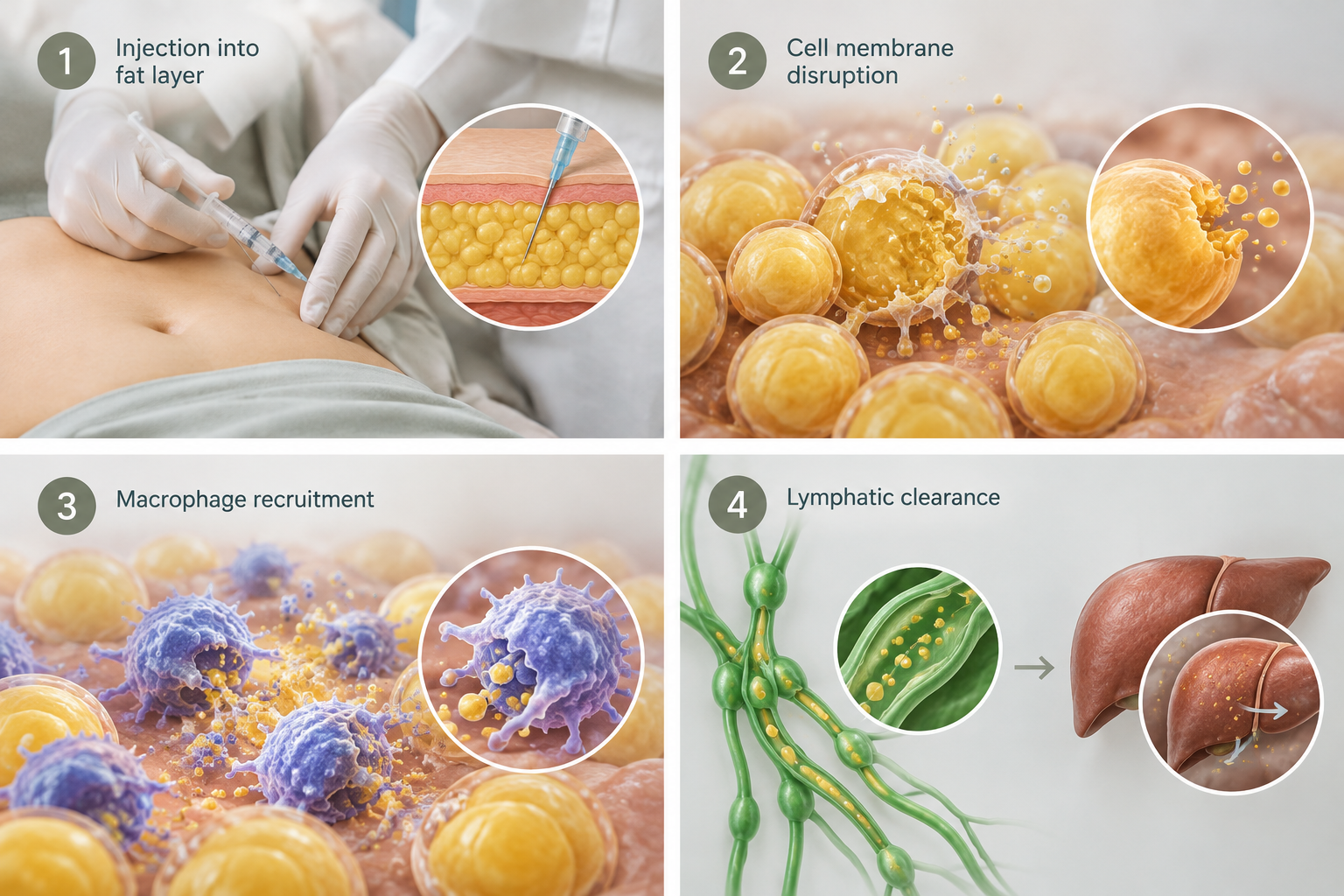
Because the fat cells themselves are destroyed rather than simply emptied, the reduction in fat cell number in the treated area is considered long-lasting, provided the patient does not gain significant weight. However, remaining fat cells in the area and elsewhere in the body can still enlarge with weight gain, so the treatment does not confer immunity to future fat accumulation.
Active Ingredients and How They Differ
Different fat dissolving products use different active ingredients, and understanding these differences is relevant to both efficacy and safety discussions.
Deoxycholic Acid
Deoxycholic acid is the active ingredient in Kybella (known as Belkyra in some markets), which has received regulatory approval in certain countries — including the United States — specifically for the reduction of submental fat, commonly referred to as a double chin. Its mechanism is well characterised: it acts as a detergent-like molecule that solubilises fat cell membranes, leading to cell lysis. Because deoxycholic acid is non-selective in its membrane disruption, precise injection technique is important to avoid damage to surrounding structures such as nerves and skin.
Phosphatidylcholine and Deoxycholic Acid Combinations
Many fat dissolving formulations used in aesthetic practice — including products such as Aqualyx and various compounded solutions — contain phosphatidylcholine, often combined with deoxycholic acid. Phosphatidylcholine is thought to emulsify fat and may enhance the solubilisation of lipids released from disrupted cells, though its independent fat-dissolving action compared to deoxycholic acid remains an area of ongoing research. The combination is widely used in clinical practice across Europe and other regions, though regulatory status and approved indications vary by country and product.
Newer Formulations
More recently introduced products, such as Lemon Bottle, contain different ingredient combinations that may include riboflavin, bromelain, and lecithin, among others. These formulations are marketed with claims of reduced downtime and faster results, but independent clinical evidence for these newer products is more limited compared to the longer-established deoxycholic acid formulations. Prospective patients should ask their practitioner about the specific product being used, its regulatory status in their country, and the available evidence supporting its use.
Common Treatment Areas
Fat dissolving injections are most commonly used for small, defined areas of subcutaneous fat that are disproportionate to the rest of the body and have not responded adequately to lifestyle measures. The most frequently treated areas include:
- Submental area (under the chin): The most extensively studied and, in some markets, the only area with formal regulatory approval for specific deoxycholic acid products.
- Jowls and lower face: Used off-label in some practices to address fat deposits along the jawline.
- Upper arms: Targeted for localised fat reduction in the posterior arm area.
- Abdomen and flanks: Commonly requested areas, though the thickness and volume of fat in these regions may require more sessions.
- Inner and outer thighs: Treated for localised fat pockets that may be resistant to exercise.
- Bra line and back fat: Areas where small fat deposits can be difficult to address through exercise alone.
- Knees: Occasionally treated for localised fat around the inner knee.
The suitability of fat dissolving injections for a given area depends on the depth and character of the fat deposit, the overlying skin quality, and the proximity of important anatomical structures. A thorough clinical assessment is necessary before treatment in any area.
What to Expect During and After Treatment
A fat dissolving injection appointment typically begins with a consultation or review of the treatment plan, followed by cleansing of the skin and, in many cases, application of a topical anaesthetic to reduce discomfort. The practitioner marks the injection sites and administers multiple small injections across the treatment area using a fine needle. The number of injection points and the volume of solution used depend on the size of the area being treated and the product being used.
During the injections, patients commonly experience a stinging or burning sensation, which is a direct result of the solution’s interaction with tissue. This discomfort is usually brief but can be significant, particularly in sensitive areas. Some practitioners use ice or local anaesthetic to manage this.
After treatment, the treated area typically becomes swollen, red, and tender within hours. This inflammatory response is an expected and necessary part of the mechanism — it signals that the fat cell disruption process has begun. Swelling can be pronounced, particularly in the submental area, and may persist for several days to two weeks. Bruising is also common. Patients should be prepared for a period of visible swelling that may temporarily make the treated area appear larger before results become visible.
Most patients are able to return to normal daily activities relatively quickly, though strenuous exercise and heat exposure are generally advised against for a short period following treatment. The timeline for visible improvement varies, but most practitioners advise patients to assess results at six to eight weeks after each session, with full results potentially taking up to twelve weeks to become apparent.
How Many Sessions Are Typically Needed?
The number of fat dissolving injection sessions required depends on the treatment area, the volume of fat being targeted, the product used, and the individual patient’s response. Most patients require between two and six sessions to achieve their desired outcome, with sessions typically spaced four to eight weeks apart to allow adequate time for the inflammatory response to resolve and for the body to clear the disrupted fat cells before the next treatment.
It is important to understand that fat dissolving injections are not a single-session solution for most patients. Setting realistic expectations about the number of appointments required — and the associated cost — is an important part of the pre-treatment discussion. Some patients with smaller, well-defined fat deposits may see satisfactory results after fewer sessions, while others with larger or more diffuse deposits may require more treatments or may find that alternative approaches are better suited to their goals.
Risks and Side Effects
Fat dissolving injections carry a range of potential side effects and risks that patients should understand before proceeding. Common side effects that are expected as part of the treatment mechanism include:
- Swelling and oedema at the injection site, which can be significant
- Redness and warmth in the treated area
- Tenderness and pain, which may persist for several days
- Bruising
- Itching or numbness in the treated area
- Temporary firmness or nodule formation beneath the skin as the tissue heals
Less common but more serious risks include:
- Nerve injury: Particularly relevant in the submental area, where the marginal mandibular nerve is in proximity to the injection zone. Nerve injury can cause temporary or, rarely, prolonged weakness of the muscles controlling the lower lip. Precise injection technique and thorough anatomical knowledge are essential to minimise this risk.
- Skin ulceration or necrosis: If the solution is injected too superficially or into the dermis rather than the subcutaneous fat layer, it can cause skin damage.
- Dysphagia (difficulty swallowing): Reported in some patients following submental treatment, typically temporary.
- Alopecia: Hair loss in the treated area has been reported, particularly on the scalp if treatments are administered near the hairline.
- Infection: As with any injectable procedure, there is a small risk of infection at injection sites.
- Uneven results: Asymmetry or irregular fat reduction can occur, particularly if the distribution of injections is not precise.
The risk profile of fat dissolving injections is meaningfully influenced by the skill and experience of the practitioner, the product used, and the anatomical complexity of the treatment area. Patients should ensure treatment is performed by a qualified and experienced practitioner who can demonstrate appropriate training in the specific product and area being treated.
Who May Be Suitable for Fat Dissolving Injections?
Fat dissolving injections may be appropriate for adults who have localised, pinchable subcutaneous fat deposits that are disproportionate to their overall body composition and have not responded to sustained dietary and exercise efforts. Suitable candidates are generally at or near a stable, healthy body weight, as these treatments are not designed to address generalised excess weight or obesity.
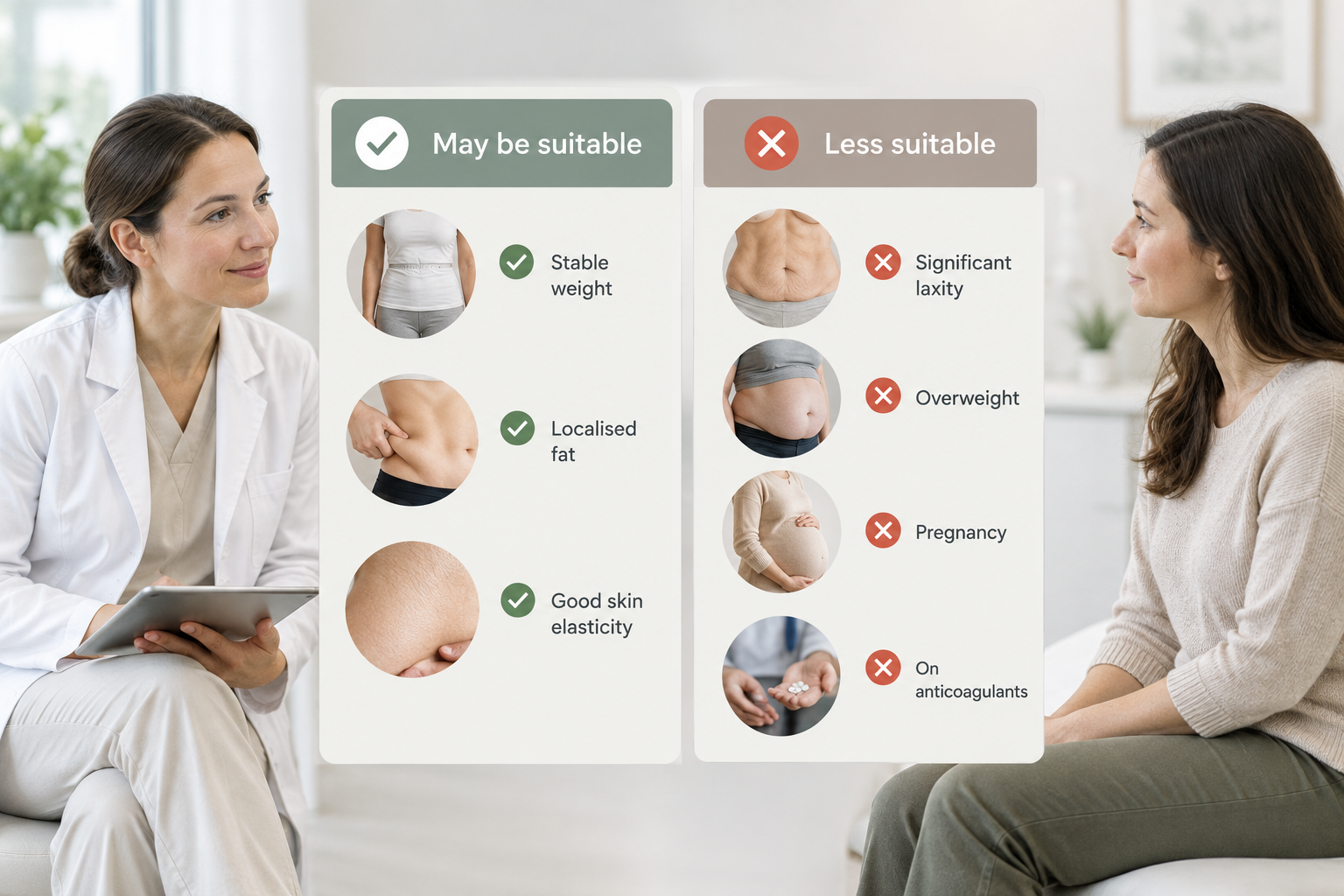
Factors that may affect suitability include:
- Overall health and medical history
- Current medications, particularly anticoagulants that may increase bruising risk
- Pregnancy or breastfeeding, which are contraindications for most injectable aesthetic treatments
- Known allergy to any component of the formulation being used
- Active infection or skin condition in the treatment area
- History of dysphagia or swallowing difficulties, particularly relevant for submental treatment
- Significant skin laxity in the treatment area, as fat reduction without adequate skin elasticity may worsen the appearance of loose skin
- Unrealistic expectations about the degree of change achievable
A thorough consultation with a qualified practitioner is essential to determine whether fat dissolving injections are appropriate for an individual’s specific anatomy, goals, and health status.
Alternatives to Fat Dissolving Injections
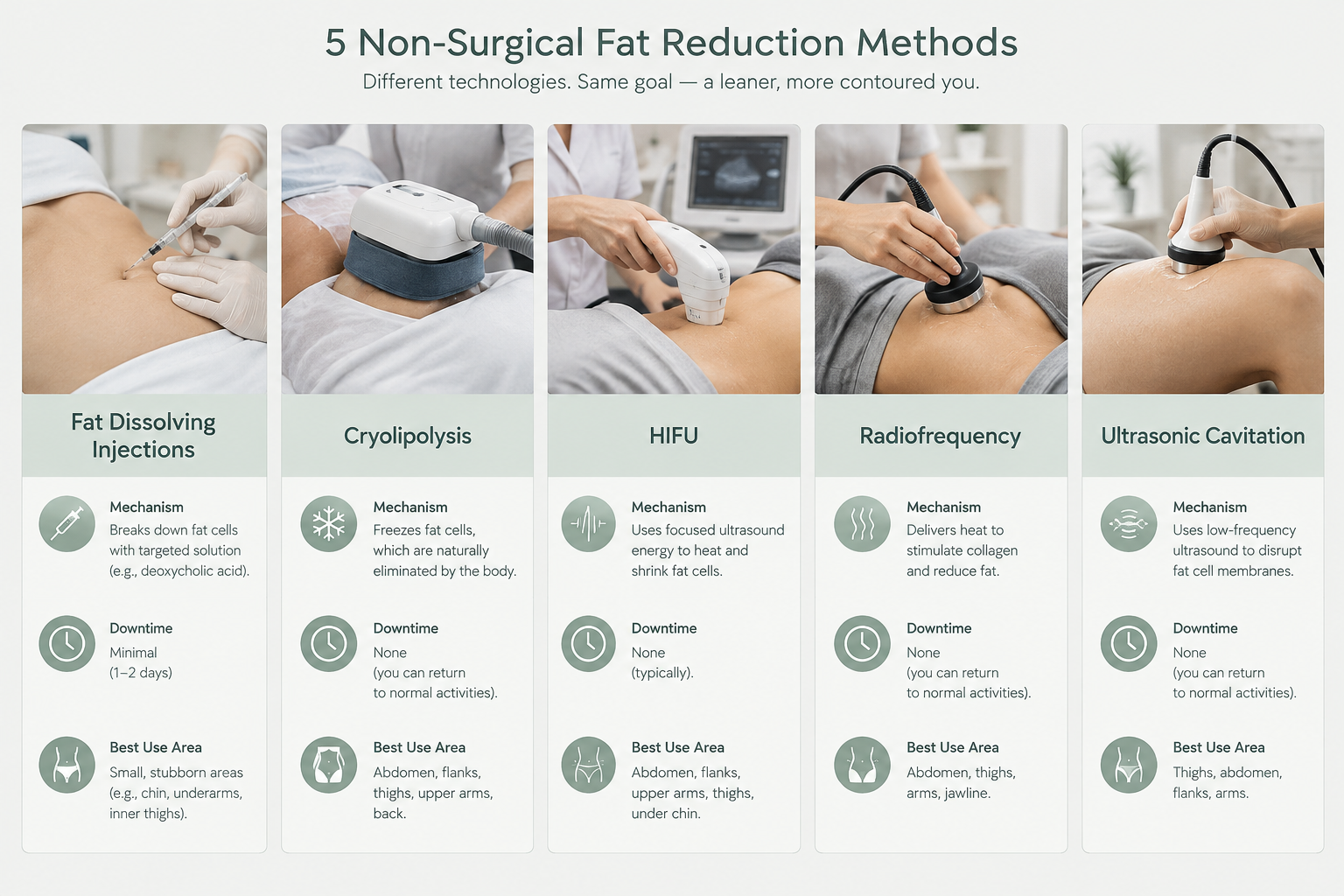
Fat dissolving injections are one of several non-surgical options for localised fat reduction. Understanding the alternatives helps patients and practitioners identify the most appropriate approach for a given concern.
Cryolipolysis (CoolSculpting): This device-based treatment uses controlled cooling to freeze and destroy fat cells without injections. It is well-studied for several body areas and may be suitable for larger fat deposits than those typically addressed with injections. Downtime is generally low, though the treatment can be uncomfortable during the cooling phase, and a rare but significant complication called paradoxical adipose hyperplasia — where the treated area enlarges rather than reduces — has been documented.
High-intensity focused ultrasound (HIFU) for fat: Ultrasound energy can be focused at specific depths within tissue to disrupt fat cells. Some devices combine fat reduction with skin tightening effects, which may be advantageous in areas where skin laxity is also a concern.
Radiofrequency-based body contouring: Certain radiofrequency devices are designed to heat subcutaneous fat to temperatures that cause cell disruption, while also stimulating collagen production in the overlying skin. These may be useful where both fat reduction and skin tightening are desired.
Ultrasonic cavitation: A non-invasive treatment that uses low-frequency ultrasound waves to create pressure changes within fat tissue, disrupting fat cell membranes. Evidence for its efficacy is more limited than for some other modalities, and results tend to be modest.
Emsculpt and Emsculpt Neo: These devices use high-intensity focused electromagnetic energy to stimulate muscle contractions, with the Neo version also incorporating radiofrequency for fat reduction. These treatments are primarily aimed at muscle toning and definition rather than significant fat volume reduction, and they represent a different category of body contouring.
Surgical liposuction: For patients with larger volumes of fat or those seeking more predictable and significant reduction, surgical liposuction remains the most established option. It carries greater risks and recovery time than non-surgical alternatives but can address larger areas and volumes in a single procedure.
The most appropriate option depends on the size and location of the fat deposit, the patient’s skin quality, their tolerance for downtime, their medical history, and their goals. A practitioner experienced in multiple modalities is best placed to advise on which approach may be most suitable.
Frequently Asked Questions
Are fat dissolving injections the same as liposuction?
No. Fat dissolving injections are a non-surgical treatment that uses chemical agents to destroy fat cells in a targeted area. Liposuction is a surgical procedure that physically removes fat through suction. Injections are better suited to small, defined fat deposits, while liposuction can address larger volumes and provides more predictable results in a single session. The recovery, risks, and costs differ significantly between the two approaches.
How long do the results of fat dissolving injections last?
Because the treatment destroys fat cells rather than simply reducing their size, the reduction in fat cell number in the treated area is considered long-lasting. However, remaining fat cells — both in the treated area and elsewhere — can enlarge with weight gain. Maintaining a stable body weight after treatment helps preserve results. Results are not guaranteed to be permanent in all circumstances.
Is the swelling after fat dissolving injections normal?
Yes. Swelling is an expected and predictable consequence of the inflammatory response triggered by the treatment. It is part of the mechanism through which the body clears disrupted fat cells. Swelling can be significant, particularly in the submental area, and may last from several days to two weeks. Patients should be prepared for this and plan their schedule accordingly.
Can fat dissolving injections help with weight loss?
No. Fat dissolving injections are a body contouring treatment, not a weight loss intervention. They target small, localised fat deposits and do not produce meaningful changes on the scales. They are not appropriate for patients who are significantly overweight or obese, and they should not be considered a substitute for dietary and lifestyle changes.
How do I know if a fat dissolving product is safe and approved?
Regulatory approval and licensed indications for fat dissolving products vary by country and by specific product. Patients should ask their practitioner which product is being used, whether it holds regulatory approval in their country, and for which indications it is approved or used off-label. Choosing a qualified and experienced practitioner who uses products from reputable suppliers is an important safety consideration.
Will fat dissolving injections tighten loose skin?
Fat dissolving injections do not have a primary skin tightening mechanism. In patients with good skin elasticity, the skin may adapt reasonably well to the reduction in underlying fat volume. However, in patients with significant skin laxity, reducing the fat beneath the skin without addressing the skin itself may worsen the appearance of looseness. This is an important factor to discuss during consultation, particularly in areas such as the abdomen or upper arms.
Is Fat Dissolving the Right Approach for Your Goals?
Fat dissolving injections offer a non-surgical route to reducing localised subcutaneous fat deposits through a well-characterised cellular mechanism. For patients who are close to their target weight, have specific areas of stubborn fat that have not responded to lifestyle measures, and have realistic expectations about the gradual and incremental nature of results, this treatment may be worth discussing with a qualified practitioner.
The treatment is not appropriate for everyone. Patients with significant skin laxity, larger volumes of fat, unrealistic expectations, or relevant medical contraindications may be better served by alternative approaches. The number of sessions required, the expected downtime from swelling and bruising, and the gradual timeline for visible results are all factors that should be weighed carefully before committing to treatment.
A thorough consultation with an experienced practitioner — one who can assess your anatomy, discuss the specific product and its evidence base, explain the realistic range of outcomes, and identify whether an alternative modality might better suit your goals — is the essential first step. Fat dissolving injections can be a useful tool within a broader body contouring strategy, but they work best when used selectively and with clear, informed expectations in place.