

A persistent layer of fat beneath the chin — often called a double chin or submental fat — is one of the most common aesthetic concerns that patients bring to clinic consultations. It can be resistant to diet and exercise, and for many people it affects how they feel about their profile. Fat dissolving injections offer a non-surgical option for reducing submental fat, but understanding what the treatment can and cannot achieve is essential before deciding whether it is worth exploring further.
Key Takeaways
- Fat dissolving injections use a synthetic form of deoxycholic acid to break down fat cells beneath the chin, reducing the appearance of a double chin without surgery.
- Most patients require between two and four treatment sessions, spaced at least four weeks apart, to achieve a meaningful reduction in submental fullness.
- Swelling, bruising, and temporary numbness in the treated area are common and expected; serious complications are less common but possible.
- Results may be long-lasting once the target fat cells are destroyed, but individual outcomes vary depending on anatomy, skin laxity, and the number of sessions completed.
- Fat dissolving injections are a body contouring treatment, not a weight loss solution, and are most suitable for patients with localised submental fat rather than generalised weight gain.
What Is Submental Fat and Why Is It Difficult to Treat?
Submental fat is the layer of adipose tissue that sits beneath the chin and above the neck. Genetics play a significant role in how much fat accumulates in this area and how it is distributed, which is why some people develop a noticeable double chin even at a healthy body weight. The submental region is also an area where fat tends to be stubborn — caloric restriction and exercise can reduce overall body fat, but they cannot selectively target fat in a specific anatomical location. This is the fundamental reason why localised treatments such as fat dissolving injections have become a point of interest for patients who are otherwise at or near their target weight but remain bothered by chin fullness.
It is also worth noting that the appearance of a double chin is not always caused by fat alone. Skin laxity, the position of the hyoid bone, and the thickness of the platysma muscle can all influence how the chin and neck look in profile. A thorough clinical assessment is important to determine whether submental fat is genuinely the primary contributing factor, because fat dissolving injections will not address loose skin or structural anatomy.
How Do Fat Dissolving Injections Work?
The active ingredient in the most widely studied fat dissolving injections for the chin is deoxycholic acid, a bile acid that occurs naturally in the body and plays a role in the digestion and absorption of dietary fat. When a synthetic form of deoxycholic acid is injected directly into submental fat tissue, it disrupts the cell membrane of fat cells, causing them to break down. The body then clears the released fat through its natural metabolic and lymphatic processes over the following weeks.
Because the mechanism targets the structural integrity of fat cell membranes, the fat cells that are destroyed do not regenerate. This is the basis for the claim that results may be long-lasting — once a fat cell is eliminated, it cannot return. However, remaining fat cells in the area can still enlarge if a patient gains significant weight after treatment, which is why maintaining a stable body weight is relevant to sustaining results over time.
Several injectable products are used for this purpose in clinical practice. Kybella (deoxycholic acid) holds regulatory approval from the US Food and Drug Administration specifically for the treatment of moderate to severe submental fat in adults. In the United Kingdom and parts of Europe, products such as Aqualyx — which contains a plant-derived compound called deoxycholate — are used for similar purposes, though regulatory status and licensed indications vary by country. Patients should confirm the regulatory status of any product being used in their region with their treating practitioner.
What Happens During a Treatment Session?
Before any injections are administered, a qualified practitioner should conduct a thorough consultation. This typically involves reviewing the patient’s medical history, assessing the submental area, discussing realistic expectations, and confirming that the patient is a suitable candidate. Photographs are often taken to provide a baseline for comparison.
On the day of treatment, the chin and neck area is cleaned and a topical anaesthetic cream may be applied to reduce discomfort. The practitioner marks the injection sites across the submental fat pad and administers multiple small injections into the fatty tissue. The number of injections per session depends on the size of the treatment area and the product being used. The appointment itself typically takes between 20 and 45 minutes, though this can vary.

Patients should expect a noticeable burning or stinging sensation during and immediately after the injections. This is a direct result of the deoxycholic acid interacting with the fat tissue and is considered a normal part of the treatment experience. The discomfort usually subsides within the first hour, though the treated area will typically feel tender for several days afterwards.
Recovery and Downtime After Chin Fat Dissolving Injections
The recovery period following fat dissolving injections to the chin is one of the most important practical considerations for prospective patients. Swelling is the most predictable and often the most significant side effect. The submental area can become noticeably swollen — sometimes substantially so — within hours of treatment, and this swelling may persist for one to three weeks. Some patients experience swelling that temporarily makes the chin area appear larger before the reduction in fat becomes visible, which can be disconcerting if patients are not prepared for it.
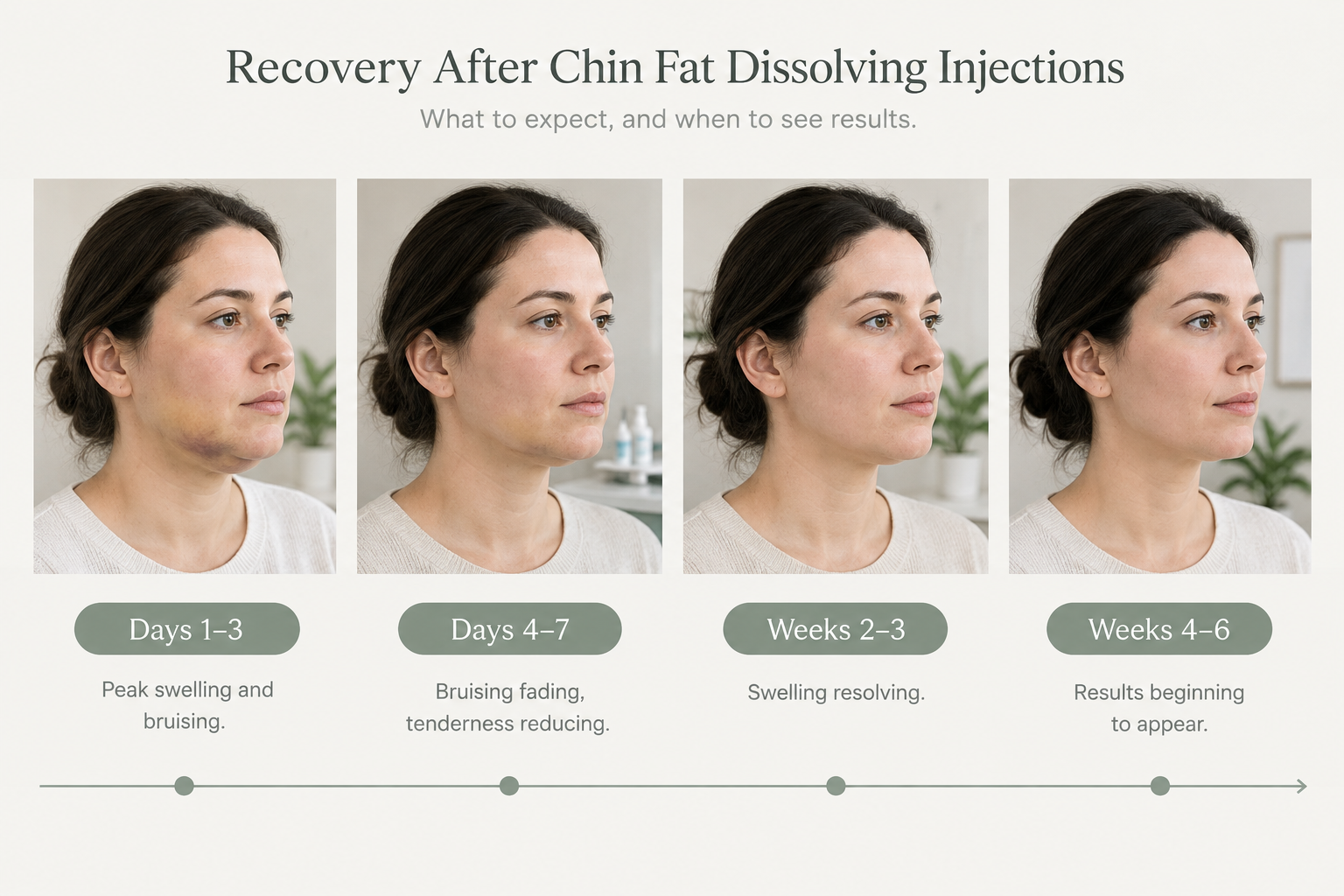
Bruising is also common and may extend into the neck. Temporary numbness, firmness, or a sensation of tightness in the treated area is frequently reported and generally resolves over several weeks. Redness and mild discomfort at the injection sites are expected in the days immediately following treatment.
Most patients are able to return to desk-based work within a day or two, though visible swelling and bruising may make some people prefer to take a few days away from social or professional commitments. Strenuous physical activity is generally advised against for the first 24 to 48 hours. Patients are usually advised to avoid alcohol, blood-thinning medications where clinically appropriate, and excessive heat in the days surrounding treatment.
When Will Results Become Visible?
Because the body needs time to clear the broken-down fat cells through the lymphatic system and metabolic processes, results from fat dissolving injections do not appear immediately. Initial swelling in the first one to two weeks can temporarily obscure any reduction in fat volume. Most patients begin to notice a visible change in the submental area approximately four to six weeks after a session, once the swelling has fully resolved.
The full effect of a single session may not be apparent until six to eight weeks after treatment. This timeline is important to understand because it means that assessing whether further sessions are needed requires patience. Practitioners typically recommend waiting at least four to six weeks between sessions and evaluating progress before deciding on additional treatment.
How Many Sessions Are Typically Needed?
The number of treatment sessions required varies between individuals and depends on factors including the volume of submental fat present, the product used, and the patient’s response to treatment. Clinical studies on deoxycholic acid for submental fat have generally used between two and six treatment sessions. In practice, many patients see a meaningful improvement after two to four sessions, though those with a larger volume of submental fat may require additional treatments to reach their desired outcome.
It is important to approach fat dissolving injections for the chin as a course of treatment rather than a single appointment. Patients who expect a dramatic result from one session are likely to be disappointed. A realistic treatment plan, discussed in detail during the initial consultation, helps set appropriate expectations and allows the practitioner to monitor progress and adjust the approach if needed.
How Long Do Results Last?
Because deoxycholic acid destroys fat cells rather than simply shrinking them, the reduction in submental fat achieved through a completed course of treatment may be long-lasting. Clinical data on Kybella, for example, has shown that patients who responded to treatment maintained their results at follow-up assessments conducted one year after their final session. However, long-term maintenance of results depends on the patient maintaining a reasonably stable body weight. Significant weight gain after treatment can cause remaining fat cells in the area to enlarge, which may partially diminish the improvement achieved.
It is also worth noting that the ageing process continues after treatment. Changes in skin laxity, muscle tone, and overall facial volume that occur with age are not addressed by fat dissolving injections and may influence how the chin and neck area looks over time.
Risks and Side Effects
Fat dissolving injections for the chin carry a range of possible side effects and risks that patients should understand before proceeding. The most common side effects — swelling, bruising, pain, numbness, redness, and firmness — are generally temporary and resolve without intervention. However, more serious complications are possible and should be discussed openly during the consultation.
One of the most clinically significant risks associated with deoxycholic acid injections in the submental area is injury to the marginal mandibular nerve, a branch of the facial nerve that runs close to the lower jaw. If the injection is placed too close to this nerve, temporary or, in rare cases, more prolonged weakness of the muscles that control the lower lip and smile can occur. This risk underscores the importance of having the treatment performed by a practitioner with a thorough understanding of facial anatomy and experience with submental injections.
Other potential complications include:
- Skin ulceration or necrosis if the product is injected too superficially or into the skin rather than the fat layer
- Dysphagia (difficulty swallowing), which has been reported in clinical trials and is usually temporary
- Alopecia (hair loss) in the treated area, which is uncommon but has been reported
- Infection at the injection sites
- Uneven results or asymmetry
- Hardened nodules or areas of firmness beneath the skin that may take weeks or months to resolve
Patients should be given a clear explanation of these risks and have the opportunity to ask questions before consenting to treatment. The risk profile of fat dissolving injections is generally considered acceptable for suitable candidates when the treatment is performed by a qualified and experienced practitioner, but it is not a risk-free procedure.
Who May Be a Suitable Candidate?
Fat dissolving injections for submental fat are generally most appropriate for adults who have a moderate to significant amount of localised fat beneath the chin that is not primarily attributable to generalised overweight or obesity. Suitable candidates are typically at or near a stable body weight and are bothered by chin fullness that has not responded adequately to lifestyle measures.
Good skin elasticity is an advantage. Patients with significant skin laxity in the neck and chin area may find that reducing the underlying fat volume reveals or worsens loose skin, which fat dissolving injections cannot address. In such cases, a practitioner may discuss whether additional or alternative treatments would be more appropriate.
Patients who may not be suitable candidates include:
- Those who are pregnant or breastfeeding
- Those with an active infection or skin condition in the treatment area
- Those with a history of difficulty swallowing or relevant neurological conditions affecting the neck and throat
- Those taking anticoagulant medications, unless cleared by their prescribing doctor
- Those with a known allergy to any component of the injectable product
- Those who have had previous surgery or other procedures in the submental area, depending on the nature of those procedures
A comprehensive medical history and clinical assessment by a qualified practitioner is the only reliable way to determine individual suitability.
Alternatives to Fat Dissolving Injections for the Chin
Fat dissolving injections are one of several non-surgical options available for addressing submental fat, and they are not the only approach worth considering. Understanding the alternatives helps patients make a more informed decision about which treatment may be most appropriate for their specific anatomy and goals.
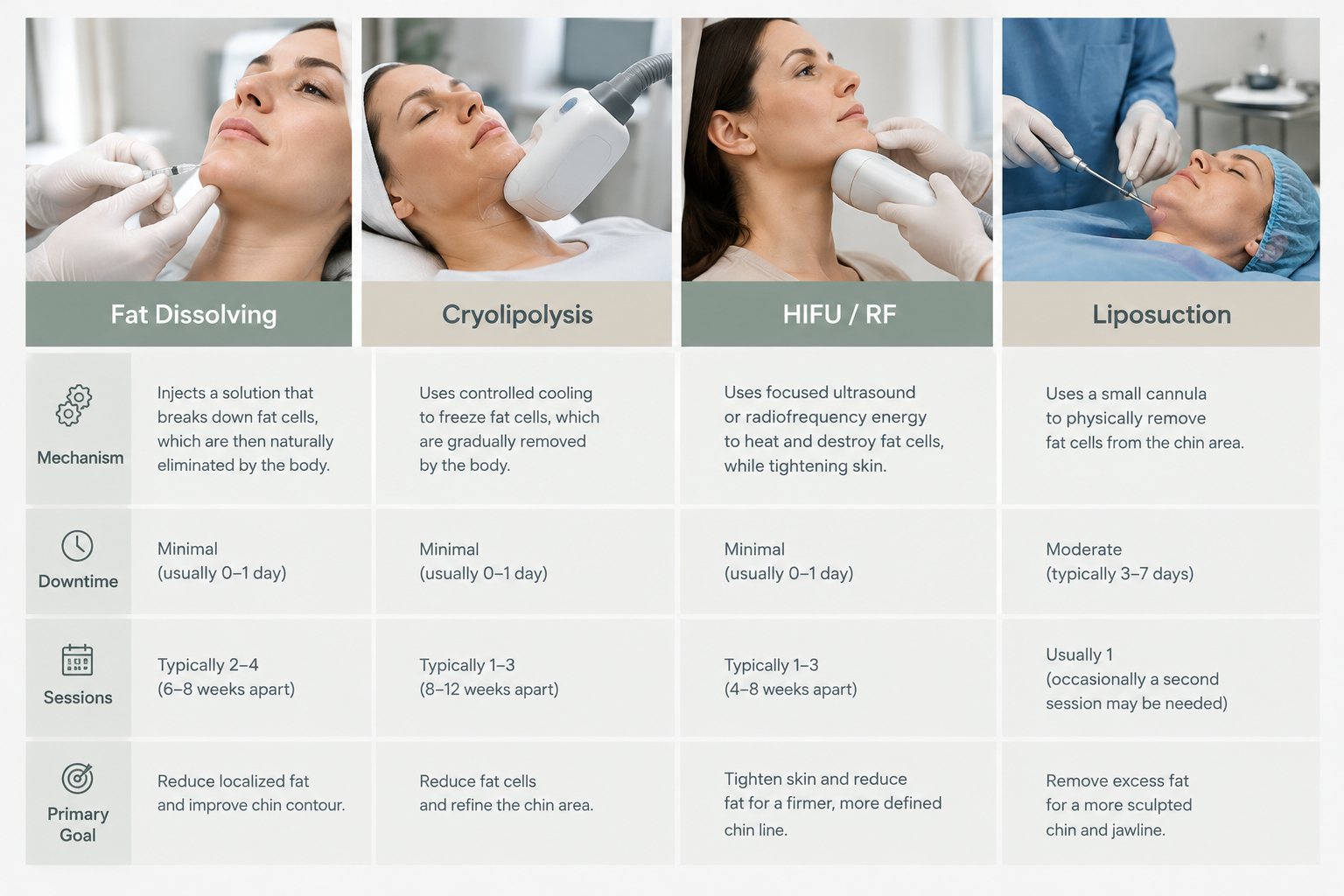
Cryolipolysis (CoolSculpting or similar devices) uses controlled cooling to freeze and destroy fat cells in a targeted area. Applicators designed for the submental region are available, and the treatment has a reasonable evidence base for chin fat reduction. Downtime is generally minimal, though swelling and temporary numbness are also common. Multiple sessions may be needed, and results develop gradually over two to three months.
High-intensity focused ultrasound (HIFU) and radiofrequency treatments are primarily used for skin tightening rather than fat reduction, but they may be relevant for patients whose main concern is skin laxity in the chin and neck area rather than fat volume. These treatments work by stimulating collagen production and tissue remodelling rather than destroying fat cells.
Liposuction remains the surgical gold standard for submental fat removal. It allows precise removal of fat in a single procedure and can be combined with skin tightening techniques where appropriate. Recovery is more involved than with non-surgical options, but results are typically more predictable and may be achieved in a single session. Patients with a larger volume of submental fat or significant skin laxity may find that surgical options offer a more comprehensive outcome.
Lifestyle modification — including dietary changes and regular exercise — can reduce overall body fat and may improve the appearance of the chin area, though it cannot selectively target submental fat. For patients who are significantly above their target weight, addressing overall body composition before considering localised treatments is generally advisable.
Frequently Asked Questions
Are fat dissolving injections for the chin painful?
Most patients describe a burning or stinging sensation during the injections, which is caused by the deoxycholic acid interacting with the fat tissue. Topical anaesthetic cream is often applied beforehand to reduce discomfort. The area typically remains tender and sore for several days after treatment. Pain tolerance varies between individuals, and the level of discomfort experienced can differ from one session to the next.
Will I look worse before I look better?
Significant swelling in the days following treatment is very common and can temporarily make the chin area appear larger. This is a normal part of the inflammatory process through which the body begins to clear the treated fat cells. Most patients find that the swelling peaks within the first 48 to 72 hours and then gradually subsides over one to three weeks. Being prepared for this temporary change in appearance helps manage expectations during the recovery period.
Can fat dissolving injections tighten loose skin under the chin?
Fat dissolving injections reduce the volume of fat beneath the chin but do not directly tighten skin. In patients with good skin elasticity, the skin may adapt reasonably well to the reduced fat volume. However, in patients with pre-existing skin laxity, reducing the underlying fat may make loose skin more noticeable. A practitioner should assess skin quality as part of the consultation and discuss whether additional treatments for skin tightening might be appropriate.
How much does a course of treatment typically cost?
The cost of fat dissolving injections for the chin varies depending on the clinic, the practitioner’s experience, the product used, and the number of sessions required. Because most patients need more than one session, the total investment across a full course of treatment can be significant. Patients should ask for a clear breakdown of costs per session and an estimate of the likely number of sessions needed during the initial consultation.
Is there a risk of the fat coming back after treatment?
The fat cells destroyed by deoxycholic acid do not regenerate. However, if a patient gains a significant amount of weight after completing treatment, the remaining fat cells in the submental area can enlarge, which may partially reduce the improvement achieved. Maintaining a stable body weight after treatment is therefore relevant to preserving long-term results.
How do I choose a practitioner for this treatment?
Because fat dissolving injections in the submental area carry specific anatomical risks — including the possibility of nerve injury — it is important to choose a practitioner with relevant medical qualifications, a thorough understanding of facial and neck anatomy, and documented experience with this type of treatment. Patients should feel comfortable asking about the practitioner’s training, the product being used, and the clinic’s approach to managing complications.
Is Fat Dissolving the Right Approach for Your Chin Concerns?
Fat dissolving injections for the chin can offer a meaningful, non-surgical reduction in submental fat for patients who are well-selected and have realistic expectations. The treatment has a reasonable evidence base, particularly for deoxycholic acid products, and the destruction of fat cells means that results may be maintained over the long term provided body weight remains stable. For patients who are bothered by a double chin that has not responded to lifestyle changes and who have good skin elasticity, it is a treatment worth discussing with a qualified practitioner.
At the same time, fat dissolving injections are not suitable for everyone, are not without risk, and require a course of sessions rather than a single appointment. The recovery period — particularly the swelling in the first one to two weeks — is a practical consideration that patients should factor into their planning. Those with significant skin laxity, a large volume of submental fat, or concerns that extend beyond fat reduction may find that alternative or complementary treatments better address their goals.
A thorough consultation with an experienced practitioner who can assess your anatomy, discuss your goals honestly, and explain the realistic range of outcomes is the most important first step. This allows you to make an informed decision about whether fat dissolving injections for the chin are the right approach for your individual situation.