

A botox nose lift — sometimes called a non-surgical rhinoplasty or liquid nose job — uses small injections of botulinum toxin to subtly alter the appearance of the nose without surgery. Before committing to any procedure, most patients want to understand what changes are genuinely achievable, how long those changes last, and whether the results visible in before and after photographs reflect what they can personally expect. This article explains the mechanism behind the treatment, the realistic scope of improvement, patient selection, risks, and how botox nose lift results compare with surgical and other non-surgical options.
Key Takeaways
- Botulinum toxin injections can produce subtle improvements in nasal tip position and the appearance of a drooping tip, but cannot reduce nasal width, remove a dorsal hump, or reshape bone and cartilage.
- Results are temporary, typically lasting three to four months, and require repeat treatments to maintain any visible improvement.
- Before and after photographs from clinics show the best-case outcomes; individual results depend on anatomy, muscle activity, and practitioner technique.
- The treatment carries a low but real risk of complications, including asymmetry, bruising, and — in rare cases — vascular injury if performed incorrectly.
- A thorough consultation with a qualified medical practitioner is essential to determine whether botulinum toxin, dermal filler, or surgical rhinoplasty is the most appropriate option for a specific concern.
What Is a Botox Nose Lift?
The term “botox nose lift” refers to the use of botulinum toxin type A — most commonly the brand Botox, though other licensed botulinum toxin products may also be used — injected into specific muscles around the nose to influence its resting appearance. The procedure is distinct from non-surgical rhinoplasty with dermal filler, which physically adds volume to reshape nasal contours. Botulinum toxin works by temporarily reducing muscle activity rather than adding structure.
The most common application targets the depressor septi nasi muscle, a small muscle that pulls the nasal tip downward when a person smiles or speaks. By reducing the activity of this muscle, the nasal tip may appear slightly elevated at rest and during facial movement. Some practitioners also address the nasalis muscle or the muscles contributing to a bunny lines appearance on the nasal bridge, though these are separate aesthetic concerns.
It is important to understand that the word “lift” describes a modest functional change in tip position rather than a dramatic structural transformation. The nose itself — its bone, cartilage, and skin — is not altered. The change is produced by modifying how the surrounding muscles pull on the tip.
How Botulinum Toxin Changes Nasal Appearance
Botulinum toxin works by blocking the release of acetylcholine at the neuromuscular junction, which temporarily prevents the targeted muscle from contracting with its usual force. When injected into the depressor septi nasi, the muscle’s downward pull on the columella and nasal tip is reduced. This allows the natural upward tension from other nasal structures to become relatively more dominant, which can result in a subtle elevation of the tip.
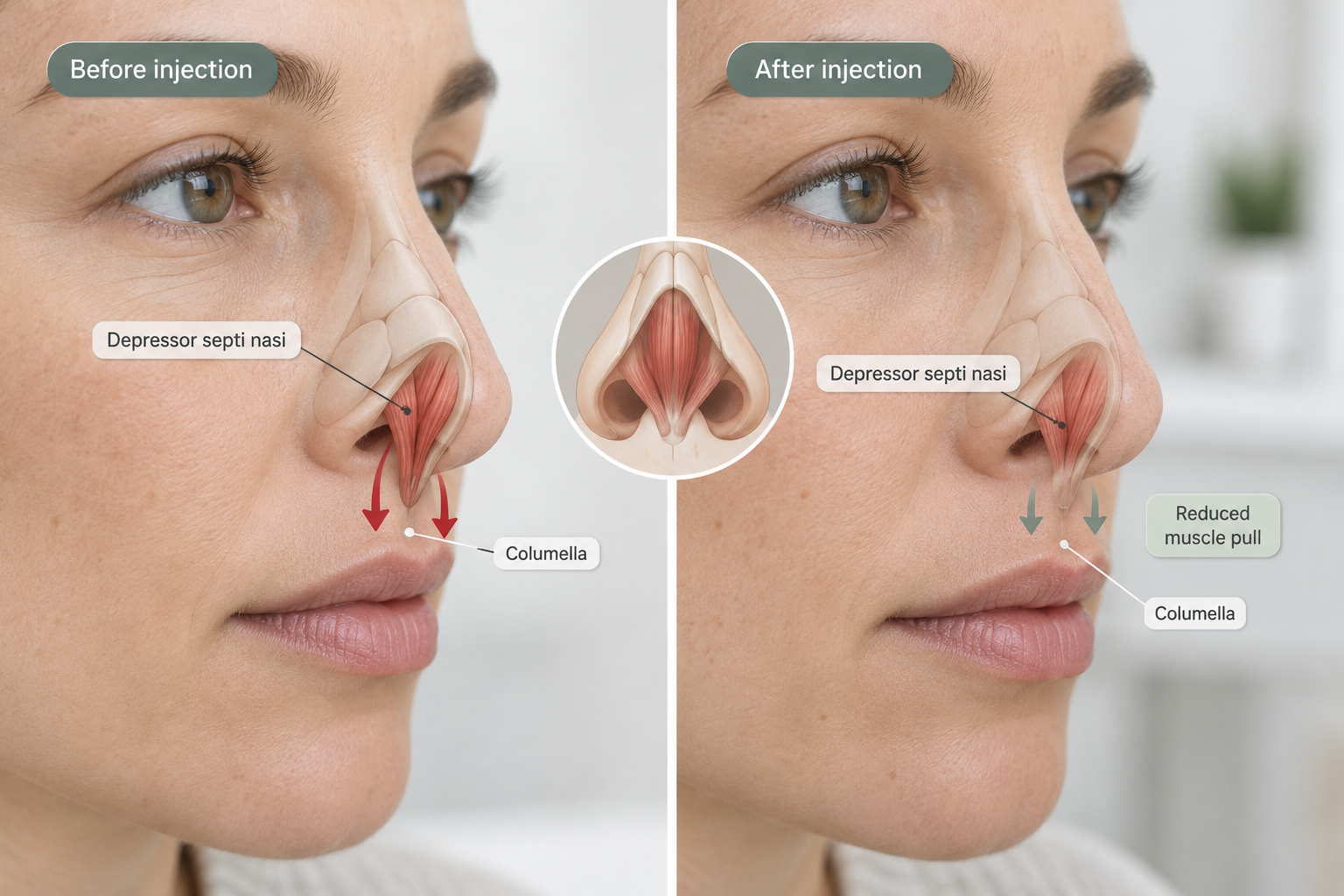
The degree of visible change depends on several anatomical factors. Patients who have a noticeably active depressor septi nasi — meaning the tip drops significantly when they smile — tend to show the most meaningful improvement. In patients whose tip position is already relatively stable during movement, or whose drooping is caused by cartilage shape rather than muscle activity, the effect of botulinum toxin may be minimal or imperceptible.
The onset of effect typically begins within three to five days of injection, with the full result usually visible by two weeks. This timeline is consistent with botulinum toxin treatments in other facial areas. The effect is not immediate, which means patients should not judge the outcome at the appointment itself.
Botox Nose Lift Before and After: Understanding the Evidence
Before and after photographs are the most common way clinics and patients communicate results, but they require careful interpretation. A well-selected before and after image can demonstrate a genuine, clinically meaningful improvement in nasal tip position. However, the same photographs can also reflect differences in lighting, camera angle, head position, and facial expression between the two images — factors that can exaggerate or minimize the apparent change.
Published clinical evidence on botulinum toxin for nasal tip elevation is limited in volume compared with the evidence base for established uses such as glabellar lines or crow’s feet. Small case series and observational studies suggest that the depressor septi nasi injection can produce a measurable upward shift in nasal tip angle, with some studies reporting an average improvement of a few degrees in the nasolabial angle. However, the clinical significance of this change varies considerably between patients, and the evidence base does not yet include large randomized controlled trials.
When reviewing before and after images — whether from a clinic’s website, social media, or published literature — it is worth asking whether the photographs were taken under standardized conditions, whether the patient’s expression is consistent between images, and whether the improvement shown reflects a concern similar to your own. A drooping tip that is primarily dynamic (most visible during smiling) may respond differently from one that is predominantly static (present at rest).
What Changes Are Realistically Achievable
Botulinum toxin injections around the nose can realistically achieve the following in suitable patients:
- Subtle elevation of a drooping nasal tip, particularly the dynamic droop that becomes more pronounced during smiling or speaking.
- A slight improvement in the nasolabial angle, which is the angle between the upper lip and the base of the nose, making the tip appear marginally more upturned.
- Reduction of tip movement during animation, which some patients find aesthetically preferable.
- Softening of bunny lines on the nasal bridge when the nasalis muscle is also treated, though this is a separate concern from tip position.
Botulinum toxin injections around the nose cannot achieve the following:
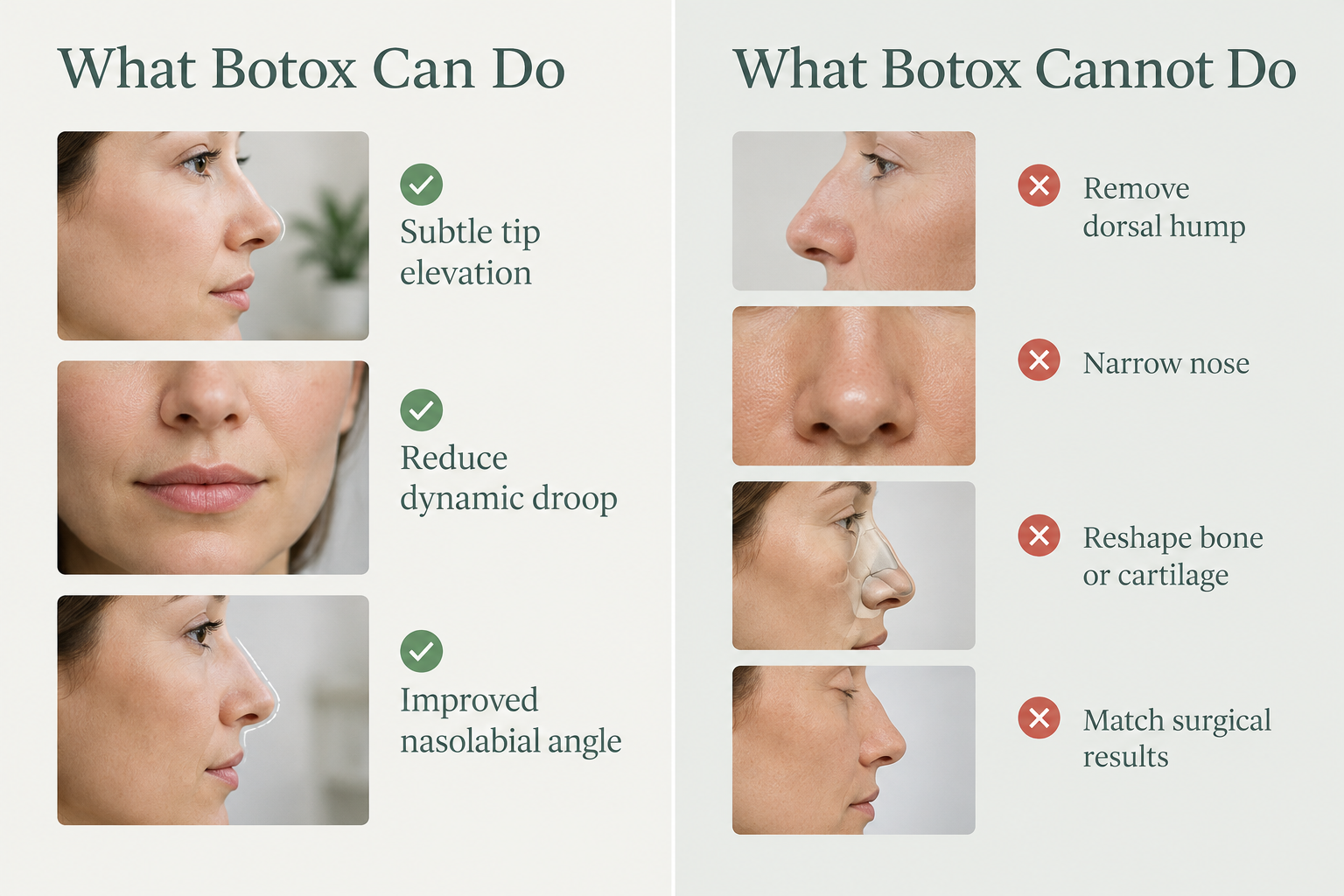
- Reduction of nasal width or flaring nostrils in a structural sense.
- Removal or significant reduction of a dorsal hump (the bump on the nasal bridge).
- Reshaping of nasal bone or cartilage.
- Correction of a severely deviated septum or significant asymmetry caused by structural anatomy.
- Results comparable to surgical rhinoplasty in terms of magnitude or permanence.
Understanding this distinction is central to realistic expectations. Patients who are seeking a dramatic change in nasal shape are unlikely to be satisfied with botulinum toxin alone, and a qualified practitioner should explain this clearly during consultation.
Who May Be a Suitable Candidate
A botox nose lift may be worth discussing with a qualified practitioner if you have one or more of the following concerns:
- A nasal tip that visibly drops when you smile, making the nose appear longer or more hooked during facial expression.
- A mildly drooping tip at rest that you would like subtly elevated without surgery.
- A desire to preview a potential improvement before committing to surgical rhinoplasty.
- Previous surgical rhinoplasty with residual mild tip ptosis (drooping) that does not warrant revision surgery.
Suitability also depends on general health factors. Botulinum toxin injections are generally not recommended during pregnancy or breastfeeding. Patients with certain neuromuscular conditions, known hypersensitivity to botulinum toxin or its excipients, or active infection at the injection site are typically not suitable candidates. A full medical history review is part of any responsible pre-treatment consultation.
Patients with very thick nasal skin, significant structural asymmetry, or concerns that are primarily cartilaginous or bony in origin are unlikely to see meaningful improvement from botulinum toxin and should be counselled accordingly. In these cases, dermal filler or surgical rhinoplasty may be more appropriate depending on the specific concern and the patient’s goals.
The Treatment Experience: What to Expect at the Appointment
A botox nose lift appointment is typically brief, often completed within fifteen to thirty minutes including consultation time. The practitioner will assess the nasal anatomy, discuss the specific concern, and confirm suitability before proceeding.
The injection itself involves a small number of precisely placed injections, most commonly at the base of the columella (the strip of tissue between the nostrils) where the depressor septi nasi muscle is accessible. A topical anaesthetic cream may be applied beforehand, though many patients find the discomfort minimal given the small needle size and limited number of injection points.
There is no significant downtime associated with botulinum toxin injections in this area. Minor redness, swelling, or tenderness at the injection site may occur and typically resolves within a few hours to a day. Bruising is possible, particularly in patients taking blood-thinning medications or supplements, and may take several days to resolve. Patients are generally advised to avoid strenuous exercise, alcohol, and lying face-down for the remainder of the day following treatment.
The full result becomes visible over approximately two weeks as the botulinum toxin takes effect. A follow-up review at two weeks allows the practitioner to assess the outcome and determine whether any adjustment is appropriate.
How Long Do Botox Nose Lift Results Last?
The effects of botulinum toxin in the nasal area are temporary. Most patients find that results last approximately three to four months, after which muscle activity gradually returns and the nasal tip reverts to its pre-treatment position. Some patients report that results persist slightly longer with repeated treatments over time, though this varies between individuals and is not guaranteed.
The temporary nature of the treatment is both a limitation and, for some patients, an advantage. It allows patients to experience the aesthetic change without permanent commitment, and any unwanted outcome will resolve naturally as the botulinum toxin wears off. However, maintaining the improvement requires ongoing repeat treatments, which has implications for both cost and the cumulative time investment.
Patients considering this treatment as a long-term solution should factor in the frequency of repeat appointments and associated costs when comparing it with more permanent options such as surgical rhinoplasty.
Risks and Side Effects
Botulinum toxin injections around the nose carry a low but real risk of adverse effects. Patients should be aware of the following before proceeding:
- Bruising and swelling at the injection site are the most common side effects and are usually mild and temporary.
- Asymmetry can occur if the botulinum toxin spreads unevenly or if the underlying anatomy is asymmetric. Minor asymmetry often resolves as the product settles; significant asymmetry may require review.
- Unintended muscle weakness in adjacent areas is possible if the botulinum toxin diffuses beyond the intended target. In the nasal area, this could theoretically affect lip movement or smile symmetry, though this is uncommon when the treatment is performed by an experienced practitioner using appropriate technique.
- Overcorrection, resulting in an excessively upturned tip, is possible and may be aesthetically undesirable. This will resolve as the product wears off.
- Vascular complications, including inadvertent intravascular injection, are rare but represent the most serious potential risk associated with any injectable treatment in the face. The nasal area has a complex vascular supply, and injections should only be performed by a qualified medical professional with a thorough understanding of facial anatomy and the ability to manage complications.
Choosing a practitioner with appropriate medical qualifications, training in facial anatomy, and experience with nasal injections significantly reduces the risk of serious complications. Patients should ask about the practitioner’s qualifications, training, and experience before proceeding with any injectable treatment.
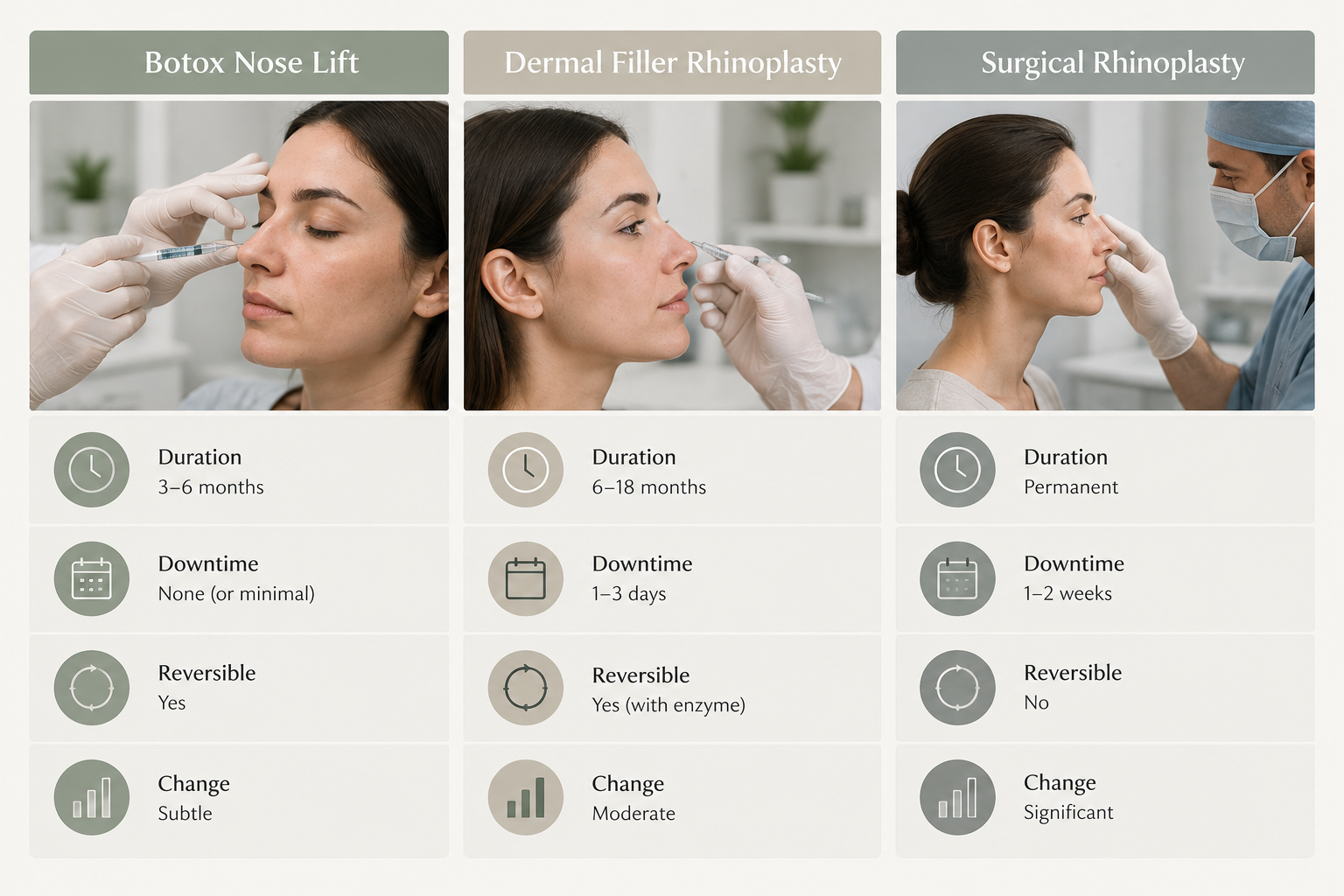
Botox Nose Lift vs Dermal Filler Rhinoplasty vs Surgery
Understanding how botulinum toxin compares with other nose reshaping options helps patients make a more informed decision about which approach may suit their specific concern.
| Feature | Botox Nose Lift | Dermal Filler Rhinoplasty | Surgical Rhinoplasty |
|---|---|---|---|
| Mechanism | Reduces muscle activity pulling tip downward | Adds volume to reshape contours | Restructures bone and cartilage |
| Main concerns addressed | Dynamic or mild static tip droop | Dorsal hump camouflage, tip refinement, asymmetry | Structural reshaping, hump reduction, width, asymmetry |
| Magnitude of change | Subtle | Moderate | Significant |
| Onset | 3–14 days | Immediate | Weeks to months (post-swelling) |
| Duration | 3–4 months | 9–18 months (varies by product) | Permanent (with natural ageing) |
| Downtime | Minimal | Minimal to mild | 1–3 weeks significant; months for full resolution |
| Reversibility | Temporary; resolves naturally | Partially reversible with hyaluronidase (if HA filler) | Not reversible |
| Risk level | Low (when performed correctly) | Low to moderate; vascular risk present | Higher; surgical risks apply |
| Cost | Lower per session; ongoing maintenance required | Moderate; maintenance required | Higher upfront; longer-lasting |
Some practitioners combine botulinum toxin with small amounts of dermal filler in a single non-surgical rhinoplasty session, using filler to address structural concerns such as a dorsal hump or tip definition while using botulinum toxin to address dynamic tip drooping. This combination approach may offer a broader range of improvement than either treatment alone, but it also carries the combined risks of both modalities and requires careful patient selection.
Alternatives to a Botox Nose Lift
Patients who are not suitable for botulinum toxin, or who are seeking a more significant or longer-lasting result, may wish to discuss the following alternatives with a qualified practitioner:
- Non-surgical rhinoplasty with hyaluronic acid filler can camouflage a dorsal hump by adding volume above and below it, refine tip projection, and improve symmetry. Results last longer than botulinum toxin but the treatment carries its own risks, including the rare but serious risk of vascular occlusion.
- Surgical rhinoplasty remains the only option capable of producing permanent, structurally significant changes to nasal shape. It is appropriate for patients with concerns that cannot be adequately addressed non-surgically, and for those seeking a lasting result without ongoing maintenance.
- Thread lifts for the nose are occasionally offered as a non-surgical option, though the evidence base for nasal thread lifting is limited and the risk-to-benefit profile requires careful consideration.
- Accepting natural anatomy is always a valid option. A skilled practitioner will help patients understand whether their concern is likely to respond meaningfully to any available treatment, and will not recommend a procedure where the expected benefit is minimal.
Questions to Ask Your Practitioner
Before proceeding with a botox nose lift, consider asking the following questions during your consultation:
- Are you a qualified medical professional with specific training in facial anatomy and injectable treatments?
- Is my specific concern — the type and degree of tip drooping I have — likely to respond to botulinum toxin, or would another approach be more appropriate?
- What realistic improvement can I expect based on my anatomy, and what will not change?
- What are the risks specific to my anatomy and medical history?
- What happens if I am not satisfied with the result, or if a complication occurs?
- How many treatments will I need to maintain the result, and what is the approximate ongoing cost?
- Would you recommend combining botulinum toxin with dermal filler for my concerns, and if so, why?
Frequently Asked Questions
Can a botox nose lift make my nose look smaller?
Botulinum toxin does not reduce the physical size of the nose. It can subtly elevate a drooping tip, which may make the nose appear slightly shorter or less prominent in profile, but it cannot narrow the nose or reduce its overall volume. Patients seeking a smaller-looking nose may find that dermal filler used to camouflage a dorsal hump creates a more balanced appearance, or that surgical rhinoplasty is the most appropriate option.
Is the treatment painful?
Most patients describe the injections as mildly uncomfortable rather than painful. The needle used is very fine, and the number of injection points in the nasal area is small. Topical anaesthetic cream can be applied beforehand if preferred. Discomfort at the injection site typically resolves within minutes.
How soon will I see results after a botox nose lift?
The botulinum toxin begins to take effect within three to five days, but the full result is usually visible at around two weeks. Patients should not assess the final outcome before this point, as the muscle relaxation continues to develop during this period.
Can I have a botox nose lift if I have had surgical rhinoplasty?
In many cases, yes. Some patients who have had surgical rhinoplasty develop or retain mild tip ptosis that does not warrant revision surgery. Botulinum toxin may be a reasonable option in this context, though the altered anatomy following surgery means that a thorough assessment by an experienced practitioner is particularly important.
Will the results look natural?
When performed by an experienced practitioner on a suitable candidate, the change produced by a botox nose lift is typically subtle and natural-looking. The goal is a modest improvement in tip position rather than a dramatic transformation. Overcorrection — resulting in an excessively upturned tip — is possible but will resolve as the product wears off.
Are there any long-term effects from repeated botox nose lift treatments?
Repeated botulinum toxin injections in any area can lead to gradual atrophy (reduction in size) of the treated muscle over time, which may prolong the interval between treatments for some patients. There is no established evidence of harmful long-term structural effects on the nose from repeated depressor septi nasi injections, but long-term data specific to this application remain limited.
How does a botox nose lift differ from a non-surgical rhinoplasty?
The term non-surgical rhinoplasty most commonly refers to the use of dermal filler to reshape nasal contours. A botox nose lift specifically uses botulinum toxin to modify muscle activity and is generally more limited in scope. Some practitioners use both treatments together and may refer to the combined approach as non-surgical rhinoplasty, so it is worth clarifying exactly which products and techniques are being proposed during your consultation.
Is a Botox Nose Lift the Right Choice for Your Concern?
A botox nose lift can be a genuinely useful option for patients with a specific, well-defined concern: a nasal tip that droops noticeably during smiling or at rest, where the cause is primarily muscular rather than structural. In this context, before and after results from well-selected patients can show a meaningful, natural-looking improvement in tip position with minimal downtime and low risk when the treatment is performed by a qualified practitioner.
The treatment is not appropriate for patients seeking significant structural change, reduction of a dorsal hump, narrowing of the nose, or results that last beyond a few months without repeat treatment. Reviewing before and after photographs is a useful starting point, but the most important step is a thorough in-person consultation with a qualified medical professional who can assess your specific anatomy, explain what is and is not achievable, and recommend the most appropriate approach — whether that is botulinum toxin, dermal filler, surgical rhinoplasty, or a combination.
If you are considering a botox nose lift, seek a practitioner with verifiable medical qualifications, specific training in facial injectables, and a transparent approach to discussing realistic outcomes and risks. A responsible practitioner will tell you honestly whether your concern is likely to respond to this treatment, and will not recommend a procedure where the expected benefit does not justify the cost and the risk.