

Key Takeaways
- A warm compress applied for 10–15 minutes is the safest first step to draw out an ingrown hair, softening the skin and encouraging the hair to move toward the surface.
- Gentle exfoliation with a chemical exfoliant such as salicylic acid or glycolic acid helps clear dead skin cells blocking the hair follicle.
- If the hair is visible beneath the skin, a sterilised needle or sterile tweezers can be used to gently lift — not pluck — it free.
- Squeezing, digging, or picking at an ingrown hair significantly increases the risk of infection, scarring, and hyperpigmentation.
- Signs of infection, a growing ingrown hair cyst, or recurring ingrown hairs that do not resolve warrant assessment by a doctor or dermatologist.
What Is an Ingrown Hair and Why Does It Happen?
An ingrown hair occurs when a hair that has been cut or removed grows back into the skin rather than upward through the follicle opening. The body treats the curled hair as a foreign object, triggering an inflammatory response that produces the characteristic reddish, raised bump — sometimes filled with pus — that many people mistake for a spot or pimple.
The most common cause is improper shaving technique. When a razor cuts hair at a sharp angle or too close to the skin, the hair tip can curl back and re-enter the follicle before it reaches the surface. Dead skin cell buildup can also block the follicle opening, forcing the hair to grow sideways. Waxing, tweezing, and plucking carry similar risks because they can break the hair below the skin line or distort the follicle structure.
People with curly or coarse hair are at significantly higher risk because the natural curve of the hair shaft makes re-entry into the skin more likely. This is why a condition called pseudofolliculitis barbae — chronic razor bumps caused by recurring ingrown hairs — disproportionately affects people with tightly coiled hair, particularly in the beard area and along the bikini line. Darker skin tones also carry a higher risk of post-inflammatory hyperpigmentation if ingrown hairs are handled aggressively.
Surface vs. Deep Ingrown Hairs: Why the Distinction Matters
Not all ingrown hairs are the same, and the correct approach depends on where the hair sits relative to the skin surface. A surface ingrown hair is one where the looped or curled hair is clearly visible just beneath the skin — often appearing as a dark line or curve under a thin layer of skin. A deep ingrown hair sits further below the surface and may not be visible at all, presenting only as a tender, inflamed bump.
For a deep ingrown hair, attempting to extract the hair immediately is likely to cause more harm than good. The correct approach is patience: use warm compresses and gentle exfoliation over several days to encourage the hair to migrate toward the surface naturally. Only once the hair becomes visible should any tool be used to assist its release. Attempting to dig into the skin to find a hair that cannot be seen risks introducing bacteria, causing scarring, and worsening inflammation.
How to Draw Out an Ingrown Hair: Step-by-Step
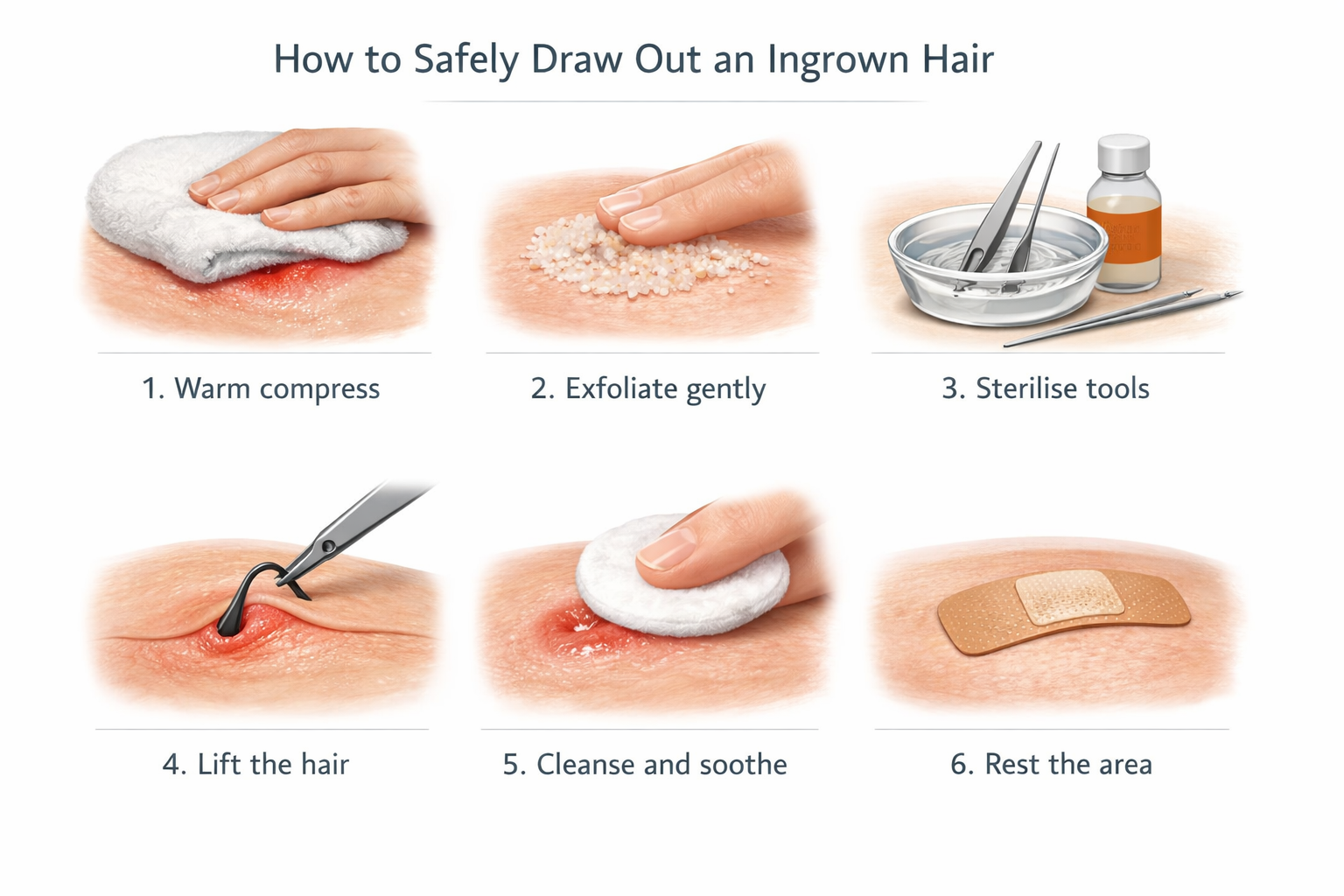
The following method is appropriate for a surface ingrown hair — one where the hair is visible or very close to the skin surface. If the hair is not yet visible, follow steps one and two only and repeat daily until it becomes accessible.
- Apply a warm compress. Soak a clean flannel or soft cloth in warm (not scalding) water and hold it firmly against the affected area for 10 to 15 minutes. The warmth softens the skin, opens the pores, and encourages the trapped hair to move toward the surface. Repeat this two to three times before attempting any further steps. A warm shower or bath achieves a similar effect.
- Gently exfoliate the area. After the compress, use a gentle circular motion with a soft washcloth, exfoliating brush, or a mild chemical exfoliant to loosen dead skin cells sitting over the follicle. This can help free a hair that is only just below the surface. Avoid aggressive scrubbing, which can inflame already irritated skin.
- Sterilise your tools. If the hair is now visible, clean a sterile needle or sterile tweezers with rubbing alcohol (isopropyl alcohol at 70% concentration is effective) and allow them to dry. Wipe the skin around the ingrown hair with an antiseptic solution as well. This step is non-negotiable — using unsterilised tools is a leading cause of secondary skin infections.
- Gently lift the hair free. Using the tip of the sterile needle, carefully slide it under the visible loop of hair and lift it upward so the tip clears the skin surface. The goal is to lift (not pluck) the hair — releasing it so it can grow normally. Sterile tweezers can then be used to guide the hair out if needed, but do not pull the hair out from the root at this stage, as this can cause the same problem to recur.
- Cleanse and soothe the area. Once the hair is free, clean the skin again with an antiseptic and apply a soothing, non-comedogenic product. Aloe vera gel, a product containing niacinamide, or a light antibiotic ointment can help calm redness and reduce the risk of infection. Avoid applying heavy creams or occlusive products that could block the follicle again.
- Leave the area alone. Resist the urge to shave over the area immediately. Give the skin at least 24 to 48 hours to settle before resuming hair removal in that zone.
Topical Ingredients That Help
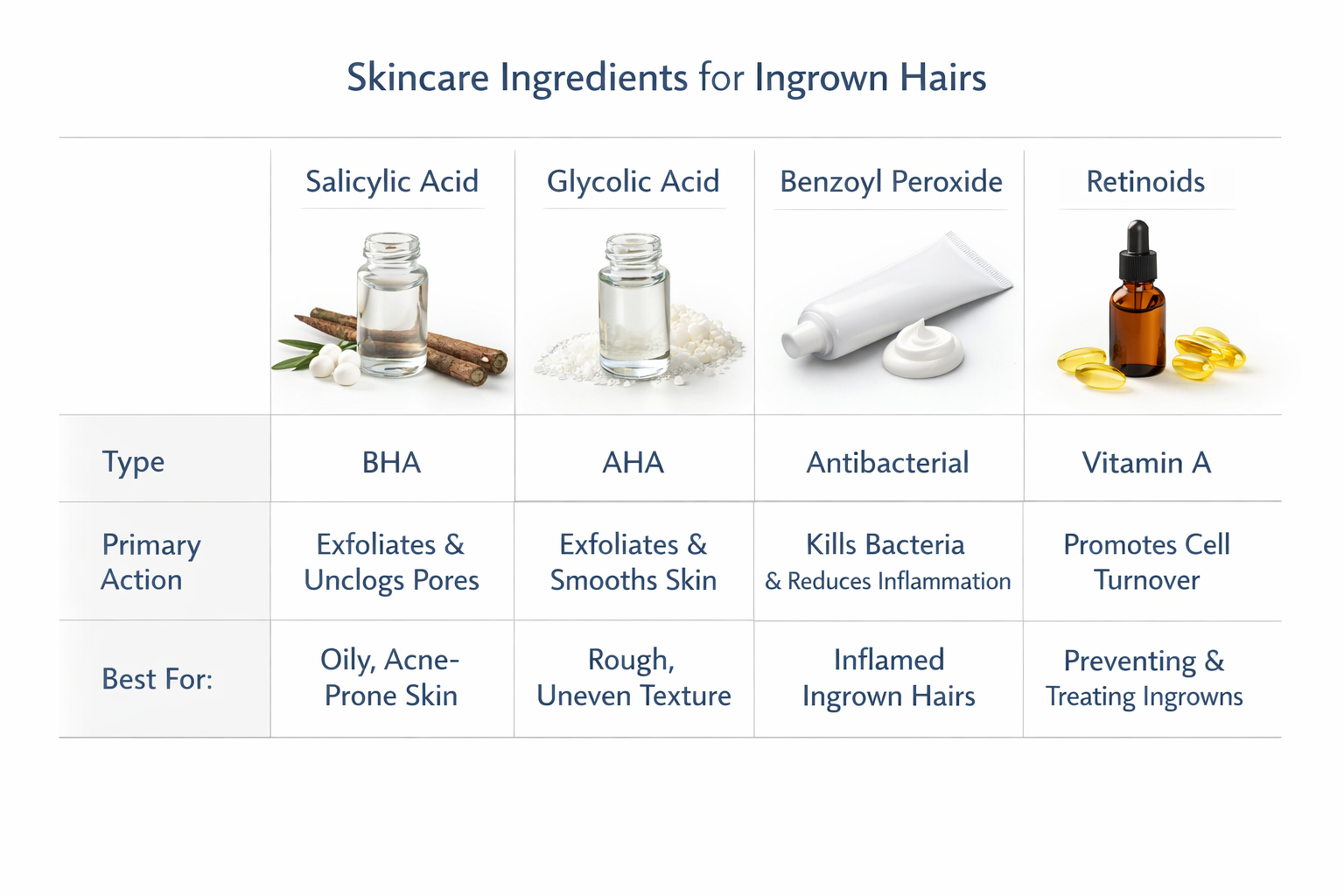
Several over-the-counter ingredients can assist in drawing out an ingrown hair and reducing associated inflammation. Understanding what each one does helps you choose the right product for your skin type and the stage of the ingrown hair.
| Ingredient | Type | Primary Action | Best Used For |
|---|---|---|---|
| Salicylic acid | BHA (chemical exfoliant) | Penetrates into the pore, dissolves dead skin cells, anti-inflammatory | Oily or acne-prone skin; blocked follicles; early-stage ingrown hairs |
| Glycolic acid | AHA (chemical exfoliant) | Exfoliates the skin surface, improves cell turnover | Dry or normal skin; post-ingrown hyperpigmentation |
| Benzoyl peroxide | Antibacterial | Kills bacteria within the follicle, reduces pustule formation | Infected or pus-filled ingrown hairs; folliculitis-prone skin |
| Retinoids / retinol | Vitamin A derivative | Accelerates cell turnover, prevents follicle blockage | Chronic or recurring ingrown hairs; prevention (not for use during pregnancy) |
| Niacinamide | Vitamin B3 | Reduces redness, supports skin barrier, mild anti-inflammatory | Post-removal soothing; hyperpigmentation-prone skin |
| Tea tree oil | Natural antiseptic | Antimicrobial, reduces surface bacteria | Mild cases; use diluted to avoid irritation |
Salicylic acid is particularly useful because, as a beta-hydroxy acid (BHA), it is oil-soluble and can penetrate into the hair follicle itself — making it more effective than surface-only exfoliants for clearing the blockage that traps the hair. Glycolic acid works at the skin surface and is a good option for improving overall skin texture and reducing post-inflammatory marks after the ingrown hair resolves.
A note on retinoids: prescription-strength retinoids are sometimes recommended by dermatologists for people with chronic ingrown hairs, but they are contraindicated during pregnancy and can cause significant irritation if introduced too quickly. Over-the-counter retinol products are milder but still warrant caution on sensitive or recently irritated skin.
What Not to Do
Knowing what to avoid is just as important as knowing the correct technique. The following actions are consistently associated with worsening outcomes:
- Do not squeeze or pop the bump. Squeezing forces bacteria deeper into the tissue, significantly increasing the risk of a more serious infection and making scarring far more likely.
- Do not dig into the skin. If the hair is not visible, no tool should break the skin surface. Digging blindly causes trauma, introduces infection risk, and can damage the follicle permanently.
- Do not pluck the hair from the root. Removing the entire hair from the follicle does not solve the underlying problem and may cause the next hair to grow in the same distorted direction.
- Do not use dirty or shared tools. Unsterilised needles or tweezers are a direct route for bacterial contamination. Always sterilise before use.
- Do not shave over an active ingrown hair. Shaving across an inflamed bump can break the skin, spread bacteria, and delay healing.
- Do not apply heavy, pore-blocking products. Thick creams or oils applied directly over an active ingrown hair can trap bacteria and worsen the blockage.
Ingrown Hair by Body Area
Face and Neck
Ingrown hairs on the face and neck — particularly in the beard area — are among the most common presentations of pseudofolliculitis barbae. The skin here is relatively sensitive, and the hair in this region is often coarser and more tightly curled. A single-blade razor or electric shaver used with a light touch tends to cause fewer ingrown hairs than a multi-blade razor, which can cut hair below the skin line. Shaving in the direction of hair growth (with the grain) rather than against it reduces the sharpness of the cut hair tip and lowers re-entry risk.
Bikini Line and Pubic Area
The bikini line is particularly prone to ingrown hairs because the hair in this region is often coarser and curlier, and the skin is subject to friction from clothing. Waxing and close shaving are common triggers. The skin in this area is also more sensitive and more prone to hyperpigmentation following inflammation. Gentle exfoliation two to three times per week between hair removal sessions can significantly reduce recurrence. Loose-fitting underwear after hair removal reduces friction during healing.
Legs
Ingrown hairs on the legs are common after shaving or waxing and often appear as small, scattered razor bumps. Using a fresh blade, applying a moisturising shaving gel, and exfoliating the legs before shaving all reduce the likelihood of hairs becoming trapped. Post-shave application of a product containing salicylic acid or glycolic acid can help maintain clear follicles between sessions.
Armpits
The armpit is a warm, moist environment where bacteria thrive, making infected ingrown hairs in this area more likely than in drier zones. Antiperspirant products applied immediately after shaving can also irritate freshly cut follicles. Allowing the skin to settle for a few hours before applying deodorant, and using a gentle chemical exfoliant two to three times per week, can reduce both ingrown hairs and associated irritation.
Ingrown Hair Cysts: When It Becomes More Complicated
An ingrown hair cyst is a deeper, more significant complication that develops when a hair follicle becomes blocked and a fluid-filled sac forms around the trapped hair. Unlike a standard ingrown hair bump, a cyst feels firm or fluctuant beneath the skin, may be significantly larger, and does not resolve with home treatment methods. Ingrown hair cysts should not be squeezed or lanced at home. A doctor can drain the cyst under sterile conditions and may prescribe a topical or oral antibiotic if infection is present. Attempting home drainage of a cyst carries a real risk of spreading infection and causing permanent scarring.
A pilonidal cyst — which occurs near the base of the spine — is a related but distinct condition that requires medical assessment and should not be confused with a standard ingrown hair.
Signs of Infection and When to See a Doctor
Most ingrown hairs resolve without complication when handled correctly. However, certain signs indicate that the ingrown hair has become infected and requires professional assessment rather than continued home treatment.
Seek medical advice if you notice any of the following:
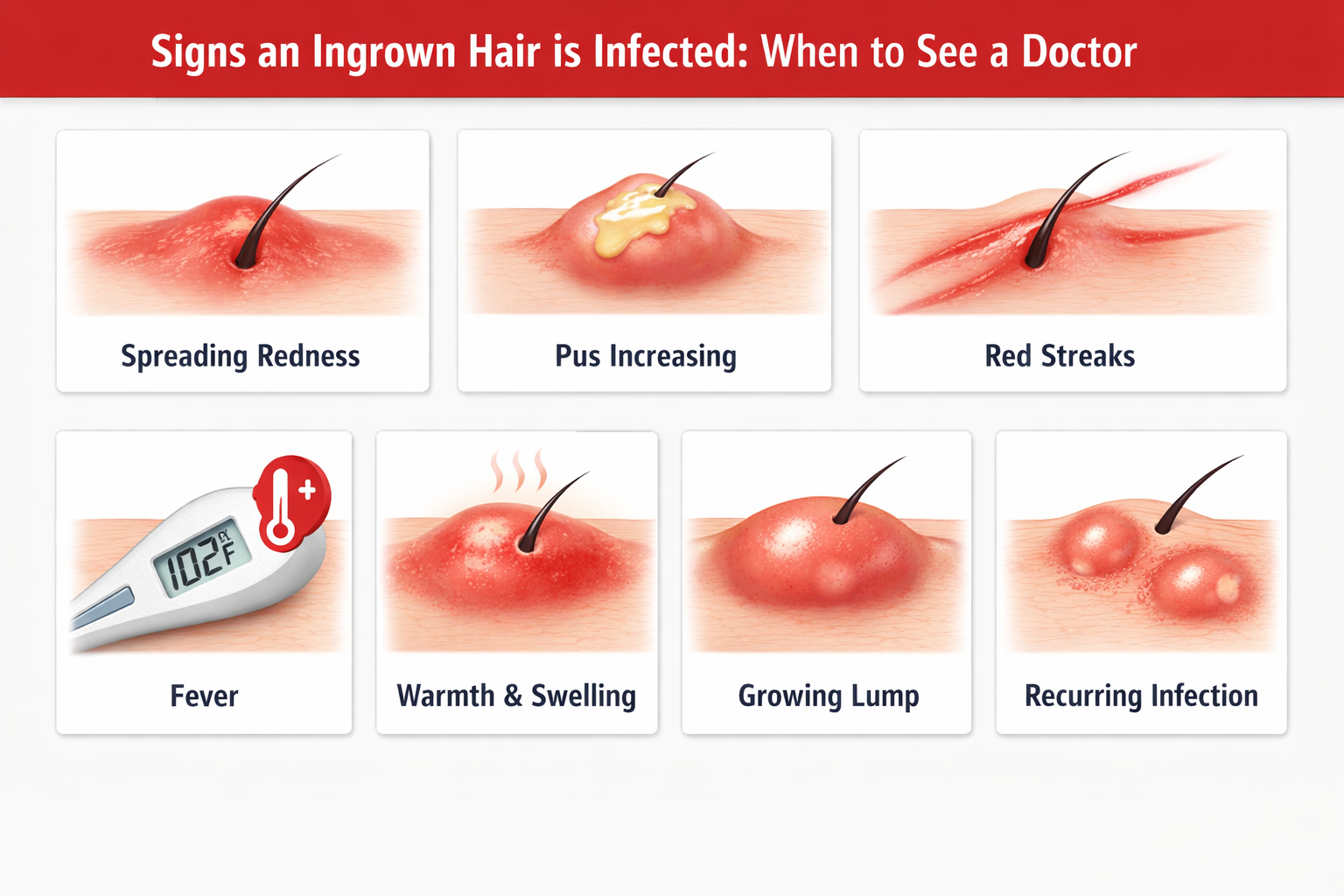
- Spreading redness around the bump that is worsening rather than improving
- Significant warmth or swelling in the surrounding skin
- Pus that is increasing in volume or changing in colour
- Red streaks extending outward from the site (a potential sign of spreading infection)
- Fever or feeling generally unwell alongside a skin lesion
- A lump that continues to grow and does not respond to warm compresses after one to two weeks
- Recurring ingrown hairs in the same location that keep becoming infected
A doctor may prescribe a topical antibiotic, an oral antibiotic for more significant infections, or a short course of a steroid cream to reduce inflammation. For a visible, accessible ingrown hair that has become infected, a doctor can make a small incision under sterile conditions to release the hair safely — a procedure that should never be attempted at home.
How Long Does It Take to Draw Out an Ingrown Hair?
A surface ingrown hair that is handled correctly — warm compress, gentle exfoliation, careful lifting with a sterile tool — can often be resolved in a single session. However, a deeper ingrown hair may take three to seven days of consistent warm compress and exfoliation before the hair migrates close enough to the surface to be safely lifted. If an ingrown hair has not shown any improvement after two weeks of appropriate home care, or if it is worsening, professional assessment is the appropriate next step rather than more aggressive home intervention.
How to Prevent Ingrown Hairs
Prevention is considerably more effective than treatment. The following measures reduce the frequency and severity of ingrown hairs across all body areas:
- Shave in the direction of hair growth. Shaving with the grain rather than against it produces a less sharp hair tip that is less likely to re-enter the follicle.
- Use a single-blade razor or a well-maintained electric shaver. Multi-blade razors cut hair below the skin line, increasing ingrown hair risk. Change blades frequently — a dull blade drags and cuts unevenly.
- Prepare the skin before shaving. A warm shower or warm compress before shaving softens the hair and opens the pores, making the cut cleaner and reducing trauma to the follicle.
- Use a shaving cream or gel. These products lubricate the skin surface, allowing the blade to glide rather than drag, and reduce the likelihood of the razor cutting too close.
- Exfoliate regularly. Removing dead skin cells two to three times per week keeps follicle openings clear. A gentle chemical exfoliant containing salicylic acid or glycolic acid is often more effective and less abrasive than a physical scrub.
- Moisturise after hair removal. A good post-shave routine that includes a non-comedogenic moisturiser helps maintain the skin barrier and reduces dryness that can contribute to follicle blockage.
- Consider alternative hair removal methods. Depilatory creams dissolve the hair at the skin surface rather than cutting it, producing a blunter tip that is less likely to re-enter the follicle. For a longer-term solution, laser hair removal targets the hair follicle directly, progressively reducing hair density and significantly lowering the incidence of ingrown hairs over a course of treatments. Electrolysis offers permanent hair removal for suitable candidates. These options are worth discussing with a qualified practitioner, particularly for people with chronic pseudofolliculitis barbae or recurring ingrown hair cysts.
Frequently Asked Questions
Can I squeeze an ingrown hair to get it out?
Squeezing is not recommended. Applying pressure to an ingrown hair bump forces bacteria deeper into the tissue, increases the risk of a more serious infection, and makes post-inflammatory scarring and hyperpigmentation significantly more likely. The warm compress and gentle exfoliation method is safer and more effective.
What if the hair is not visible under the skin?
If the hair cannot be seen beneath the skin surface, do not attempt to use a needle or tweezers. Apply a warm compress for 10 to 15 minutes twice daily and use a gentle chemical exfoliant to encourage the hair to migrate toward the surface. Only attempt to lift the hair once it becomes clearly visible.
Is it safe to use a needle at home?
Using a sterile needle to gently lift a visible ingrown hair is generally considered acceptable for surface ingrown hairs, provided the needle is properly sterilised with rubbing alcohol beforehand and the surrounding skin is cleaned with an antiseptic. The needle should only be used to lift the hair tip free — not to break the skin or dig beneath it.
How do I sterilise a needle or tweezers properly?
Wipe the tip of the needle or the gripping surface of the tweezers thoroughly with a cotton pad soaked in isopropyl alcohol (70% concentration). Allow the tool to air dry before use. Do not use a flame to sterilise tools, as this can leave carbon deposits on the metal. Clean the skin around the ingrown hair with an antiseptic wipe before and after the procedure.
Are certain people more prone to ingrown hairs?
Yes. People with curly or coarse hair are at significantly higher risk because the natural curve of the hair shaft makes it more likely to re-enter the follicle after cutting. People who shave frequently, particularly in areas such as the face, bikini line, and neck, are also more susceptible. Those with darker skin tones face an additional concern: post-inflammatory hyperpigmentation, which can leave lasting dark marks even after the ingrown hair itself resolves.
Can ingrown hairs cause permanent scarring?
Repeated picking, squeezing, or aggressive extraction can cause permanent scarring and hyperpigmentation. Ingrown hairs that become infected and are not treated appropriately also carry a higher scarring risk. Handling ingrown hairs gently and seeking professional help for infected or cystic lesions significantly reduces this risk.
When does laser hair removal help with ingrown hairs?
Laser hair removal reduces hair density over a course of treatments by targeting the hair follicle. For people who experience frequent or chronic ingrown hairs — particularly those with pseudofolliculitis barbae — laser hair removal can substantially reduce the problem long-term. It is most effective on darker hair against lighter skin, though newer devices have expanded suitability. A consultation with a qualified practitioner is needed to assess whether laser hair removal is appropriate for your skin tone, hair type, and treatment area.
When Home Treatment Is Not Enough: Knowing Your Options
Most ingrown hairs respond well to the methods described in this guide. A warm compress, consistent gentle exfoliation, and careful use of a sterile tool when the hair is visible will resolve the majority of cases without complication. The key is patience — particularly for deeper ingrown hairs — and restraint, particularly when the urge to squeeze or pick is strong.
For people who experience ingrown hairs frequently, especially in the same areas, a dermatologist or aesthetic practitioner can offer more targeted solutions. Prescription retinoids can accelerate cell turnover and keep follicles clear. Topical antibiotics or a short course of oral antibiotics may be appropriate for recurrent infected ingrown hairs. For longer-term relief, laser hair removal addresses the root cause by reducing the hair itself, making it a practical option for those whose ingrown hairs are chronic, painful, or causing significant hyperpigmentation.
If you are unsure whether what you are dealing with is a standard ingrown hair, an ingrown hair cyst, or another skin condition such as folliculitis, a professional assessment will give you a clear diagnosis and an appropriate treatment plan — and will help you avoid the risk of making the problem worse through well-intentioned but incorrect home treatment.