

Key Takeaways
- Tear lines (also called tear troughs) are grooves or hollows at the junction between the lower eyelid and the upper cheek, made more visible by age-related volume loss and structural changes.
- Hyaluronic acid filler — placed directly into the tear trough or indirectly via the cheek — is the most common non-surgical treatment, though it carries specific risks in this delicate area.
- Not everyone is a suitable candidate for filler; patients with significant excess skin, severe fat herniation, or unrealistic expectations may be better served by surgical options.
- Adjunct treatments such as polynucleotides, Profhilo, and radiofrequency skin tightening can improve skin quality in the periorbital region and may be used alongside or instead of filler.
- A thorough clinical assessment by an experienced practitioner is essential before any treatment in this area.
What Are Tear Lines?
Tear lines is a consumer-friendly term for what clinicians call the tear trough — a groove or depression that runs from the inner corner of the eye (the medial canthus) diagonally downward and outward along the lid-cheek junction. When this groove becomes pronounced, it creates a shadow that makes the under-eye area look hollow, sunken, or perpetually tired. The clinical term tear trough deformity is used when the depression is significant enough to be a cosmetic concern.
The tear trough sits at the transition zone between the lower eyelid and the upper cheek. Immediately lateral to it — extending toward the outer cheek — lies the palpebromalar groove, and together these two structures form what is often described as the lid-cheek junction. A related groove, the nasojugal groove, runs along the inner aspect of the lower lid. In practice, patients rarely distinguish between these structures; they simply notice a hollow, a shadow, or a tired appearance that no amount of sleep seems to resolve.
Why Do Tear Lines Form?
Tear lines become visible due to a combination of structural anatomy, age-related changes, and in some cases, genetic predisposition. Understanding the underlying cause matters because it directly influences which treatment is most appropriate.
The Role of the Orbicularis Retaining Ligament
A key anatomical structure in tear trough formation is the orbicularis retaining ligament (ORL) — a fibrous band that tethers the skin and orbicularis oculi muscle (the circular muscle surrounding the eye) to the underlying bone along the infraorbital rim. Because the ORL holds the skin down at this point, any loss of volume above or below it creates a visible groove. The ligament itself does not change significantly with age, but the soft tissue on either side of it does — and that contrast is what makes tear lines more pronounced over time.
Volume Loss and Fat Pad Changes
Periorbital aging involves several overlapping processes. The malar fat pad — the soft tissue that gives the upper cheek its youthful fullness — gradually descends and thins with age. Subcutaneous fat in the lower eyelid and infraorbital region also atrophies. As this volume is lost, the skin above the ORL becomes less supported, deepening the groove. Separately, orbital fat behind the lower eyelid can herniate forward, creating puffiness or under-eye bags that make the adjacent hollow appear even more pronounced by contrast.
Bone Remodelling and Skin Changes
The bony orbital rim itself changes shape with age — the infraorbital area tends to recede, reducing the skeletal support for the overlying soft tissue. Skin elasticity also declines as collagen production slows, meaning the skin becomes thinner and less able to mask the structural changes beneath it. In younger patients, tear lines may be present from an early age due to inherited anatomy rather than aging — a thinner face, prominent orbital rims, or naturally sparse periorbital fat can all contribute.
Tear Lines vs. Dark Circles vs. Under-Eye Bags
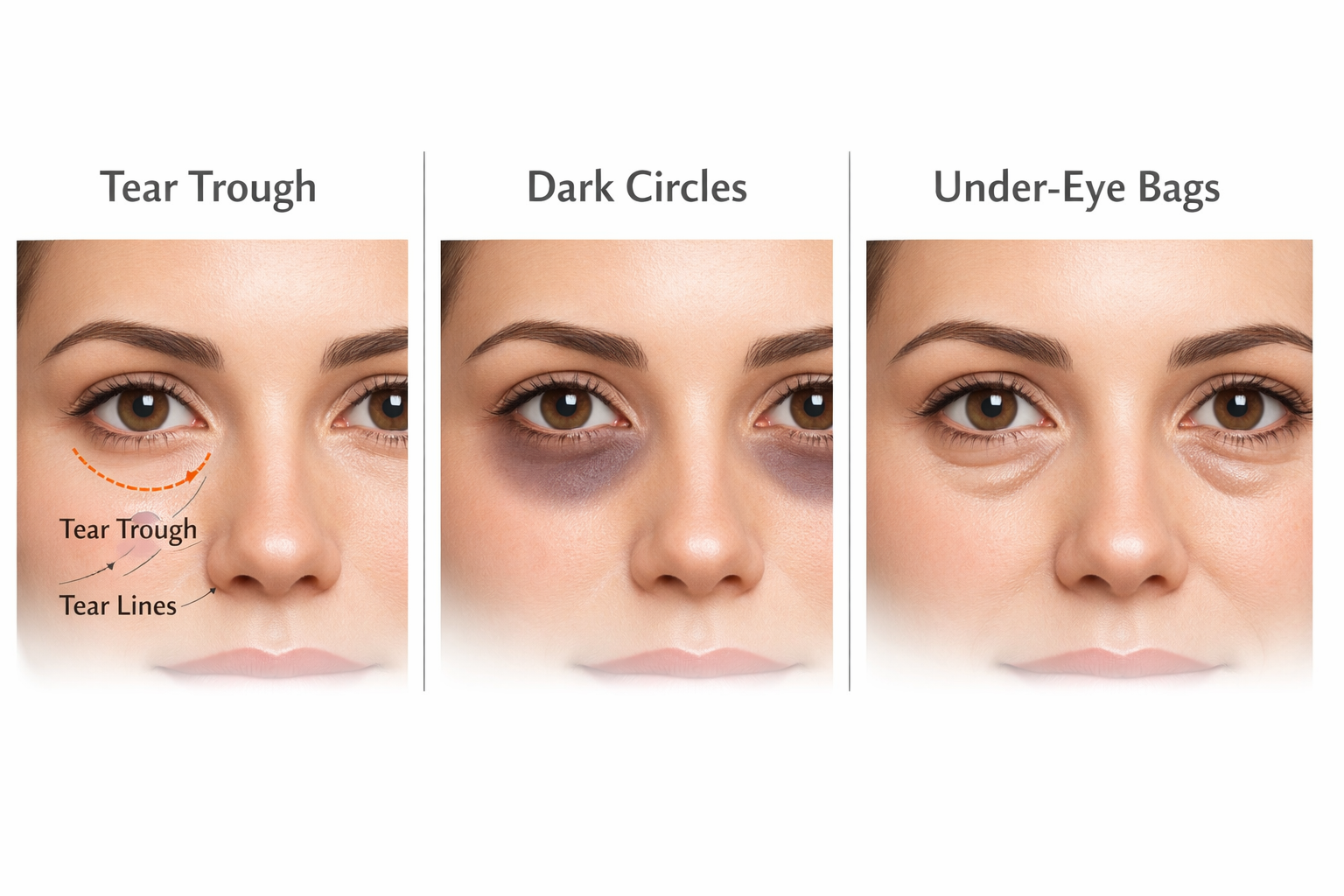
These three concerns are often confused, but they have different causes and respond to different treatments. Identifying the primary issue — or recognising that more than one is present — is an important first step before considering any intervention.
| Concern | Primary Cause | Key Feature | Common Treatments |
|---|---|---|---|
| Tear lines / tear trough | Volume loss, ORL tethering, fat pad descent | Hollow groove creating a shadow | HA filler, cheek filler, fat repositioning |
| Dark circles | Pigmentation, vascular visibility, thin skin | Discolouration (brown, purple, or blue tones) | Topical agents, chemical peels, laser, polynucleotides |
| Under-eye bags | Orbital fat herniation, fluid retention, skin laxity | Puffiness or swelling below the eye | Lower blepharoplasty, lifestyle changes |
Many patients present with a combination of all three. A shadow beneath the eye may be partly a true hollow (tear trough) and partly a vascular or pigmentation issue. Filler can address the hollow component but will not correct pigmentation. Equally, adding volume to an area that already has significant fat herniation may worsen the appearance of puffiness. This is why a careful clinical assessment — rather than a single-treatment approach — tends to produce the most satisfying outcomes.
Who May Be a Suitable Candidate for Tear Line Treatment?
Patient candidacy for tear trough treatment is one of the most important considerations in this area of aesthetic medicine. The periorbital region is anatomically complex, and not every patient presenting with under-eye concerns will benefit from filler.
Characteristics That May Indicate Suitability
- A clearly defined hollow or groove at the lid-cheek junction, rather than primarily puffiness or pigmentation
- Relatively good skin quality with adequate thickness — very thin or crepey skin may not conceal filler well
- Mild to moderate volume loss rather than severe structural change
- Realistic expectations about the degree of improvement achievable
- No active skin infection, inflammation, or autoimmune condition affecting the area
- No history of significant complications from previous periorbital filler
Candidacy Red Flags
Patients with significant excess lower eyelid skin, prominent fat herniation (bulging under-eye bags), or very thin, translucent skin may not be ideal candidates for filler alone. In these cases, adding volume can worsen the appearance of puffiness or increase the risk of visible filler (the Tyndall effect — a blue-grey discolouration caused by superficially placed hyaluronic acid). Patients with a history of malar oedema — fluid accumulation in the cheek area — may also be at higher risk of this complication following periorbital filler. A surgical consultation may be more appropriate for patients with moderate to severe structural concerns.
Non-Surgical Treatment Options
Hyaluronic Acid Filler: Direct Tear Trough Approach
Hyaluronic acid (HA) filler injected directly into the tear trough remains the most widely used non-surgical treatment for tear lines. Hyaluronic acid is a naturally occurring substance in the body, and HA-based dermal fillers are reversible — they can be dissolved using an enzyme called hyaluronidase if a complication arises or the result is unsatisfactory. This reversibility is a meaningful safety advantage in a high-risk anatomical zone.
Not all HA fillers are equally suited to the tear trough. The ideal product for this area has a low G’ prime (a measure of stiffness) and low hydrophilicity (water-attracting tendency), meaning it integrates softly into the tissue without spreading or swelling excessively. Products with high hydrophilicity can absorb water and expand after injection, increasing the risk of malar oedema and a puffy appearance. In the United States, Juvéderm Volbella XC is the only FDA-approved filler specifically indicated for the tear trough. Other products such as Restylane and RHA Redensity are used in clinical practice in various markets, but practitioners should select products based on their rheological properties and their own clinical experience.
The Indirect Cheek Approach
An alternative — and often complementary — strategy is the indirect cheek approach, in which filler is placed into the midface or cheek rather than directly into the tear trough. By restoring volume to the malar fat pad and upper cheek, this technique can lift the lid-cheek junction from below, reducing the depth of the tear trough without placing filler in the most sensitive periorbital tissue. This approach is particularly useful when midface volume loss is a significant contributing factor, and it carries a lower risk of the Tyndall effect because the filler is placed further from the thin lower eyelid skin.
In many cases, combining a small amount of direct tear trough filler with cheek filler produces a more natural and comprehensive result than either approach alone. This is sometimes described as a non-surgical cheek lift or liquid eye lift. The decision between direct, indirect, or combined treatment depends on the individual patient’s anatomy and the practitioner’s clinical assessment.
Cannula vs. Needle Technique
Filler in the periorbital area can be delivered using either a sharp needle or a blunt-tipped cannula. The cannula technique is generally considered to carry a lower risk of bruising and vascular injury because the blunt tip is less likely to puncture blood vessels. However, both techniques require significant anatomical knowledge and clinical experience. The choice of technique depends on the practitioner’s training, the specific injection plane being targeted, and the patient’s anatomy.
Surgical Treatment Options
For patients with significant structural concerns — particularly excess lower eyelid skin, prominent fat herniation, or skin laxity that filler cannot adequately address — surgical options may produce more appropriate and longer-lasting results.
| Treatment | Type | Invasiveness | Downtime | Longevity | Reversible? | Best For |
|---|---|---|---|---|---|---|
| HA filler (tear trough) | Non-surgical | Minimal | 1–5 days (bruising/swelling) | 9–18 months (variable) | Yes (hyaluronidase) | Mild to moderate hollowing, volume loss |
| Cheek filler (indirect) | Non-surgical | Minimal | 1–5 days | 12–24 months (variable) | Yes (hyaluronidase) | Midface volume loss contributing to tear trough |
| Lower blepharoplasty | Surgical | Moderate to high | 2–4 weeks | Long-lasting (years) | No | Excess skin, significant fat herniation |
| Fat repositioning | Surgical | Moderate | 2–4 weeks | Long-lasting | No | Orbital fat herniation with tear trough hollowing |
Lower blepharoplasty — surgery to remove or reposition excess lower eyelid tissue — addresses structural issues that filler cannot correct. A transconjunctival approach (incision inside the eyelid) is commonly used when fat repositioning is the primary goal, as it avoids a visible external scar. Fat repositioning, in which herniated orbital fat is moved to fill the tear trough hollow rather than removed, can address both puffiness and hollowing simultaneously. These procedures require a consultation with a qualified oculoplastic or plastic surgeon.
Adjunct and Alternative Treatments
Filler and surgery are not the only options for improving the periorbital area. Several treatments target skin quality rather than volume, and these may be appropriate as standalone treatments for patients who are not suitable filler candidates, or as adjuncts to enhance and prolong filler results.
- Polynucleotides (such as Lumi Eyes): Injected into the periorbital skin, polynucleotides stimulate collagen production and improve skin hydration and quality. They are particularly useful when the primary concern is skin thinning, crepiness, or fine lines rather than volume loss. Evidence for polynucleotides in this area is still developing, but clinical use is growing.
- Profhilo: A high-concentration HA product designed to remodel and hydrate skin rather than add volume. It may improve skin quality in the periorbital region and can complement filler treatment.
- Radiofrequency skin tightening: Devices that deliver radiofrequency energy to stimulate collagen and tighten lax skin may be useful for patients with mild skin laxity who are not ready for surgery.
- Topical retinoids and chemical peels: These can improve skin texture, pigmentation, and fine lines over time, though they do not address structural hollowing.
Risks and Complications
The periorbital region is one of the highest-risk areas for filler injection in aesthetic medicine. Patients should be fully informed of the following before proceeding.
Common Risks
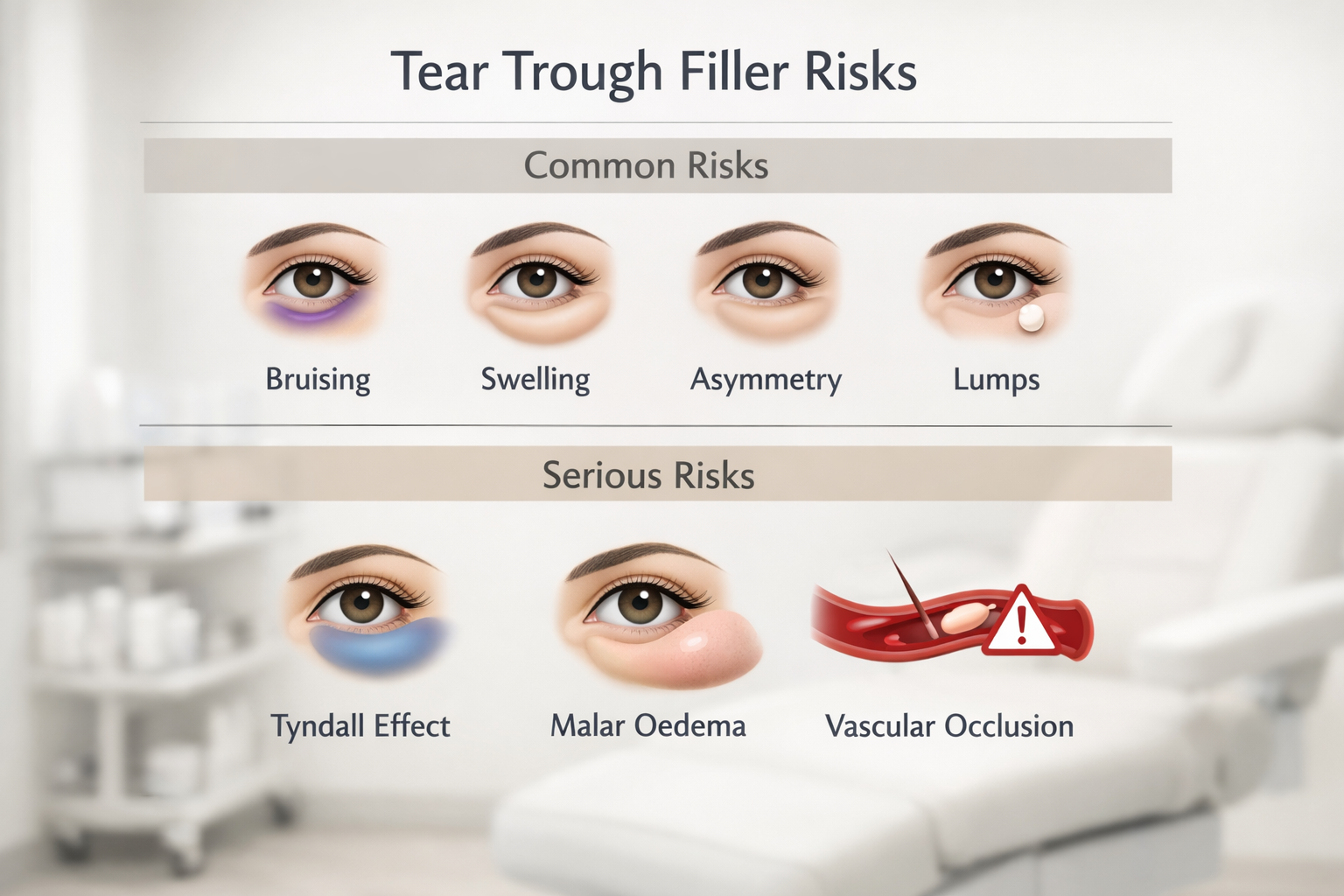
- Bruising and swelling: Expected to some degree after any injection in this area; usually resolves within one to two weeks.
- Asymmetry: Minor asymmetry is common and may improve as swelling resolves; significant asymmetry may require adjustment.
- Lumps or nodules: Can occur if filler is placed too superficially or in excess; may resolve spontaneously or require hyaluronidase dissolution.
Specific Risks in the Periorbital Area
- Tyndall effect: A blue-grey discolouration caused by superficially placed HA filler scattering light through thin skin. More likely with high-G’ or high-hydrophilicity products placed too close to the skin surface. Treated with hyaluronidase.
- Malar oedema: Fluid accumulation in the cheek area following periorbital filler, causing a puffy or swollen appearance. Can be persistent and difficult to manage. Risk is higher with hydrophilic fillers and in patients with pre-existing lymphatic drainage issues.
- Filler migration: HA filler can migrate from the injection site over time, particularly if a high-hydrophilicity product is used or if excessive volume is placed.
Serious but Rare Risks
- Vascular occlusion: Accidental injection into or compression of a blood vessel can restrict blood flow, potentially causing skin necrosis (tissue death). In the periorbital area, there is also a rare but serious risk of filler entering the ophthalmic circulation, which can lead to vision impairment or loss. This is an extremely rare complication but underscores the importance of treatment by a highly experienced practitioner with appropriate emergency protocols.
- Infection and biofilm: As with any injectable procedure, infection is possible. Biofilm — a bacterial community that can form around filler — may present as delayed-onset nodules.
The risk of serious complications is significantly reduced when treatment is performed by a practitioner with advanced anatomical knowledge, appropriate product selection, conservative dosing, and access to hyaluronidase for emergency dissolution.
What to Expect: The Treatment Process
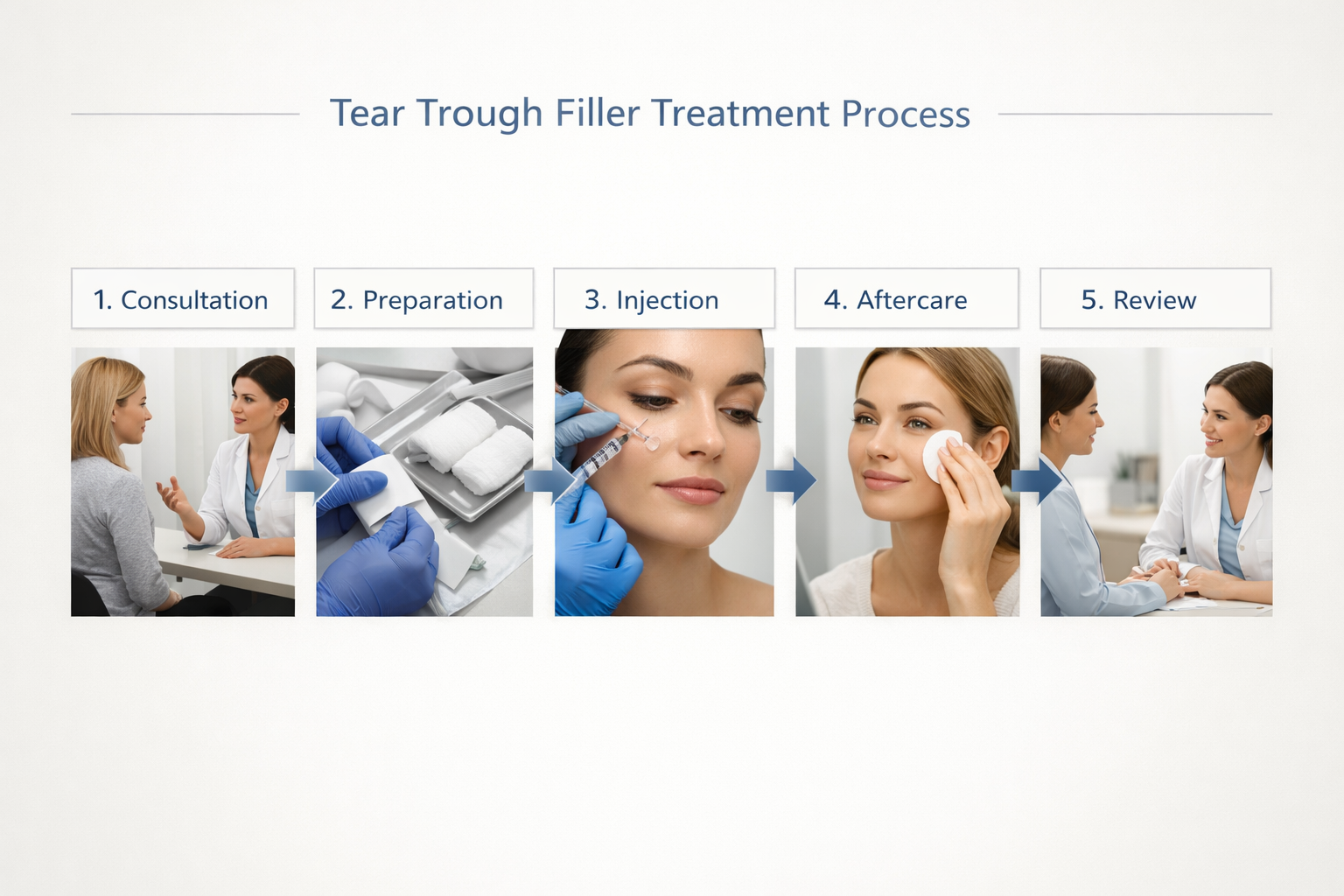
- Consultation: A thorough assessment of the under-eye area, overall facial anatomy, skin quality, and medical history. The practitioner should discuss realistic outcomes, risks, and whether filler, an indirect cheek approach, adjunct treatments, or a surgical referral is most appropriate.
- Preparation: Topical anaesthetic cream is typically applied 20–30 minutes before treatment to reduce discomfort. The area is cleaned and marked.
- Injection: Filler is placed using a needle or cannula, usually in small increments. The procedure typically takes 15–30 minutes depending on the approach.
- Immediate aftercare: Ice may be applied to reduce swelling. Patients are usually advised to avoid strenuous exercise, alcohol, NSAIDs, and face-down sleeping for 24–48 hours.
- Review: A follow-up appointment at approximately two weeks allows the practitioner to assess the result once initial swelling has resolved and make any minor adjustments if needed.
How Long Do Results Last?
Tear trough filler results typically last between 9 and 18 months, though this varies considerably between patients. Several factors influence longevity: the specific product used, the volume placed, the patient’s metabolism, their activity level, and whether the filler was placed directly in the tear trough or indirectly via the cheek (cheek filler generally lasts longer due to the denser tissue environment). Patients who metabolise filler quickly may notice results fading sooner; those with slower metabolism may retain results for longer.
Maintenance treatment is usually required to sustain results. Many practitioners recommend a conservative approach — using the minimum effective volume and building gradually over successive appointments — rather than placing large amounts of filler in a single session. This reduces the risk of overfilling, filler accumulation, and complications over time.
Male Patients and Tear Line Treatment
Tear trough filler is increasingly sought by male patients, though this demographic is underrepresented in much of the published aesthetic literature. Male facial anatomy differs from female anatomy in several relevant ways: men typically have thicker skin, stronger bony structure, and different fat distribution patterns. These differences can influence product selection, injection technique, and the volume required. Men may also prefer a more conservative result that avoids any feminising effect. A practitioner experienced in treating male patients will tailor the approach accordingly.
Frequently Asked Questions
Is tear trough filler painful?
Most patients find the procedure tolerable with topical anaesthetic applied beforehand. Some discomfort, pressure, or stinging during injection is normal. The use of a cannula rather than a needle may reduce discomfort for some patients. Pain thresholds vary between individuals.
Can tear lines be treated if I have dark circles?
It depends on the cause. If the dark circles are primarily due to hollowing and shadow (a structural issue), filler may improve their appearance. If they are caused by pigmentation or visible blood vessels through thin skin, filler is unlikely to help significantly and other treatments — such as topical agents, chemical peels, or laser — may be more appropriate. Many patients have a combination of causes, which is why a careful assessment is important.
What happens if I don’t like the result?
Hyaluronic acid filler can be dissolved using hyaluronidase, an enzyme that breaks down HA. This is one of the key safety advantages of HA-based products in this area. Dissolution is usually effective, though it may require more than one treatment session and can temporarily cause additional swelling.
How much filler is typically used?
Conservative dosing is strongly recommended in the tear trough area. Most experienced practitioners use less than 1 ml per side, often significantly less, and prefer to build volume gradually over multiple sessions rather than placing large amounts at once. Overfilling is a common cause of complications including malar oedema and the Tyndall effect.
Is there a risk of the filler looking unnatural?
Yes, if too much filler is placed, if the wrong product is used, or if it is placed too superficially. Choosing a practitioner with specific experience in periorbital treatment and a conservative approach significantly reduces this risk. The goal is a natural, rested appearance — not a filled or puffy look.
Are there any reasons I should not have this treatment?
Tear trough filler may not be appropriate if you have active skin infection or inflammation in the area, a history of severe allergic reactions to HA products, significant excess lower eyelid skin or fat herniation (where surgery may be more suitable), a history of malar oedema, or certain autoimmune or bleeding conditions. A full medical history review at consultation will identify any contraindications relevant to your situation.
Is Tear Line Treatment the Right Option for You?
Tear lines are a genuinely common concern, and for the right patient, hyaluronic acid filler — whether placed directly in the tear trough or indirectly via the cheek — can produce a meaningful improvement in the rested, refreshed appearance of the under-eye area. The treatment is minimally invasive, reversible, and when performed conservatively by an experienced practitioner, carries an acceptable risk profile for most suitable candidates.
However, the periorbital region is one of the most technically demanding areas in aesthetic medicine. The risks — including the Tyndall effect, malar oedema, and the rare but serious possibility of vascular occlusion — are real and should be understood before proceeding. Not every patient presenting with under-eye concerns is a suitable candidate for filler; some will achieve better outcomes through adjunct treatments that improve skin quality, and others may require a surgical consultation.
If you are considering treatment for tear lines, a thorough consultation with a practitioner who has specific experience in periorbital anatomy and injectable techniques is the most important first step. A good practitioner will assess your individual anatomy, discuss realistic outcomes, and recommend the approach most likely to achieve a natural result safely — whether that involves filler, an alternative treatment, or a combination of both.