

Key Takeaways
- Hyaluronic acid lip fillers are the most widely used option for non-surgical lip augmentation and are reversible with hyaluronidase if needed.
- The major brands — Juvederm, Restylane, Belotero and RHA — use different gel technologies, which affects how each filler feels, moves and lasts in the lips.
- There is no single best lip filler for everyone; the right choice depends on your anatomy, goals, and the clinical judgement of an experienced injector.
- Lip filler longevity typically ranges from six to twelve months, with results influenced by the product used, the volume injected, and individual metabolism.
- Choosing a medically trained, qualified injector matters as much as choosing the right product — technique and placement are central to achieving natural-looking results.
What Is Lip Filler and How Does It Work?
Lip filler is a gel-like substance injected into or around the lips to add volume, improve shape, define the vermilion border, or enhance the cupid’s bow. The vast majority of lip fillers used today are based on hyaluronic acid (HA), a naturally occurring sugar molecule found in skin and connective tissue. Hyaluronic acid attracts and retains water, which is why HA-based fillers create soft, hydrated volume rather than a rigid or artificial feel.
During treatment, a qualified injector places small amounts of the filler gel at precise depths within the lip tissue using a fine needle or, in some cases, a blunt-tipped cannula. The filler integrates with the surrounding tissue and the results are visible immediately, though the final appearance typically settles over two to four weeks once any swelling has resolved. Because hyaluronic acid is biodegradable and biocompatible, the body gradually breaks it down over time, which is why maintenance appointments are needed to sustain results.
One important safety feature of HA fillers is that they are reversible with hyaluronidase, an enzyme that dissolves hyaluronic acid. This means that if a result is unsatisfactory or a complication occurs, a trained practitioner can dissolve the filler. This reversibility is one reason HA fillers remain the preferred choice for lip augmentation over non-reversible alternatives.
Comparing the Leading Lip Filler Brands
The four main brand families used for lip augmentation are Juvederm, Restylane, Belotero and the RHA Collection. Each uses a different manufacturing technology that affects the filler’s viscosity, flexibility, longevity and feel. Understanding these differences helps explain why an experienced injector may recommend one product over another for a specific goal.
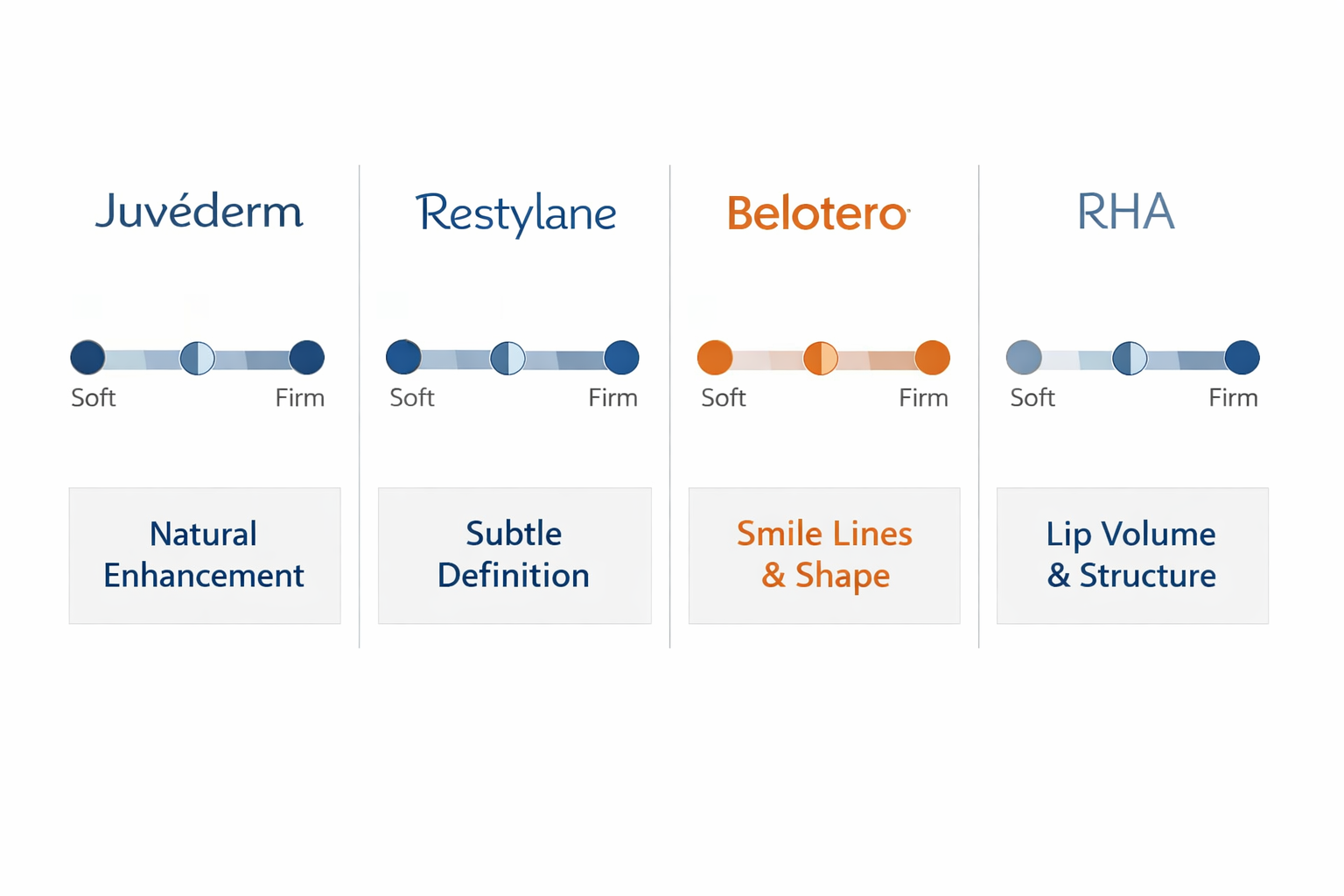
| Brand / Product | Technology | Gel Consistency | Best Suited For | Typical Longevity |
|---|---|---|---|---|
| Juvederm Ultra XC | Vycross cross-linking | Medium-firm | Volume, projection, fuller lips | Up to 12 months |
| Juvederm Volbella XC | Vycross cross-linking | Soft, low viscosity | Subtle volume, lip lines, fine definition | Up to 12 months |
| Restylane Kysse | XpresHAn technology | Flexible, medium | Natural movement, colour enhancement, volume | 6–12 months |
| Restylane Silk | NASHA technology | Fine, soft | Subtle enhancement, lip lines, thin lips | 6 months |
| Belotero Balance / Soft | CPM (Cohesive Polydensified Matrix) | Very soft, integrates easily | Fine lines, perioral area, delicate definition | 6–9 months |
| RHA 2 / RHA 3 | Preserved HA (resilient cross-linking) | Dynamic, flexible | Natural movement, expressive lips, active patients | Up to 12 months |
Juvederm: Vycross Technology and Predictable Volume
The Juvederm family is manufactured by Allergan Aesthetics and uses Vycross technology, which cross-links hyaluronic acid chains of different molecular weights. This produces a smooth, cohesive gel that integrates well into lip tissue. Juvederm Ultra XC is commonly chosen when a patient wants meaningful volume and projection, while Juvederm Volbella XC — a softer, lower-viscosity product — is often preferred for subtle enhancement, lip line softening, or patients who want a more delicate result. Both products contain lidocaine, a built-in numbing agent that improves comfort during injection. Juvederm products are FDA-approved for lip augmentation in adults.
Restylane: XpresHAn Technology and Natural Movement
Restylane Kysse, part of the Restylane family manufactured by Galderma, uses XpresHAn technology — a flexible cross-linking method designed to allow the filler to move naturally with facial expressions. Clinical studies have supported its use for lip volume and colour enhancement, and it has received FDA approval for lip augmentation. Restylane Kysse is often cited for producing results that feel soft and move naturally, which makes it a popular choice for patients concerned about an overfilled or stiff appearance. Restylane Silk, an older product using NASHA technology, uses finer particles and is typically suited to subtle lip refinement or perioral line treatment rather than significant volume addition.
Belotero: CPM Technology for Fine Integration
Belotero products, manufactured by Merz Aesthetics, use Cohesive Polydensified Matrix (CPM) technology. This produces a very soft, homogeneous gel that integrates smoothly into superficial tissue layers. Belotero Balance and Belotero Soft are particularly well suited to treating fine perioral lines — sometimes called smoker’s lines — and to adding delicate definition around the vermilion border without adding significant bulk. Belotero is less commonly chosen for patients seeking substantial lip volume but can be valuable for fine-detail work or in combination with other products.
RHA Collection: Resilient Hyaluronic Acid for Dynamic Lips
The RHA (Resilient Hyaluronic Acid) Collection, developed by Teoxane and distributed in the US by Revance, uses a manufacturing process designed to preserve the natural structure of hyaluronic acid chains more closely than conventional cross-linking methods. The result is a filler that is intended to flex and adapt with facial movement rather than remaining static. RHA 2 and RHA 3 are the products most relevant to lip augmentation, with RHA 3 offering slightly more structure. For patients who are very expressive or who are concerned that filler will look unnatural during movement, RHA products are worth discussing with an injector. Teosyal Kiss, from the same Teoxane family, is widely used in UK and European clinics and is similarly designed for lip-specific treatment.
Which Lip Filler May Suit Your Goals?
Rather than a single best product, the most appropriate lip filler depends on what you are trying to achieve. The following framework may help you think about your goals before a consultation.
- First-time patient wanting subtle enhancement: A softer product such as Juvederm Volbella XC, Restylane Silk or Belotero Soft, often in a 0.5ml dose, may be appropriate. Starting conservatively allows you to assess how your lips respond before committing to more volume.
- Patient wanting noticeable volume and projection: Juvederm Ultra XC or Restylane Kysse in a 1ml dose may be more suitable. These products have the structure to add meaningful volume while still allowing natural movement.
- Patient concerned about natural-looking results and movement: Restylane Kysse or RHA 2/3 are designed with flexibility in mind and may be worth discussing if you want results that move naturally with your expressions.
- Patient with lip line concerns or perioral wrinkles: Belotero Balance or Juvederm Volbella XC are commonly used for fine perioral lines and can be combined with lip body treatment if needed.
- Patient with lip asymmetry: Asymmetry correction requires precise placement and careful volume calibration. Any of the major brands can be used, but injector skill and anatomical assessment are particularly important in this case.
It is worth noting that an experienced injector may use more than one product in a single session — for example, a firmer product for the lip body and a softer product for the border — to achieve a balanced, natural-looking result. This is a clinical decision that should be made during a thorough consultation.
What Makes Lip Filler Look Natural — or Unnatural?
One of the most common concerns patients raise is the fear of an overfilled appearance or an overdone look. Understanding what causes unnatural results helps set realistic expectations and reinforces why product choice and injector skill both matter.
An overfilled appearance typically results from injecting too much volume relative to the patient’s facial proportions. The lips exist within the context of the whole face, and results that respect facial harmony — the relationship between lip size, facial width, and surrounding features — tend to look more natural than those that simply maximise volume. Most practitioners use the guideline that the lower lip should be slightly fuller than the upper lip, and that the cupid’s bow and vermilion border should remain defined rather than blurred.
Filler migration — where product spreads beyond the intended area — can create a blurred or puffy appearance above the lip border. This is more likely when high volumes are used, when a product with inappropriate viscosity is chosen for a given area, or when injection technique is suboptimal. Choosing a qualified injector with specific experience in lip anatomy significantly reduces this risk.
Poor product selection also contributes to unnatural results. Using a high-viscosity filler designed for deeper structural support in the superficial lip tissue, for example, can create visible lumps or an uneven texture. This is why filler viscosity and gel consistency should be matched to the treatment area and depth of placement — a decision that requires clinical training and experience.
What to Expect During a Lip Filler Appointment
A lip filler appointment typically begins with a consultation, during which the practitioner assesses your lip anatomy, discusses your goals, reviews your medical history, and recommends a treatment plan. This is the appropriate time to ask about which product will be used and why, what volume is being proposed, and what results are realistic for your anatomy.
Before injection, a topical anaesthetic cream is usually applied to the lips and surrounding area for around twenty minutes. Many lip filler products also contain lidocaine within the gel itself, which further reduces discomfort as the treatment progresses. Some practitioners offer a dental nerve block for patients who are particularly sensitive.
The injection process itself typically takes fifteen to thirty minutes. The practitioner will inject small amounts of filler at multiple points, shaping and moulding the tissue as they work. Results are visible immediately, though the lips will appear slightly swollen at this stage. The final result becomes clearer once swelling has resolved, usually within two to four weeks.
Lip Filler Aftercare and Recovery Timeline
Swelling and bruising are the most common side effects after lip filler treatment. Swelling tends to peak within the first twenty-four to forty-eight hours and then gradually subsides. Bruising, if it occurs, typically resolves within five to ten days. The lips may feel tender or firm in the days immediately after treatment.
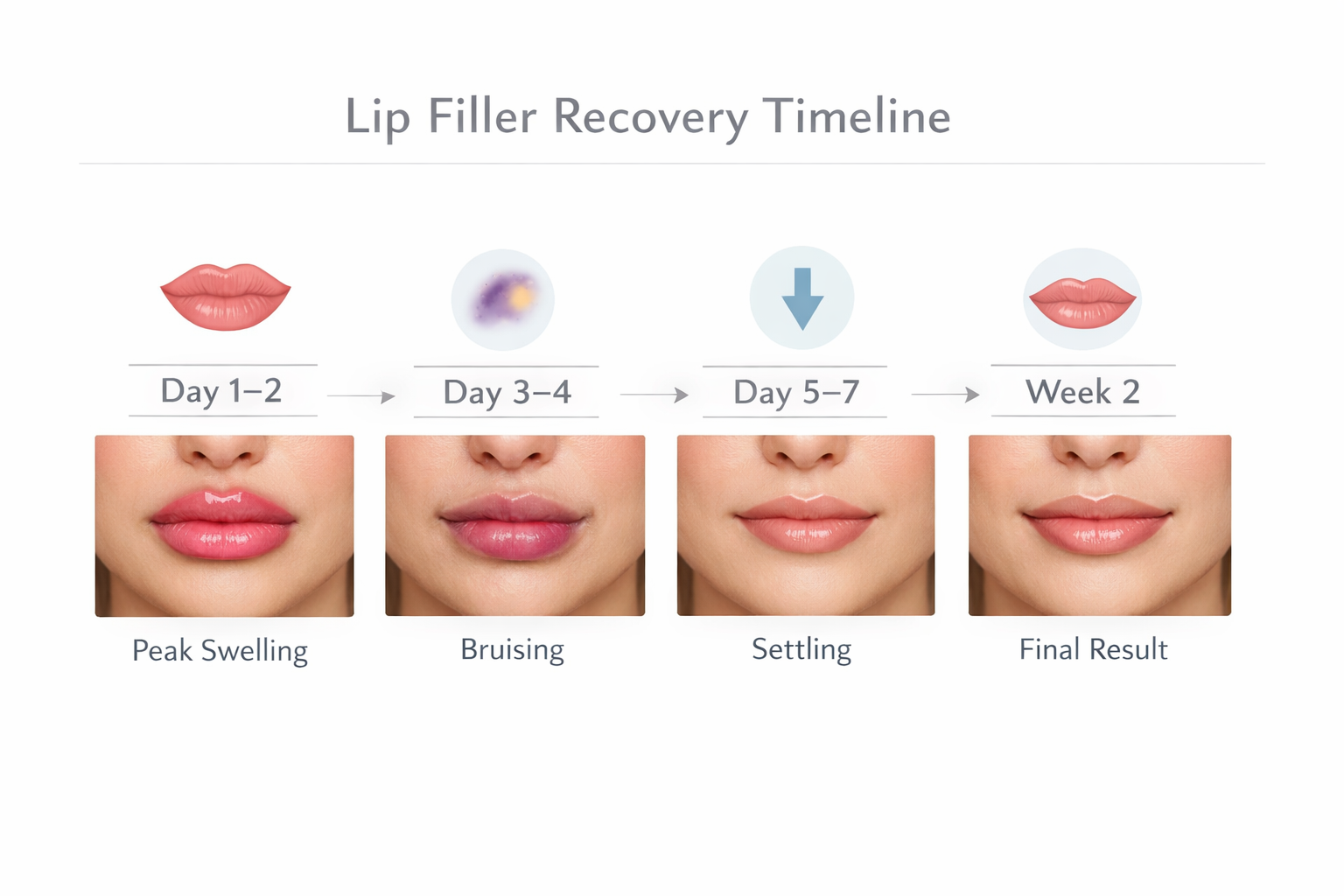
- Day 1–2: Swelling is at its most noticeable. The lips may look larger than the intended final result. Applying a clean ice pack wrapped in a cloth can help reduce swelling. Avoid strenuous exercise, alcohol, and excessive heat such as saunas or hot showers.
- Day 3–4: Swelling begins to reduce. Bruising, if present, may be at its most visible. Most patients feel comfortable returning to normal daily activities.
- Day 5–7: The majority of swelling has resolved. The lips begin to look closer to the intended result. Any remaining bruising can usually be covered with makeup.
- Week 2 onwards: The filler continues to settle and integrate with the surrounding tissue. The final result is typically visible by the end of the second week. A follow-up appointment at two to four weeks is recommended to assess the outcome and discuss whether a touch-up treatment is needed.
Good lip filler aftercare also includes staying well hydrated, avoiding pressure on the lips (such as sleeping face-down), and not undergoing dental procedures or other facial treatments in the immediate post-treatment period. Your practitioner will provide specific aftercare guidance based on the product used and the volume injected.
How Long Does Lip Filler Last?
Lip filler longevity varies between individuals and between products. Most hyaluronic acid lip fillers last between six and twelve months, though some patients find their results fade more quickly and others find they persist longer. Factors that influence how long lip filler lasts include the specific product used, the volume injected, the patient’s metabolism, and how active the lip area is — lips move constantly during speaking and eating, which accelerates the breakdown of filler compared to less mobile areas of the face.
Softer, lower-viscosity products such as Juvederm Volbella XC or Restylane Silk may metabolise more quickly than firmer products. RHA fillers are designed to resist mechanical stress, which may contribute to longevity in dynamic areas, though individual results vary. A maintenance appointment or top-up treatment is typically recommended when the patient notices the volume beginning to diminish, rather than waiting until the filler has fully dissolved.
Lip Filler vs. Lip Flip: Understanding the Difference
A lip flip is a separate, non-filler procedure that uses a small amount of botulinum toxin injected into the orbicularis oris muscle around the upper lip. By relaxing this muscle, the upper lip rolls slightly outward, creating the appearance of a fuller upper lip without adding actual volume. A lip flip does not add projection or significantly change lip shape — it is a subtle effect that may suit patients who want a minor enhancement or who are not ready for filler.
Lip filler and a lip flip can be used together in some cases, but they serve different purposes. Lip filler adds genuine volume, shape and definition, while a lip flip creates a subtle visual effect through muscle relaxation. A lip flip is not a replacement for lip filler if meaningful volume or border definition is the goal. Discussing both options with a qualified practitioner during a consultation will help clarify which approach — or combination — may suit your anatomy and expectations.
Lip Filler Cost: What to Expect
Lip filler cost per syringe varies depending on geographic location, the clinic setting, the practitioner’s experience and qualifications, and the specific product used. In the United States, a single syringe of lip filler typically ranges from approximately $500 to $1,000 or more, with premium products and highly experienced injectors at the upper end of this range. In the United Kingdom, prices generally range from around £250 to £600 per syringe, though this varies considerably by region and clinic.
Many patients begin with a half syringe (0.5ml) for a first treatment, which reduces the initial cost and allows a conservative approach. A full syringe (1ml) is more common for patients seeking noticeable volume or who are returning for a maintenance appointment. Over time, the cumulative cost of maintenance treatments should be factored into the decision — lip filler is not a one-time expense but an ongoing commitment if you wish to sustain results.
Be cautious of significantly discounted treatments, as very low prices may reflect the use of unbranded or unlicensed products, inadequate training, or a clinic environment that does not meet appropriate safety standards.
Who May Not Be Suitable for Lip Filler
Lip filler is not appropriate for everyone. A thorough medical history review during consultation will identify any contraindications. Lip filler is generally not recommended during pregnancy or breastfeeding. Patients with an active cold sore or other oral infection in or around the lips should postpone treatment until the infection has fully resolved, as injection can trigger or worsen an outbreak. Patients taking blood-thinning medications may have an increased risk of bruising and should discuss this with their practitioner before treatment.
Patients with certain autoimmune conditions, a history of severe allergic reactions, or known hypersensitivity to any component of the filler should discuss their history in detail before proceeding. Previous lip procedures, including permanent fillers or implants, may also affect suitability and should be disclosed at consultation.
How to Choose a Qualified Injector
The practitioner performing your lip filler treatment has a greater influence on your outcome than the brand of product used. Lip anatomy is complex, and achieving natural-looking lip enhancement requires an understanding of facial proportions, injection depth, product selection, and volume calibration. Choosing a medically trained provider — such as a doctor, dentist, or nurse prescriber with specific aesthetic training — reduces the risk of complications and ensures that reversal with hyaluronidase is available if needed.
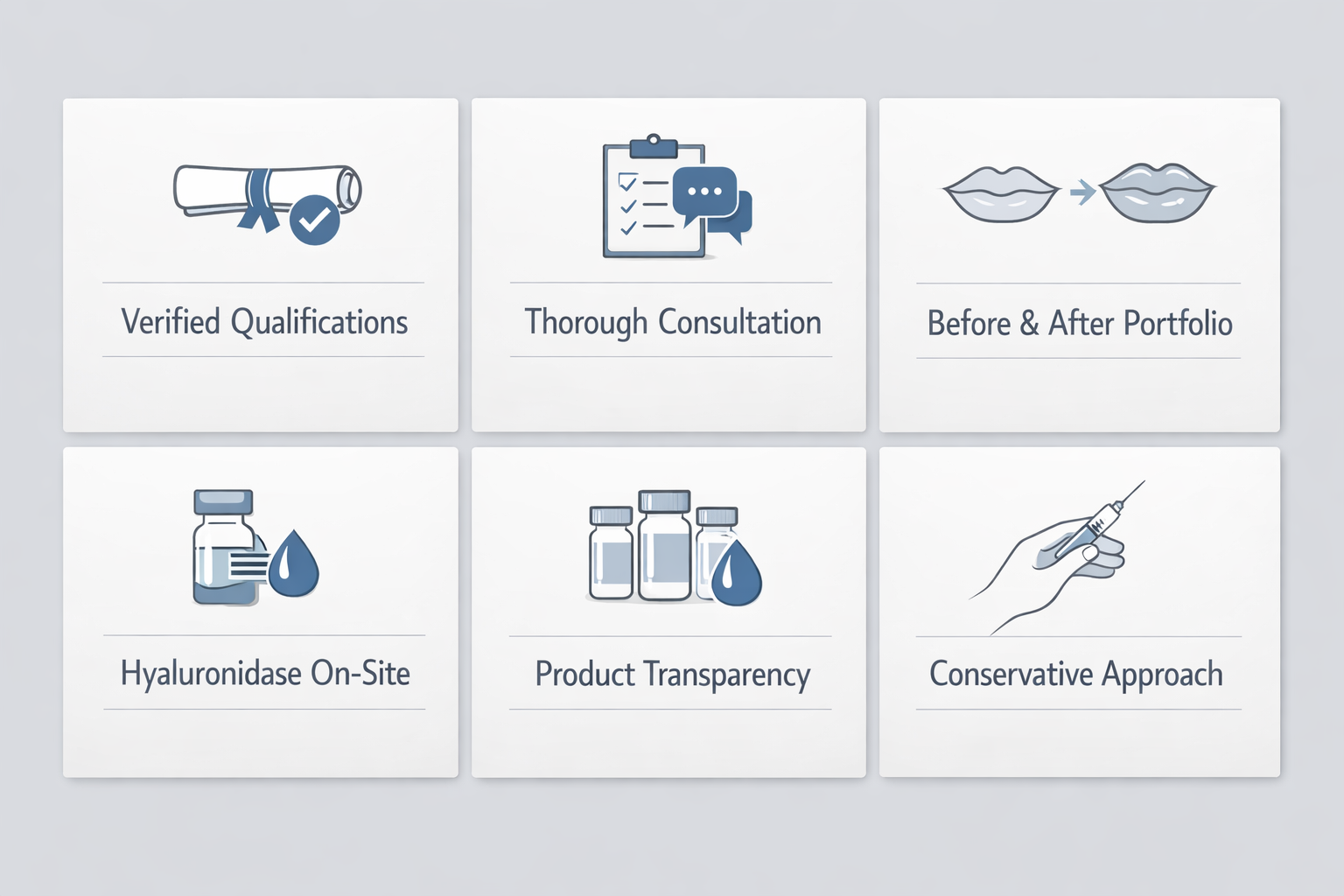
When assessing a potential injector, consider the following:
- Are they a board-certified or medically trained provider with verifiable qualifications in aesthetic medicine?
- Do they offer a thorough consultation before treatment, including a discussion of your anatomy and realistic expectations?
- Can they show a portfolio of before and after results that reflect the natural-looking style you are seeking?
- Do they stock hyaluronidase on-site and have a clear protocol for managing complications?
- Are they transparent about which product they plan to use and why?
- Do they recommend a conservative starting volume rather than immediately proposing maximum filler?
Red flags include practitioners who cannot explain which product they are using, who pressure you toward larger volumes, who do not conduct a medical history review, or who offer prices that seem implausibly low. A reputable clinic will welcome your questions and support you in making an informed decision.
Frequently Asked Questions
Can lip filler be dissolved if I don’t like the result?
Yes. Hyaluronic acid lip fillers are reversible with hyaluronidase, an enzyme that breaks down hyaluronic acid. A trained practitioner can inject hyaluronidase to dissolve some or all of the filler if the result is unsatisfactory or if a complication such as vascular occlusion occurs. Reversal is one of the key safety advantages of HA-based fillers over non-reversible alternatives.
How much lip filler do I need for a natural result?
For most patients, 0.5ml to 1ml is the typical range for a single treatment session. First-time patients often benefit from starting with 0.5ml to assess how their lips respond before adding more volume. The appropriate amount depends on your existing lip size, anatomy, and goals — this is a clinical decision best made during a face-to-face consultation.
Will lip filler hurt?
Most patients describe lip filler as uncomfortable rather than severely painful. Topical anaesthetic cream is applied before treatment, and most modern lip filler products contain lidocaine within the gel, which reduces discomfort as the injection progresses. A dental nerve block is an option for patients who are particularly sensitive. Some tenderness and sensitivity in the lips is normal for a few days after treatment.
How soon can I wear lipstick after lip filler?
Most practitioners advise avoiding lipstick and lip products for at least twenty-four hours after treatment to reduce the risk of introducing bacteria to the injection sites. After this period, most patients can resume normal lip makeup. Your practitioner will provide specific guidance based on your treatment.
Is lip filler safe for people who get cold sores?
Patients with a history of cold sores (oral herpes) should inform their practitioner before treatment. Lip injections can trigger an outbreak in susceptible individuals. Practitioners may recommend a course of antiviral medication taken before and after treatment as a precaution. Treatment should not proceed if an active cold sore is present.
Can I fly after lip filler?
There is no absolute medical prohibition on flying after lip filler, but most practitioners recommend waiting at least twenty-four to forty-eight hours. Cabin pressure and dehydration during flights may temporarily worsen swelling. If you have any concerns, discuss the timing of your treatment and travel plans with your practitioner in advance.
What is the difference between 0.5ml and 1ml of lip filler?
A 0.5ml treatment provides a subtle enhancement and is often recommended for first-time patients or those wanting a conservative result. A 1ml treatment delivers more noticeable volume and is more commonly used for patients seeking a fuller lip or returning for a maintenance appointment. The right amount depends on your starting point and goals, not on a standard formula.
Choosing the Right Lip Filler for Your Goals
There is no universally best lip filler — the most appropriate product is the one that matches your anatomy, your aesthetic goals, and the clinical judgement of a skilled, experienced injector. Juvederm Volbella XC and Restylane Silk suit patients seeking subtle, soft results. Juvederm Ultra XC and Restylane Kysse are better suited to patients wanting meaningful volume with natural movement. Belotero products excel at fine perioral detail work, and the RHA Collection offers a newer approach designed for dynamic, expressive lips.
What matters most is not the brand name on the syringe but the quality of the consultation, the practitioner’s understanding of facial harmony and lip anatomy, and a treatment plan that starts conservatively and respects your individual proportions. If you are considering non-surgical lip augmentation, a thorough consultation with a medically trained provider is the most important first step — it is the foundation on which a safe, natural-looking result is built.