

Key Takeaways
- DAO Botox relaxes the Depressor Anguli Oris muscle to gently lift downturned mouth corners and reduce a resting sad or angry expression.
- The treatment is an off-label use of botulinum toxin type A and is typically performed in under 15 minutes with minimal downtime.
- Full effects are usually visible at two weeks and results commonly last 3–4 months before a retreatment is needed.
- Precision matters: the DAO sits close to neighbouring muscles, and toxin spread can cause smile asymmetry or temporary lip control issues if the injection is poorly placed.
- Patients with significant skin laxity or deep volume loss may achieve better outcomes by combining DAO Botox with dermal fillers rather than relying on botulinum toxin alone.
What Is DAO Botox?
DAO Botox refers to the injection of botulinum toxin type A into the Depressor Anguli Oris (DAO) muscle — a small triangular muscle that runs from the lower jaw up to each corner of the mouth. When this muscle is overactive or particularly strong, it pulls the oral commissures (the corners of the mouth) downward, creating a permanently downturned appearance even when the face is at rest. The result is a resting sad expression or resting angry expression that many people find does not reflect how they actually feel, and which can affect confidence in social and professional settings.
By relaxing the DAO muscle with a carefully placed injection of botulinum toxin, an experienced aesthetic practitioner can reduce the downward pull on the mouth corners, allowing the natural elevator muscles — such as the zygomaticus major — to lift the oral commissures slightly. The effect is a subtler, more neutral or gently upturned mouth position without altering the overall structure of the face.
It is important to understand that this is an off-label use of botulinum toxin type A. Botulinum toxin products such as Botox are licensed for specific cosmetic indications, and the DAO is not among them in most countries. Off-label use is common in aesthetic medicine and is practised by qualified clinicians based on clinical evidence and anatomical knowledge, but it does mean that patients should seek treatment only from practitioners with specific experience in lower face injections.
The DAO Muscle: Anatomy and Why It Matters
Understanding the anatomy of the Depressor Anguli Oris muscle helps explain both why the treatment works and why precision is essential. The DAO is a triangular muscle originating along the oblique line of the mandible (lower jaw) and inserting into the modiolus — a fibromuscular junction at the corner of the mouth. Its primary function is to depress the oral commissures, which is a normal part of expressions such as frowning or showing displeasure. In some individuals, however, the muscle exerts a persistent downward pull even at rest, contributing to a downturned mouth and, over time, to the development of marionette lines — the vertical creases that run from the corners of the mouth toward the chin.
The DAO does not work in isolation. It sits in close proximity to several other muscles that are critical for normal facial movement. The depressor labii inferioris (DLI) lies medially and is responsible for pulling the lower lip downward. The platysma runs laterally along the neck. The orbicularis oris encircles the mouth and controls lip movement and shape. This anatomical crowding is the reason that DAO Botox carries specific risks: if botulinum toxin spreads beyond the intended injection site — particularly toward the DLI or orbicularis oris — it can temporarily affect lip control, produce smile asymmetry, or cause difficulty with eating, drinking, or speaking clearly. These complications are temporary, resolving as the toxin wears off, but they underline why treatment should only be performed by an expert injector with a thorough understanding of lower face anatomy.
The balance between depressor muscles (like the DAO) and elevator muscles (like the zygomaticus major) determines the resting position of the mouth corners. DAO Botox works by shifting this balance rather than by adding volume or physically lifting tissue, which is why it is most effective when downturning is primarily caused by muscle over-pull rather than by significant skin laxity or volume loss.
Who May Be a Suitable Candidate?
DAO Botox may be worth discussing with a qualified practitioner if you are a healthy adult who notices that your mouth corners turn downward at rest, giving the impression of sadness, displeasure, or tiredness that does not reflect your actual mood. The treatment tends to produce the most natural-looking results in patients whose downturning is mild to moderate and is primarily driven by an overactive DAO muscle rather than by structural changes in the skin or underlying tissues.
Factors that may make you a suitable candidate:
- Mild to moderate downturning of the oral commissures at rest
- Downturning that worsens with age due to increasing muscle dominance
- Good skin elasticity with no significant skin laxity or sagging jowls
- Realistic expectations about the degree of lift achievable without surgery
- No previous botulinum toxin treatment in the same area within the past three to four months
Factors that may make you less suitable or require a different approach:
- Significant skin laxity, deep jowling, or substantial volume loss — these patients may need combination with dermal fillers or a surgical assessment
- Neuromuscular conditions such as myasthenia gravis or Lambert-Eaton syndrome, which affect how muscles respond to botulinum toxin
- Pregnancy or breastfeeding
- Active skin infection or inflammation at or near the injection site
- Known allergy to botulinum toxin or any component of the formulation
- Regular use of blood-thinning medications or supplements (aspirin, ibuprofen, warfarin, fish oil, vitamin E) — these increase bruising risk and should be discussed with your practitioner before treatment
- Professions that rely heavily on precise perioral muscle control, such as singing, playing wind instruments, or acting — the temporary reduction in muscle strength may affect performance
A thorough consultation and facial assessment are essential before any treatment. A practitioner should evaluate your facial anatomy, muscle activity, skin quality, and overall facial harmony before recommending DAO Botox, dermal fillers, or a combination of both.
How DAO Botox Is Performed
DAO Botox is a brief outpatient procedure typically completed in 5 to 15 minutes. The following describes what a patient can generally expect during a treatment appointment, though individual clinic protocols may vary.
- Consultation and facial assessment: Before any injection, the practitioner evaluates your facial anatomy at rest and during movement. They will ask you to make various expressions to assess how the DAO muscle activates, how strong the downward pull is, and whether neighbouring muscles are likely to be affected. Photographs are usually taken for comparison.
- Consent and medical history review: You will be asked about medications, supplements, previous aesthetic treatments, allergies, and relevant medical history. Informed consent is obtained before proceeding.
- Skin preparation: The injection area is cleaned with an antiseptic solution. Topical numbing cream is not always required because the needles used are very fine gauge, and most patients find the discomfort minimal. Some practitioners offer topical anaesthetic cream for patients who prefer it.
- Injection: Botulinum toxin type A is injected intramuscularly into the DAO on each side of the face. Treatment is bilateral to maintain facial balance and symmetry. The injection site is typically located a short distance below and lateral to each corner of the mouth, targeting the body of the DAO muscle while avoiding the DLI and orbicularis oris. Conservative dosing is used to minimise the risk of toxin spread to neighbouring muscles.
- Post-injection review: The practitioner checks the injection sites for any immediate reactions and provides aftercare instructions before you leave.
No anaesthesia is required for most patients, and there is no recovery period that prevents you from returning to normal daily activities immediately after the appointment.
Dosage: How Many Units Are Used?
Dosage for DAO Botox is personalised based on the individual’s muscle size, strength, and sex. Because the DAO tends to be larger and stronger in male patients, the units required are generally slightly higher than for female patients. Conservative dosing is the standard approach for this area, as using too many units increases the risk of toxin spreading to adjacent muscles.
As a general guide, practitioners commonly use in the region of 2–4 units per side for female patients and 3–5 units per side for male patients, though the appropriate dose for any individual should be determined by the treating practitioner during a clinical assessment. These figures are approximate and should not be used as a self-treatment reference.
A touch-up appointment two weeks after the initial treatment allows the practitioner to assess the result and make minor adjustments if needed. Requesting a follow-up is good practice, particularly for first-time patients, as individual muscle response to botulinum toxin varies.
Results: What to Expect and How Long They Last
Botulinum toxin does not produce an immediate visible change. The toxin works by blocking the release of acetylcholine at the neuromuscular junction, which prevents the nerve signal from reaching the muscle and gradually reduces its contractile activity. This process takes time.
Most patients notice the first subtle changes within 2 to 3 days of treatment. Full effects are usually visible at two weeks, once the muscle has fully relaxed and the mouth corners have settled into their new resting position. The improvement is typically described as a gentle, natural-looking lift of the oral commissures rather than a dramatic change — the goal is to restore a neutral or slightly positive resting expression rather than to create an artificial appearance.
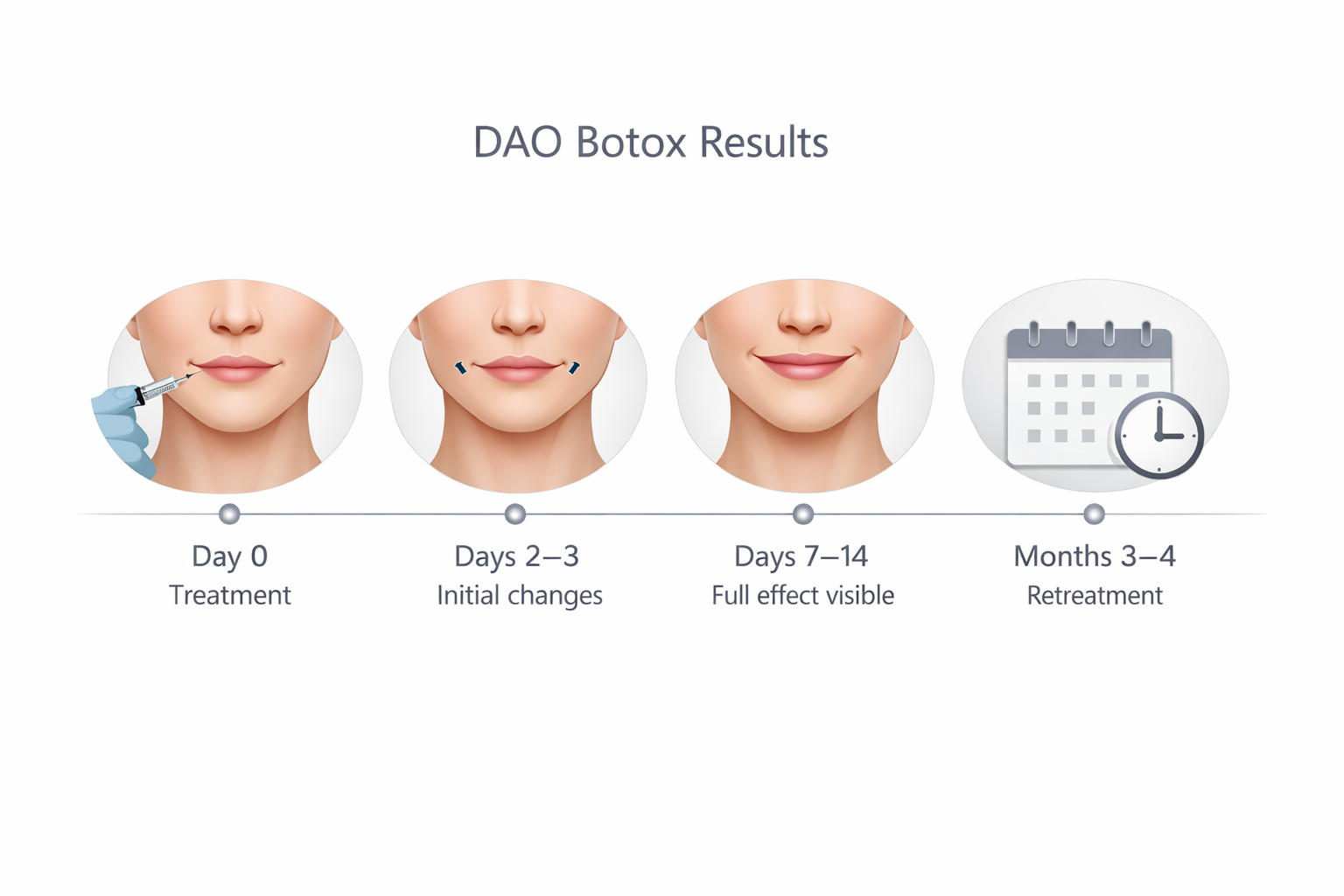
Results commonly last 3–4 months, though some patients report effects persisting for up to six months. Duration depends on factors including the dose used, individual metabolism, muscle strength, and how frequently the area is used. Patients who are very expressive or who use their perioral muscles intensively may find that results wear off more quickly.
The retreatment interval is typically every three to six months. With consistent maintenance, some patients find that the DAO muscle gradually weakens over time, potentially allowing for slightly lower doses or longer intervals between treatments — though this varies between individuals and is not guaranteed.
DAO Botox vs. Dermal Fillers: Which Approach Is Right?
DAO Botox and dermal fillers address downturned mouth corners through different mechanisms, and the right choice depends on the underlying cause of the concern.
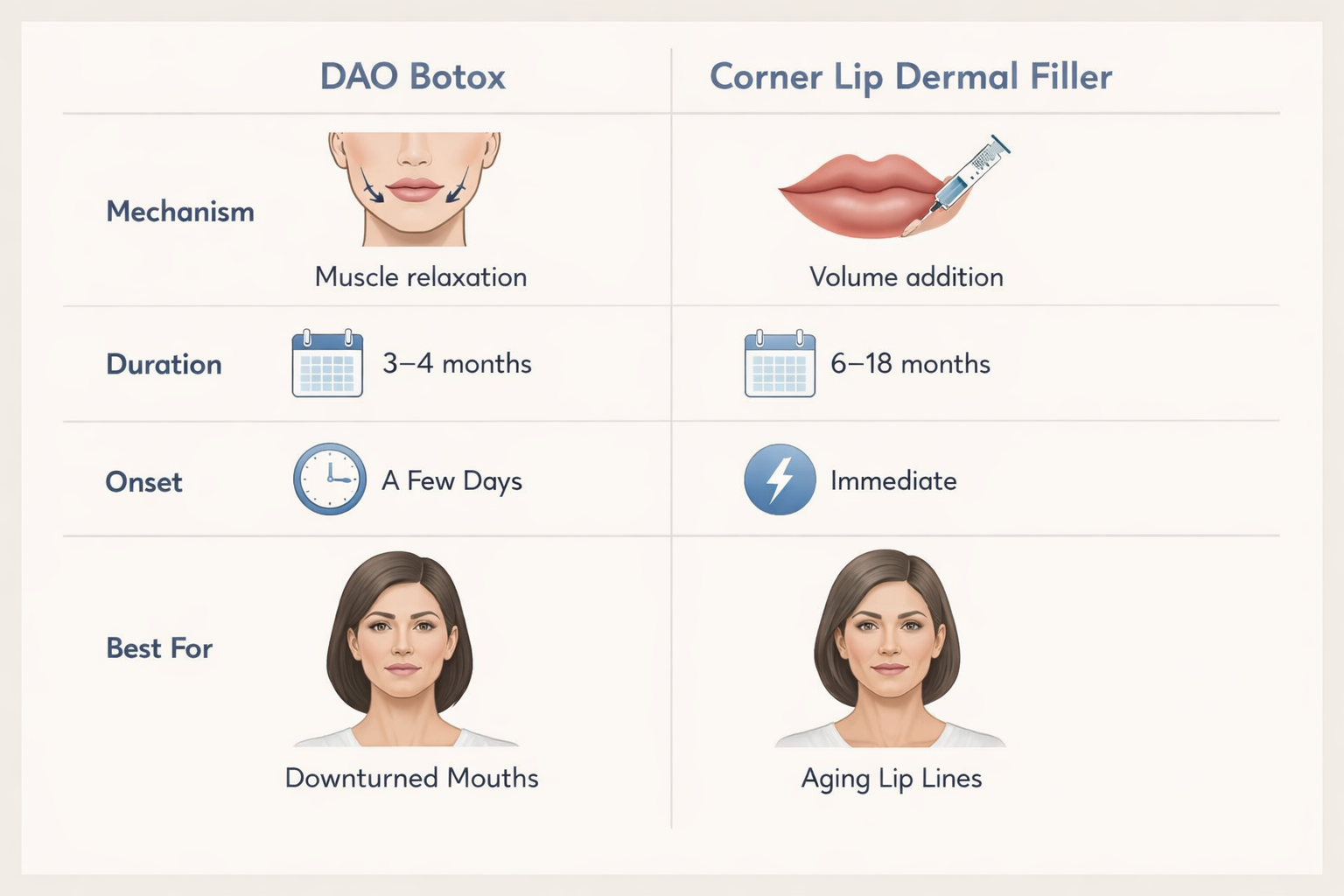
| Factor | DAO Botox | Dermal Fillers (Corner Lip / Marionette) |
|---|---|---|
| Mechanism | Relaxes the DAO muscle to reduce downward pull | Adds volume to support and lift the oral commissures or fill marionette lines |
| Best suited for | Muscle over-pull causing mild to moderate downturning | Volume loss, deep marionette lines, or structural support deficit |
| Onset | 2–14 days | Immediate (with some initial swelling) |
| Duration | 3–4 months typically | 6–18 months depending on product and area |
| Retreatment | Every 3–6 months | Every 6–18 months |
| Downtime | Minimal | Minimal to mild (bruising and swelling possible) |
| Risks | Smile asymmetry, lip asymmetry if toxin spreads | Bruising, lumpiness, vascular complications (rare but serious) |
| Combination use | Often combined with fillers for comprehensive lower face rejuvenation | Often combined with DAO Botox for muscle and volume correction |
For patients with mild downturning caused primarily by an overactive DAO muscle and good skin elasticity, DAO Botox alone may be sufficient. For patients with more significant downturning, deep marionette lines, or volume loss around the prejowl area, a combination with dermal fillers is often recommended to address both the muscular and structural components. This combination approach is a common strategy in lower face rejuvenation and can produce more comprehensive results than either treatment alone.
DAO Botox is sometimes described as a non-surgical alternative to a facelift for mild lower face concerns, though it is important to be realistic: the degree of lift achievable with botulinum toxin is modest compared with surgical intervention, and it does not address significant skin laxity or deep structural changes.
Side Effects and Risks
DAO Botox is generally well tolerated, but like all injectable treatments it carries risks that patients should understand before proceeding.
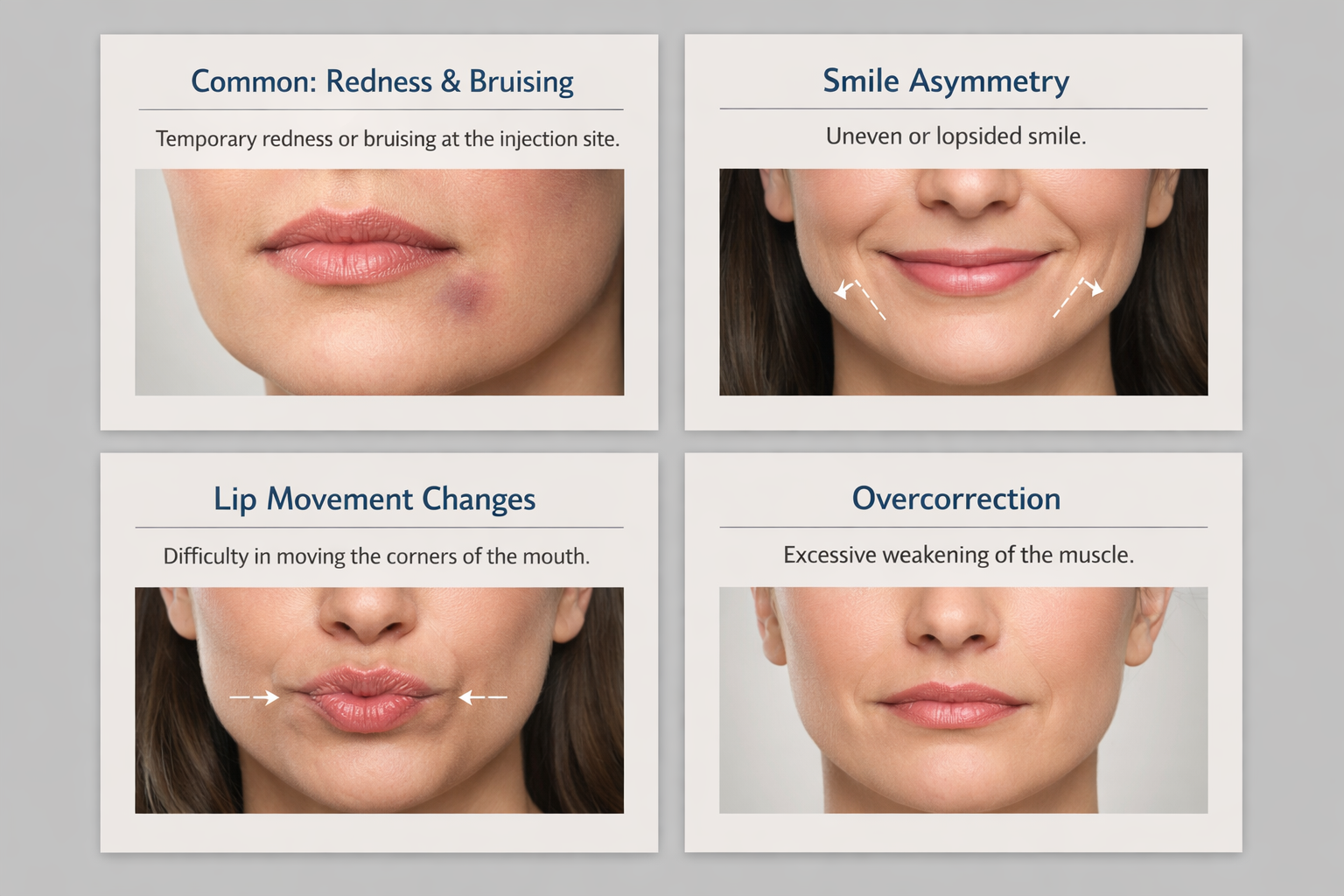
Common and expected effects:
- Mild redness, swelling, or tenderness at the injection site — these typically resolve within a few hours to a day
- Small bruises at the injection points — these usually fade within a few days and can be minimised by avoiding blood-thinning medications and supplements before treatment
Risks specific to the DAO injection site:
- Smile asymmetry: If the dose or placement differs slightly between sides, or if one side responds differently to the toxin, the mouth corners may not lift evenly. Minor asymmetry can often be corrected at a two-week review appointment.
- Lip asymmetry or altered lip movement: If botulinum toxin spreads to the depressor labii inferioris, it can temporarily affect the lower lip’s ability to move symmetrically, producing a crooked appearance when speaking or smiling.
- Difficulty eating or drinking: Spread to the orbicularis oris can temporarily reduce lip seal and control, making it harder to drink from a cup or eat certain foods. This is uncommon with conservative dosing and precise injection technique.
- Overcorrection: Too much relaxation of the DAO can produce an unnatural or frozen-looking smile. This is why conservative dosing and an experienced injector are important.
All side effects related to botulinum toxin are temporary. Because the toxin wears off over three to four months, any unwanted effects will resolve naturally within that timeframe. There is no antidote that reverses botulinum toxin effects immediately, which is why choosing a qualified and experienced practitioner is the most important safety measure a patient can take.
Aftercare Instructions
Following aftercare guidance after DAO Botox helps to minimise side effects and supports the best possible outcome. The following recommendations are commonly advised, though your practitioner may provide specific instructions tailored to your treatment.
- Do remain upright for at least four hours after treatment — avoid lying down flat during this period
- Do attend your two-week follow-up appointment so your practitioner can assess the result
- Do apply a cold compress gently to reduce any swelling or bruising, if advised by your practitioner
- Avoid rubbing, massaging, or applying pressure to the treated area for at least 24 hours
- Avoid strenuous exercise for 24 hours after treatment
- Avoid alcohol for 24 hours before and after treatment, as it increases bruising risk
- Avoid excessive heat — saunas, steam rooms, hot tubs, and sunbathing — for 24 to 48 hours
- Avoid blood-thinning medications and supplements (aspirin, ibuprofen, fish oil, vitamin E) in the days before treatment unless medically prescribed — discuss this with your practitioner in advance
The Psychological Impact of Downturned Mouth Corners
The concern that drives many patients to seek DAO Botox is not purely cosmetic — it is often deeply connected to how they feel they are perceived by others. A persistent downturned mouth at rest can cause people to be asked repeatedly whether they are tired, upset, or unhappy when they feel perfectly fine. Over time, this misreading of neutral expression can affect confidence in social interactions, professional settings, and personal relationships.
For patients whose downturning is primarily muscular in origin, DAO Botox can address this specific concern in a way that feels proportionate and natural. Many patients report that the psychological benefit of no longer projecting an unintended negative expression is as significant as the physical change itself. This is worth considering when evaluating whether the treatment is appropriate for your goals — the improvement may be subtle in photographs but meaningful in everyday life.
Frequently Asked Questions
Is DAO Botox painful?
Most patients find the injections cause only mild, brief discomfort. The needles used are very fine gauge, and the procedure is completed quickly. Topical numbing cream is available at some clinics for patients who prefer it, but it is not usually necessary.
How soon will I see results from DAO Botox?
Initial softening of the downward pull may be noticeable within 2 to 3 days. Full effects are typically visible at two weeks, once the muscle has fully relaxed. A follow-up appointment at this point allows your practitioner to assess the outcome and make any minor adjustments.
Can DAO Botox be combined with lip filler?
Yes. DAO Botox and lip or corner filler are frequently used together as part of a lower face rejuvenation plan. Botulinum toxin addresses the muscular downward pull while filler can restore volume, support the oral commissures, and soften marionette lines. Your practitioner will advise on the most appropriate combination for your anatomy and goals.
Will DAO Botox affect my smile?
When performed correctly with conservative dosing by an experienced injector, DAO Botox should not significantly alter your smile. The risk of smile asymmetry or altered lip movement exists if the toxin spreads to neighbouring muscles, but this is uncommon with precise technique and appropriate dosing. Any asymmetry that does occur is temporary.
How often will I need retreatment?
The retreatment interval for DAO Botox is typically every three to six months, depending on how long your results last. Some patients find that with consistent treatment over time, the DAO muscle gradually weakens and results may last slightly longer, though this varies between individuals.
Is DAO Botox suitable if I am a singer or musician?
Patients who rely on precise perioral muscle control for their profession — including singers, wind instrument musicians, and actors — should discuss this carefully with their practitioner before proceeding. Temporary reduction in DAO muscle strength could affect performance, and the timing of treatment relative to professional commitments should be planned accordingly.
What is the difference between DAO Botox and a surgical corner lip lift?
A surgical corner lip lift is a permanent procedure that physically removes a small amount of skin to raise the mouth corners. DAO Botox is a temporary, non-surgical treatment that works by relaxing the muscle pulling the corners down. The surgical option offers a permanent result but carries greater risk, recovery time, and cost. DAO Botox is appropriate for patients seeking a modest, reversible improvement without surgery.
Is DAO Botox the Right Treatment for Your Concerns?
DAO Botox is a well-established technique in aesthetic medicine that can produce meaningful improvement for patients whose downturned mouth corners are primarily caused by an overactive Depressor Anguli Oris muscle. The treatment is brief, requires minimal downtime, and — when performed by an experienced aesthetic practitioner with a thorough understanding of lower face anatomy — carries a manageable risk profile. The results are temporary, typically lasting 3–4 months, and maintaining them requires a consistent retreatment schedule.
The treatment is not suitable for everyone. Patients with significant skin laxity, deep volume loss, or structural changes around the lower face are unlikely to achieve satisfactory results from botulinum toxin alone and may benefit more from a combination with dermal fillers or a surgical consultation. The off-label nature of the treatment also means that practitioner selection is particularly important — this is not an area where inexperience or imprecise technique can easily be corrected.
If a persistently downturned mouth or resting sad expression is affecting your confidence and you are in good general health, DAO Botox may be a reasonable option to explore. A thorough consultation with a qualified practitioner who can assess your facial anatomy, discuss realistic outcomes, and explain the risks in the context of your individual situation is the appropriate first step before making any decision.