

Key Takeaways
- Botox for sweating works by blocking the nerve signals that trigger eccrine sweat glands, and is FDA-approved for axillary hyperhidrosis (excessive underarm sweating).
- Clinical studies report an 82–87% reduction in underarm sweating, with results typically lasting 6–12 months.
- Treatment is also used off-label for the palms, feet, forehead, and scalp, with varying duration and dosing requirements.
- Side effects are generally mild and temporary, though compensatory sweating and, for palmar treatment, temporary hand weakness are worth understanding before proceeding.
- A consultation with a board-certified dermatologist or qualified practitioner is essential to assess suitability and discuss realistic expectations.
What Is Hyperhidrosis and Why Does It Happen?
Hyperhidrosis is a medical condition characterised by sweating that exceeds what the body needs for thermoregulation. In people without the condition, sweating is a normal physiological response to heat, exercise, or emotional stress. In hyperhidrosis, the eccrine sweat glands — the most numerous type of sweat gland in the body — are overactive, producing sweat in amounts that can interfere significantly with daily life, clothing choices, professional confidence, and social interactions.
Primary focal hyperhidrosis is the most common form. It affects specific body areas — most often the underarms, palms, soles of the feet, or face — and occurs without an underlying medical cause. It tends to run in families and is thought to involve dysregulation of the cholinergic sympathetic nerves that control sweat gland activity. Secondary generalised hyperhidrosis, by contrast, is caused by an underlying condition such as a thyroid disorder, diabetes, or a medication side effect, and typically affects the body more diffusely. Botox treatment is most appropriate for primary focal hyperhidrosis; secondary hyperhidrosis requires investigation and management of the underlying cause.
The psychosocial impact of hyperhidrosis is frequently underestimated. Peer-reviewed research using validated tools such as the Dermatology Life Quality Index (DLQI) and the Hyperhidrosis Disease Severity Scale (HDSS) consistently demonstrates that the condition significantly affects quality of life, including work performance, personal relationships, and emotional wellbeing. Many patients report avoiding handshakes, wearing only dark or patterned clothing, and limiting physical activity — not because of the sweating itself, but because of the anxiety it generates.
How Does Botox for Sweating Work?
Botox is a brand name for a purified form of botulinum toxin — specifically onabotulinumtoxinA — that has been used in medicine for several decades. When injected into the skin above overactive sweat glands, it temporarily blocks the release of acetylcholine, the neurotransmitter responsible for activating eccrine sweat glands. Without this chemical signal, the glands cannot be stimulated to produce sweat, regardless of heat, stress, or physical exertion.
This mechanism is distinct from how Botox works in cosmetic applications such as wrinkle reduction, where it relaxes facial muscles. Sweat glands appear to be more susceptible to botulinum toxin than muscle tissue, which is one reason results for hyperhidrosis tend to last considerably longer than results for expression lines — often 6 to 12 months in the underarms compared with 3 to 4 months for cosmetic muscle relaxation.
Importantly, Botox for sweating does not destroy sweat glands or permanently alter thermoregulation. The body retains its ability to regulate temperature through the many other sweat glands distributed across the skin surface. The treated area simply stops contributing to sweat output for the duration of the effect.
Which Areas Can Be Treated?
Botulinum toxin injections for sweating are FDA-approved specifically for axillary hyperhidrosis — excessive underarm sweating — in adults. This approval, granted in 2004, is supported by robust clinical trial data and makes underarm treatment the most evidence-backed application.
Several other areas are treated as an off-label treatment, meaning the use is not covered by the original regulatory approval but is supported by clinical evidence and widely practised by qualified practitioners:
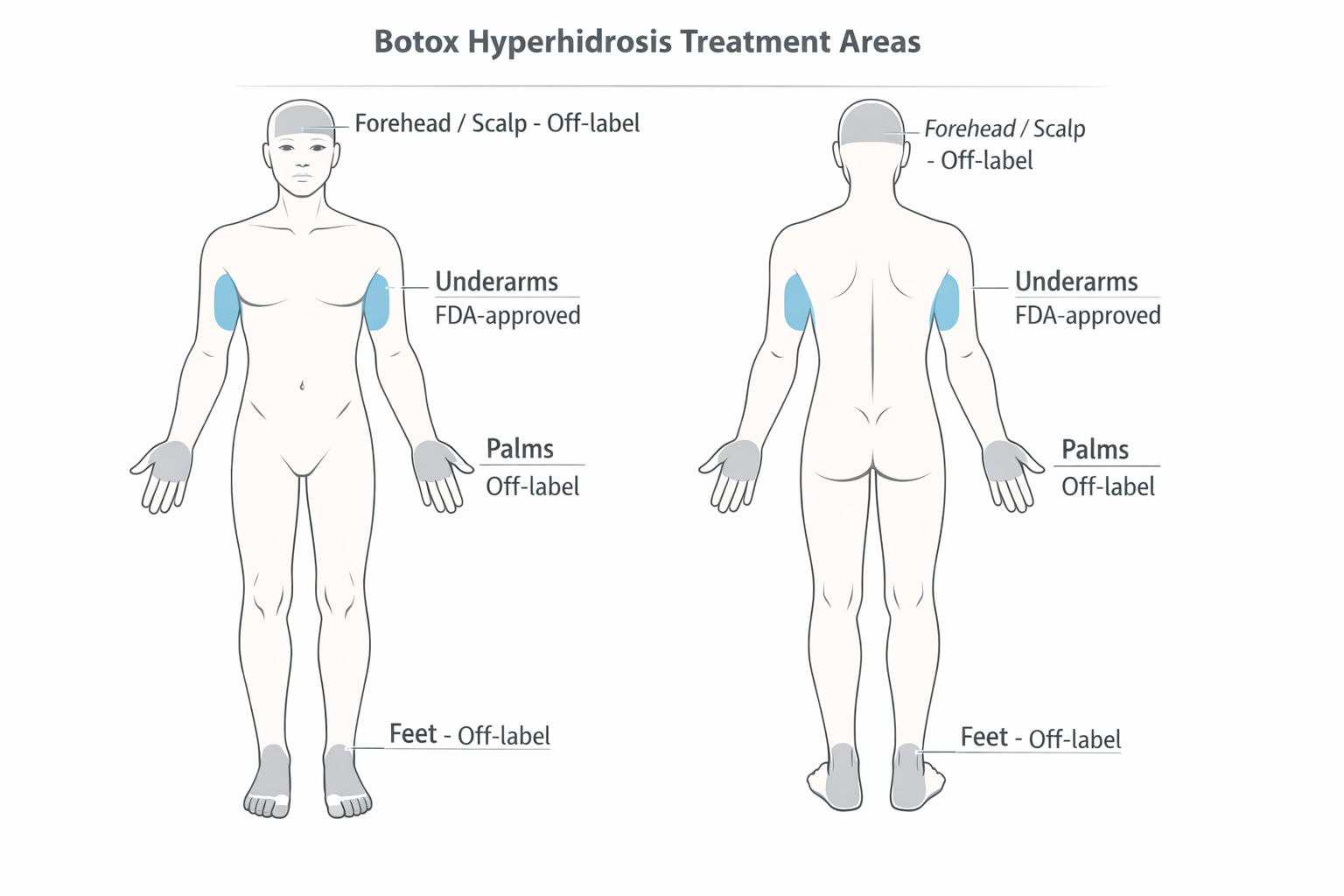
- Palmar hyperhidrosis (hands and palms): One of the most common off-label uses. Effective, but requires higher doses and may cause temporary weakness or reduced grip strength in some patients due to the proximity of small hand muscles.
- Plantar hyperhidrosis (feet and soles): Also off-label. The soles are densely innervated, making the procedure more uncomfortable than underarm treatment. Topical numbing or nerve blocks are often used.
- Craniofacial hyperhidrosis (forehead, scalp, upper lip): Off-label and requires particular expertise, as injections near the face carry a higher risk of unintended effects on nearby muscles if placement is not precise.
- Groin and under-breast areas: Less commonly treated; off-label with more limited published evidence.
| Treatment Area | FDA Status | Typical Duration | Key Consideration |
|---|---|---|---|
| Underarms (axillary) | FDA-approved | 6–12 months | Best-evidenced area; most comfortable |
| Palms (palmar) | Off-label | 4–6 months | Higher dose needed; possible temporary grip weakness |
| Feet/soles (plantar) | Off-label | 4–6 months | More discomfort; numbing usually required |
| Forehead/scalp/face | Off-label | 3–6 months | Expert placement essential to avoid muscle effects |
What Happens During the Procedure?
Botox for sweating is a minimally invasive, outpatient procedure that typically takes between 20 and 45 minutes depending on the area being treated. Here is what the process generally involves:
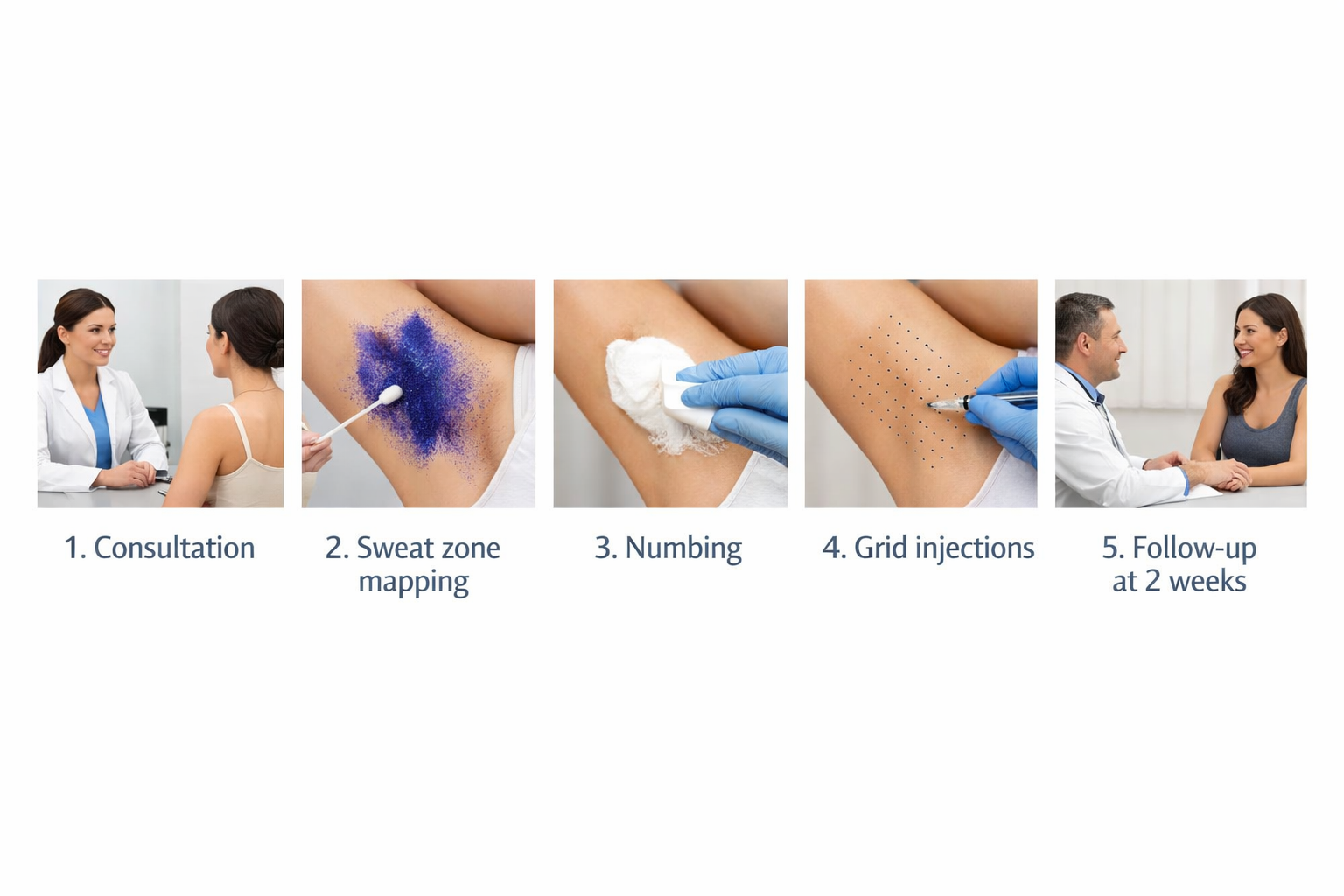
- Consultation and assessment: A qualified practitioner reviews your medical history, current medications, and the severity of your sweating. The HDSS may be used to quantify how much the condition affects your daily life. This is also the point at which suitability, realistic expectations, and treatment costs are discussed.
- Mapping the sweat zone: Some practitioners use a starch-iodine test (also known as Minor’s test) to identify the precise areas of most active sweating. Iodine solution is applied to the skin, followed by starch powder; areas of active sweating turn dark blue or purple, allowing the practitioner to target injections accurately.
- Skin preparation and numbing: The treatment area is cleaned. For underarm treatment, discomfort is usually mild and a topical numbing cream or ice may be applied. For palmar or plantar treatment, a nerve block is more commonly used given the higher density of nerve endings in the hands and feet.
- Injections: Botulinum toxin is injected in a grid pattern across the treatment area, with injection points typically spaced 1–2 cm apart. Underarm treatment usually involves approximately 15–20 injection points per side.
- Aftercare advice and follow-up: Post-treatment instructions are provided. A follow-up appointment at around two weeks allows the practitioner to assess the result and treat any areas where sweating persists.
How Long Do Results Last?
For axillary hyperhidrosis, most patients notice a reduction in sweating within 2 to 4 days of treatment, with the full effect typically established by two weeks. Results in the underarms commonly last between 6 and 12 months, which is notably longer than the 3 to 4 months typically seen with cosmetic Botox for facial lines. This difference is thought to reflect the greater sensitivity of eccrine sweat glands to botulinum toxin compared with skeletal muscle.
Clinical studies report an 82–87% reduction in sweating in the underarms following treatment, with high patient satisfaction rates. Results for palmar and plantar hyperhidrosis tend to be shorter — typically 4 to 6 months — partly because the hands and feet are subject to greater mechanical activity and may metabolise the toxin more quickly.
An observation worth noting, though not yet fully established in large-scale trials, is that some patients who undergo repeat treatments every 4–6 months over several years report that the intervals between treatments gradually lengthen. This may reflect a reduction in sweat gland activity over time with repeated botulinum toxin exposure, though individual responses vary and a practitioner cannot guarantee this outcome.
Side Effects and Risks
Botox for sweating has a well-established safety profile when administered by a qualified practitioner, but side effects and risks are real and should be understood before treatment.
Common and generally mild effects include temporary pain, redness, swelling, or bruising at injection sites. These typically resolve within a few days. Some patients experience a brief flu-like feeling or mild headache following treatment, though this is uncommon.
Compensatory sweating is a side effect that deserves specific attention. When sweating is suppressed in one area, the body may increase sweat output elsewhere — most commonly the back, chest, or thighs — as a compensatory response. This is more commonly reported after extensive treatments and is generally mild, but patients with a tendency toward generalised sweating should discuss this possibility with their practitioner beforehand.
Temporary hand weakness or reduced grip strength can occur following palmar hyperhidrosis treatment, because the small muscles of the hand lie close to the sweat glands being targeted. This effect is temporary and resolves as the botulinum toxin wears off, but it may be inconvenient for patients whose work or daily activities require fine motor control.
Contraindications include known allergy to botulinum toxin or any product ingredient, active infection at the planned injection site, neuromuscular disorders such as myasthenia gravis or Lambert-Eaton syndrome, and pregnancy or breastfeeding. Certain medications — including aminoglycoside antibiotics and some muscle relaxants — may interact with botulinum toxin and should be disclosed during consultation.
Who May Be a Suitable Candidate?
Botox for hyperhidrosis may be worth discussing with a qualified practitioner if you:
- Have been diagnosed with, or strongly suspect you have, primary focal hyperhidrosis affecting the underarms, hands, feet, or face
- Have already tried prescription-strength antiperspirants containing aluminium chloride without achieving adequate control
- Are in good general health with no neuromuscular conditions
- Are not pregnant or breastfeeding
- Have realistic expectations about the temporary nature of results and the need for maintenance treatments
- Understand that Botox addresses sweat production but does not eliminate body odour — odour is produced by apocrine glands, which are not the primary target of this treatment
Patients whose sweating is secondary to an underlying medical condition are generally not suitable candidates until that condition has been investigated and managed appropriately.
Botox for Sweating vs. Other Treatments
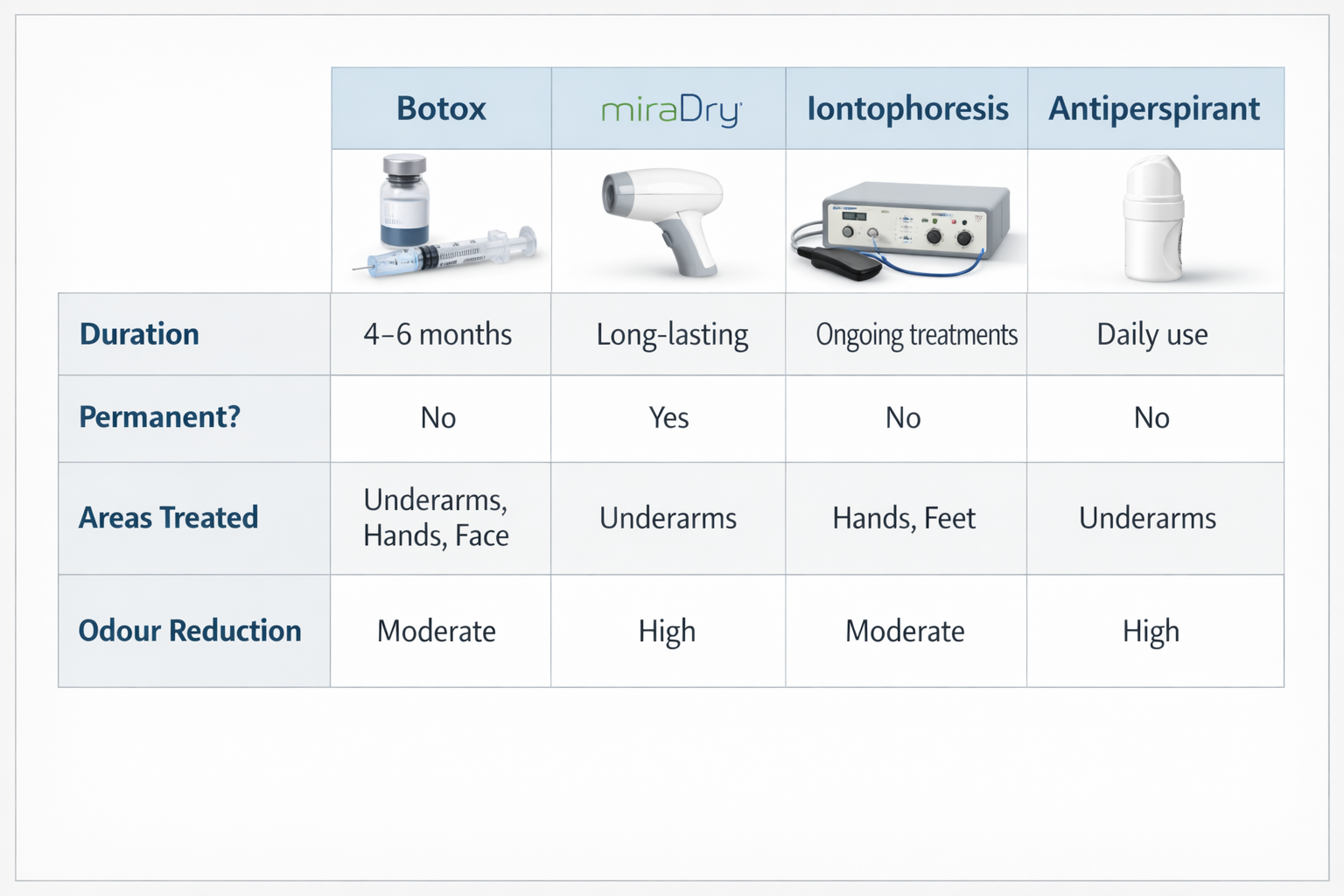
Botox is one of several options for managing hyperhidrosis. Understanding where it sits relative to alternatives helps in making an informed decision.
| Treatment | Mechanism | Areas Treated | Duration | Permanence | Key Limitation |
|---|---|---|---|---|---|
| Botox (botulinum toxin) | Blocks acetylcholine at sweat glands | Underarms, hands, feet, face | 4–12 months | No — repeat treatments needed | Ongoing cost; temporary |
| Prescription antiperspirant (aluminium chloride) | Physically blocks sweat ducts | Underarms, hands, feet | Days to weeks | No | Skin irritation; less effective in severe cases |
| Iontophoresis | Electrical current reduces gland activity | Hands, feet | Weeks (requires regular sessions) | No | Time-intensive; not suitable for underarms |
| miraDry | Microwave thermolysis destroys sweat glands | Underarms only | Permanent | Yes | Also reduces odour glands; higher upfront cost; not suitable for other areas |
| Oral anticholinergics (e.g., glycopyrrolate, oxybutynin) | Systemic blockade of acetylcholine | Whole body | While taking medication | No | Systemic side effects: dry mouth, blurred vision, urinary retention |
| ETS surgery | Cuts sympathetic nerves | Hands, underarms | Permanent | Yes | Significant compensatory sweating risk; last resort only |
One distinction worth making clearly: miraDry permanently reduces both sweat and odour in the underarms by destroying both eccrine and apocrine glands using microwave energy. Botox, by contrast, temporarily suppresses sweat production but does not affect odour-producing apocrine glands. For patients whose primary concern includes body odour alongside sweating, this difference is clinically meaningful and should be part of the treatment discussion.
Cost and Insurance Considerations
The cost of Botox for sweating varies depending on the treatment area, the number of units required, the practitioner’s experience, and the clinic’s location. Underarm treatment for both sides typically ranges from approximately $800 to $1,500 per session in the United States, with palmar and plantar treatments often at the higher end due to the greater number of units required.
In some countries and under certain insurance plans, Botox for axillary hyperhidrosis may be partially or fully covered, given its FDA-approved status for this indication. Securing coverage typically requires demonstrating that conservative treatments — particularly prescription-strength antiperspirants — have been tried and have failed to provide adequate relief. This process, known as prior authorisation, usually involves documentation from a physician confirming the diagnosis and the failure of first-line treatments. Patients pursuing insurance coverage should ask their practitioner to provide a formal diagnosis code and a letter of medical necessity, and should contact their insurer directly to understand the specific documentation requirements before the appointment.
For patients paying out of pocket, the ongoing cost of repeat treatments every 4–6 months is a meaningful consideration. Over several years, this may compare unfavourably with a one-time procedure such as miraDry for underarm sweating, though miraDry is not available for other body areas and carries its own cost and recovery considerations.
Aftercare: What to Do After Treatment
Following botulinum toxin injections for sweating, most patients can return to their normal routine the same day. The procedure involves no significant downtime, though a few straightforward aftercare steps help protect the result and minimise the risk of side effects:
- Avoid strenuous exercise and excessive heat (saunas, hot baths) for 24 hours after treatment, as these can increase blood flow to the area and potentially affect how the toxin settles.
- Avoid applying deodorant, antiperspirant, or perfumed products to the treated area for at least 24 hours.
- Do not rub or massage the treated area in the hours immediately following treatment.
- Attend your follow-up appointment at approximately two weeks. This allows the practitioner to assess the full result and administer touch-up injections to any areas where sweating persists.
Results are not immediate — the onset of sweat reduction typically begins within 2 to 4 days, with the full effect apparent at around two weeks. Patients should not judge the outcome before this point.
Questions to Ask Your Practitioner
Before proceeding with Botox for sweating, a well-prepared consultation will help you make a confident, informed decision. Consider asking:
- Are you a board-certified dermatologist or appropriately qualified practitioner with specific experience in hyperhidrosis treatment?
- How many units of botulinum toxin do you typically use for my treatment area, and how do you determine the dose?
- Will you use a starch-iodine test to map my sweat zones before injecting?
- What is your follow-up protocol if the initial treatment does not achieve adequate coverage?
- Can you assist with insurance documentation or prior authorisation if I wish to pursue coverage?
- What are the realistic expectations for how long my results will last, given my specific situation?
- Are there any aspects of my medical history that might affect my suitability or the outcome?
Frequently Asked Questions
How is Botox for sweating different from cosmetic Botox?
Both use botulinum toxin, but the mechanism and target differ. Cosmetic Botox relaxes facial muscles to soften expression lines and typically lasts 3 to 4 months. Botox for sweating blocks the nerve signals that activate eccrine sweat glands and tends to last considerably longer — often 6 to 12 months in the underarms — because sweat glands appear more sensitive to the toxin than muscle tissue.
Does Botox for sweating also reduce body odour?
No. Body odour is primarily produced by apocrine glands, which are a different type of gland from the eccrine sweat glands targeted by botulinum toxin. Botox suppresses eccrine sweat production but does not affect apocrine gland activity. Patients whose primary concern includes odour alongside sweating may wish to discuss miraDry, which targets both gland types in the underarms.
Is the treatment painful?
Underarm treatment is generally well tolerated with mild discomfort. Palmar and plantar treatments involve more sensitive areas and are more uncomfortable; nerve blocks or stronger topical anaesthesia are commonly used for these sites. Most patients find the procedure manageable, and it is completed within 20 to 45 minutes.
What is compensatory sweating and how likely is it?
Compensatory sweating refers to increased perspiration in untreated areas of the body — such as the back, chest, or thighs — that may occur when sweating is suppressed in a treated area. It is more commonly associated with surgical procedures such as endoscopic thoracic sympathectomy than with Botox, but it can occur. The risk appears to be low with localised botulinum toxin treatment, though patients with a tendency toward widespread sweating should discuss this with their practitioner.
How many treatments will I need?
Most patients require a single treatment session per area, followed by a two-week review to address any missed spots. Maintenance injections are then needed every 4 to 12 months depending on the area and individual response. Some patients find that with repeated treatments over time, the intervals between sessions gradually lengthen.
Can Botox cure hyperhidrosis permanently?
Botox does not permanently cure hyperhidrosis. It provides temporary suppression of sweat gland activity, and sweating returns as the botulinum toxin gradually wears off. Permanent options for underarm sweating include miraDry and, as a last resort, surgical sympathectomy. For hands and feet, no widely available permanent treatment currently exists.
Is Botox for sweating safe for long-term use?
Botulinum toxin injections for hyperhidrosis have been used clinically for over two decades and have a well-established safety record when administered by qualified practitioners. Long-term use does not appear to cause cumulative harm to sweat glands or surrounding tissue, and some evidence suggests that repeated treatments may gradually reduce the frequency needed. Individual suitability should be reviewed at each treatment cycle.
Is Botox for Sweating Worth Considering?
For people living with primary focal hyperhidrosis that has not responded adequately to prescription-strength antiperspirants, Botox for sweating represents a well-evidenced, clinically established option with a meaningful impact on quality of life. The 82–87% reduction in underarm sweating reported in clinical studies, combined with a duration of 6 to 12 months per treatment cycle, makes it one of the most effective non-surgical interventions currently available for this condition.
The treatment is not without limitations. Results are temporary, repeat treatments are required, and the ongoing cost is a genuine consideration — particularly when compared with a one-time procedure such as miraDry for underarm sweating. Off-label applications for the hands, feet, and face are supported by clinical experience but carry area-specific risks that require careful discussion with a qualified practitioner. Compensatory sweating, while generally mild with localised treatment, is a real possibility that should be understood in advance.
The decision is most straightforward for patients with axillary hyperhidrosis who have already tried and found prescription antiperspirants insufficient. For other areas, the balance of evidence, comfort, and duration of results varies, and a thorough consultation is essential. If you are considering treatment, seeking assessment from a board-certified dermatologist or a practitioner with specific experience in hyperhidrosis management will give you the most accurate picture of whether Botox for sweating is likely to be appropriate for your situation.