

Key Takeaways
- A lip flip using botulinum toxin type A typically lasts between 6 weeks and 5 months, with 2 to 3 months being the most common duration for first-time patients.
- The orbicularis oris muscle — the most active muscle in the face — breaks down the neuromodulator faster than other treatment areas, which is why lip flip results fade more quickly than forehead Botox.
- Individual metabolism, muscle activity, dosage, and injector technique all influence how long results last.
- Repeat treatments may gradually extend duration as the muscle adapts over time.
- A lip flip produces a subtle enhancement without adding volume; lip filler is the appropriate choice when visible fullness is the goal.
What Is a Lip Flip and How Does It Work?
A lip flip is a non-surgical lip augmentation technique that uses small amounts of botulinum toxin type A — most commonly Botox, though Dysport or Xeomin may also be used — injected into the orbicularis oris muscle around the upper lip. Rather than adding volume, the treatment works by partially relaxing the muscle fibres that cause the upper lip to curl inward. This relaxation allows the lip to evert slightly — rolling gently outward — which makes the vermillion border more visible and creates the appearance of a fuller, more defined upper lip without any filler.
The injection points are typically placed along the cupid’s bow and at the corners of the mouth. A 2025 systematic review published on PubMed confirmed that 4 to 6 units of botulinum toxin into the orbicularis oris produces consistent upper lip eversion with a favourable safety profile and high patient satisfaction. Because the mechanism relies entirely on muscle relaxation rather than physical volume, the results are subtle by design — a natural-looking lift rather than a dramatic change in lip shape.
The lip flip is also used to address a gummy smile, where excessive gingival display occurs when smiling. In this context, the injection placement targets the muscle activity that elevates the upper lip too far, reducing how much gum is visible. The treatment approach is similar but the precise injection points differ slightly, and a thorough assessment by a qualified practitioner is essential to determine the correct technique for each individual.
How Long Does a Lip Flip Last?
Lip flip results typically last between 6 weeks and 5 months, with most patients experiencing noticeable effects for approximately 2 to 3 months. Some patients — particularly those who have had consistent repeat treatments — may find results persist closer to 4 months. The wide range reflects genuine individual variation rather than inconsistency in the treatment itself.
The primary reason a lip flip fades faster than Botox in other areas is the extraordinary activity level of the orbicularis oris muscle. This muscle is engaged constantly throughout the day — during speaking, eating, drinking, and facial expression — which accelerates the breakdown of the neuromodulator compared with less-active muscles such as those in the forehead or around the eyes. This is not a flaw in the treatment; it is simply the physiological reality of treating the most-used facial muscle.
First-time patients tend to sit at the shorter end of the duration range. With consistent repeat treatments, many patients report that results gradually last a little longer, likely because the muscle becomes progressively less dominant over time. This is sometimes described informally as the muscle being “trained,” though the precise mechanism is not fully established in the clinical literature.
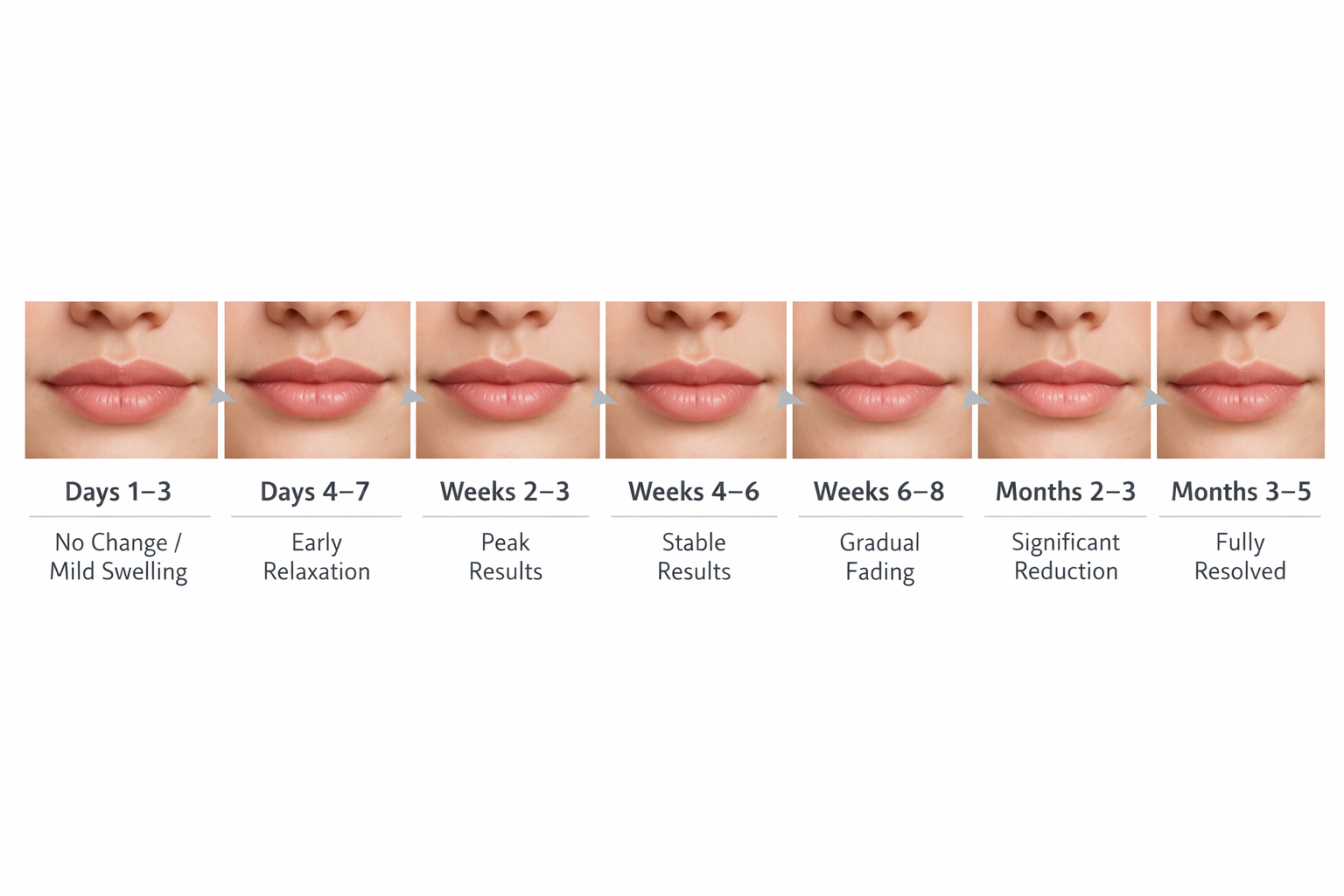
Lip Flip Results Timeline: Week by Week
Understanding the lip flip results timeline helps set realistic expectations and makes it easier to plan maintenance appointments effectively.
| Timeframe | What to Expect |
|---|---|
| Days 1–3 | Mild swelling or redness at injection sites is common. No visible lip change yet — botulinum toxin takes time to bind to nerve receptors. |
| Days 4–7 | Early relaxation of the orbicularis oris begins. Some patients notice a subtle softening of the upper lip border. |
| Weeks 2–3 | Peak results become visible. The upper lip everts more noticeably, the vermillion border appears more defined, and the cupid’s bow looks more prominent. |
| Weeks 4–6 | Results are at their most stable. This is typically the optimal window for photographs and events. |
| Weeks 6–8 | Gradual fading begins as the neuromodulator is metabolised and muscle activity slowly returns. |
| Months 2–3 | Most first-time patients notice a significant reduction in effect. Booking a touch-up appointment before full muscle movement returns is advisable. |
| Months 3–5 | Results have typically resolved completely. The lip returns to its natural appearance — no permanent change occurs. |
Scheduling a touch-up appointment before the effect has fully worn off — rather than waiting until the lip has completely returned to baseline — can help maintain continuity of results and may make it easier for the practitioner to assess the optimal dosage for subsequent treatments.
What Factors Affect How Long a Lip Flip Lasts?
Several variables influence how long Botox lasts in the lips, and understanding them helps explain why two patients treated on the same day with the same product may have noticeably different experiences.
- Individual metabolism: People who metabolise substances quickly — including those with a faster general metabolic rate — tend to break down botulinum toxin more rapidly. This is one of the most significant and least controllable factors.
- Muscle activity level: High levels of orbicularis oris activity — from frequent talking, singing, playing wind instruments, or similar habits — accelerate the breakdown of the neuromodulator. The more the muscle works, the faster the product is cleared.
- Exercise frequency: High-intensity exercise increases circulation and metabolic rate, which may shorten the duration of results. Patients who train intensively several times per week sometimes notice their results fade more quickly.
- Dosage used: The number of units injected influences both the degree of muscle relaxation and how long the effect persists. Too few units may produce a shorter-lived result; the appropriate dose should be determined by a qualified practitioner based on individual anatomy and goals.
- Injector skill and technique: Precise placement of the neuromodulator into the correct muscle fibres affects both the quality and the longevity of results. Experienced injectors who understand perioral neuromodulation are better positioned to achieve consistent, lasting outcomes.
- First-time versus repeat patient status: As noted above, first-time patients typically experience results at the shorter end of the range. Consistent repeat treatments over time may gradually extend duration.
- Sun exposure: Chronic UV exposure may accelerate the breakdown of botulinum toxin and degrade skin quality more broadly. Using SPF lip balm and avoiding prolonged sun exposure supports both skin health and treatment longevity.
Lip Flip vs Lip Filler: Key Differences
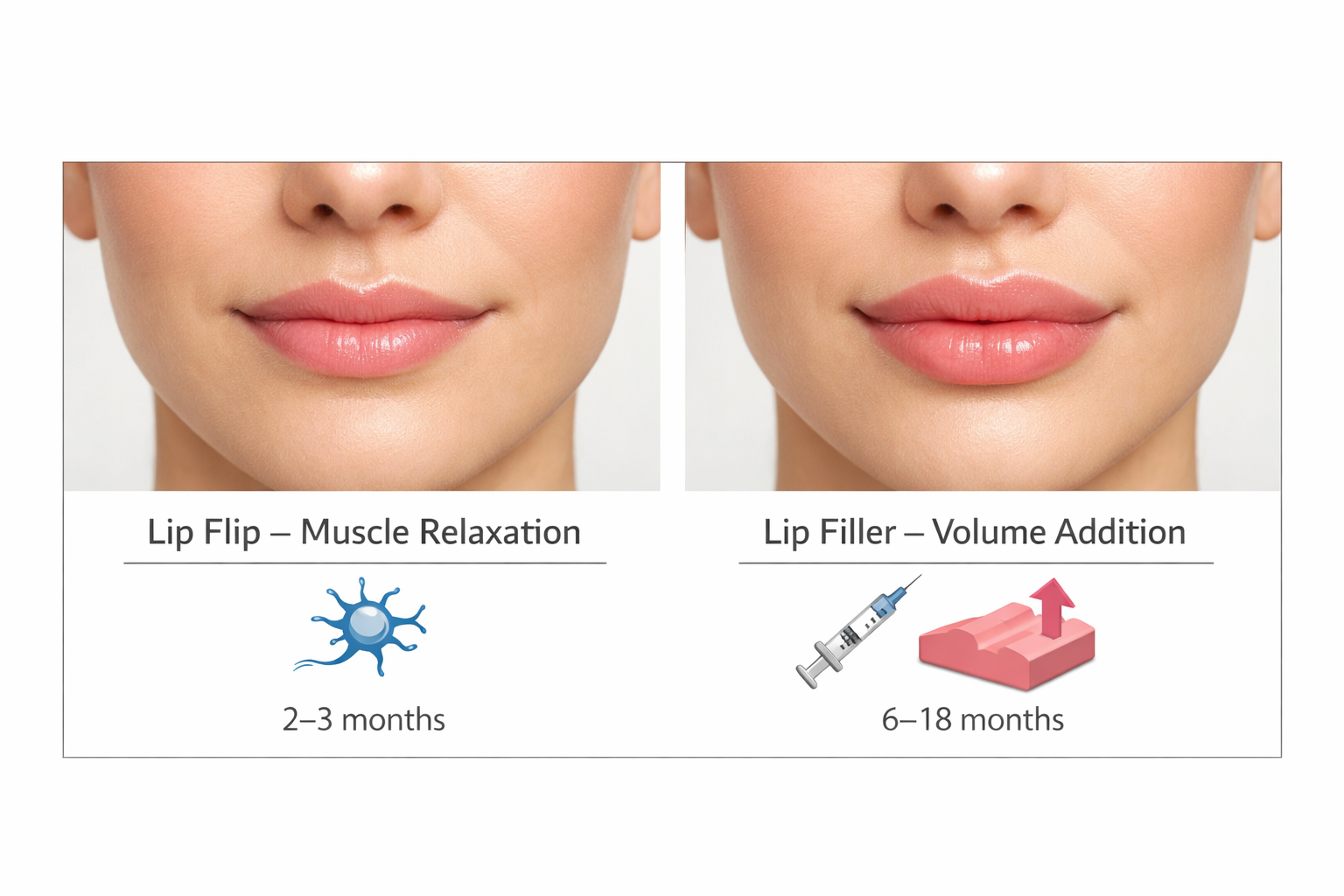
The lip flip and lip filler are frequently compared because both address the appearance of the upper lip, but they work through entirely different mechanisms and suit different goals. Understanding the distinction is important before deciding which treatment — or combination — may be appropriate.
| Characteristic | Lip Flip | Lip Filler |
|---|---|---|
| Mechanism | Muscle relaxation (orbicularis oris eversion) | Volume addition via hyaluronic acid gel |
| Result type | Subtle enhancement, improved definition | Visible volume increase, shape change |
| Duration | 6 weeks to 5 months (typically 2–3 months) | 6 to 18 months depending on product and patient |
| Units / amount | Approximately 4–6 units of botulinum toxin | 0.5–2 ml of hyaluronic acid (e.g. Juvederm, Restylane, Volbella) |
| Reversibility | Not reversible; fades naturally over time | Can be dissolved with hyaluronidase enzyme |
| Downtime | Minimal; mild swelling or bruising possible | Moderate; swelling and bruising more common |
| Ideal candidate | Wants subtle definition, not ready for filler, gummy smile concern | Wants visible volume, longer-lasting result |
| Can be combined? | Yes — often used alongside filler | Yes — filler can be complemented by a lip flip |
The lip flip does not add volume. If a patient’s primary goal is a noticeably fuller lip, lip filler using a hyaluronic acid product such as Juvederm Volbella or Restylane is the more appropriate option. The lip flip is better suited to patients who want improved definition of the vermillion border, a more visible upper lip when smiling, or correction of a gummy smile — without committing to the volume and longer duration of filler.
Combining both treatments is a well-established approach. A small amount of filler adds volume while the lip flip enhances the shape and eversion of the upper lip, often producing a more natural-looking result than either treatment alone. When combining, the practitioner will typically account for the different durations of each product when planning maintenance schedules.
Could a Different Neuromodulator Last Longer?
Most lip flips are performed with Botox (onabotulinumtoxinA), but alternative neuromodulators are available and may suit certain patients. Dysport (abobotulinumtoxinA) and Xeomin (incobotulinumtoxinA) are established alternatives with broadly similar duration profiles, though individual responses vary and units between brands are not directly interchangeable.
Daxxify (daxibotulinumtoxinA-lanm) is a newer neuromodulator that has attracted interest for its potentially longer duration — clinical data for facial aesthetic use suggests effects may last longer than conventional botulinum toxin products in some patients. A Daxxify lip flip is an emerging option that some practitioners are beginning to offer, though clinical experience in the perioral area is still developing and it may not yet be widely available. Patients interested in a longer-lasting lip flip result may wish to ask their practitioner whether Daxxify is an appropriate and available option for them.
Lip Flip Aftercare: How to Help Results Last Longer
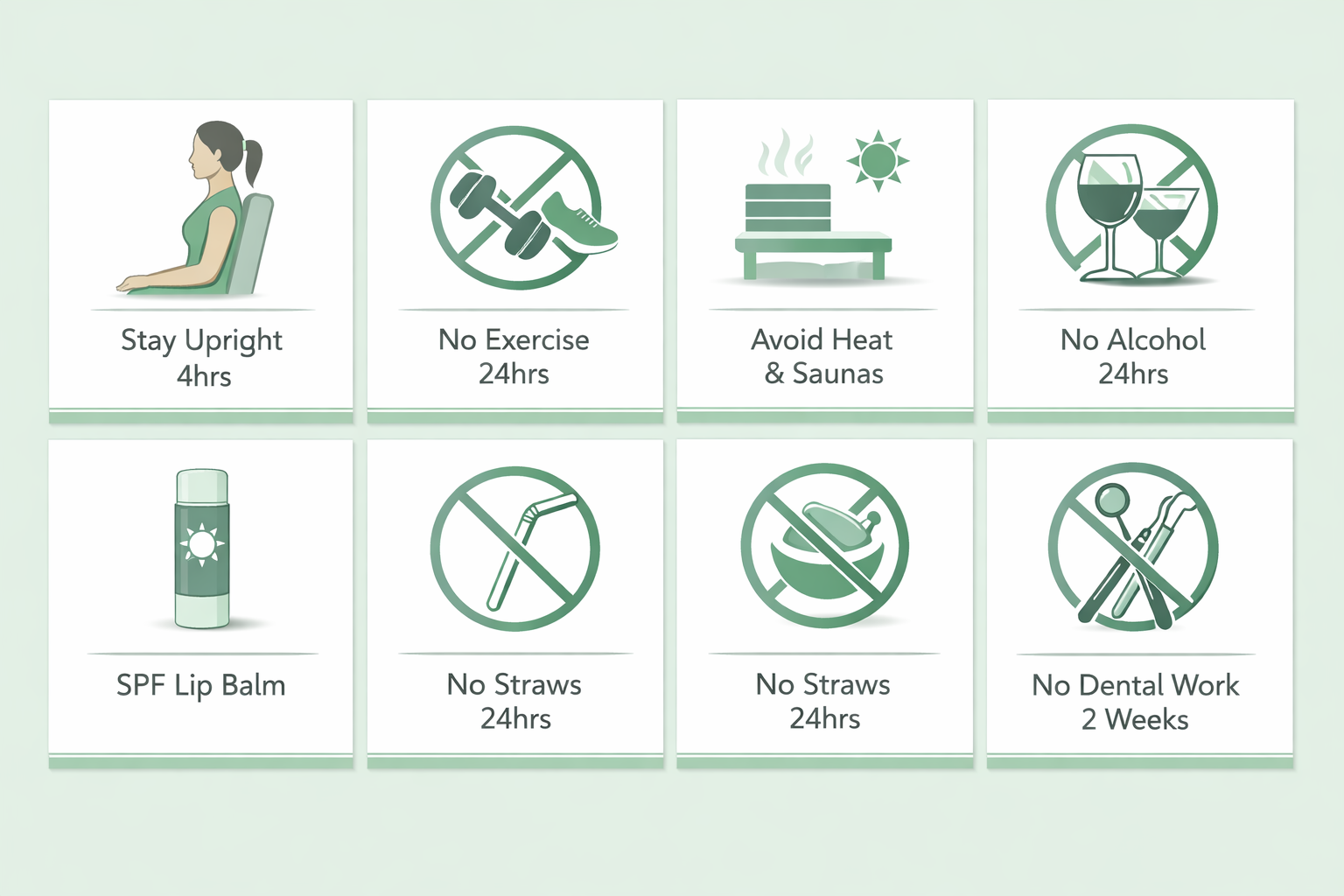
Lip flip aftercare in the first 24 to 48 hours focuses on allowing the botulinum toxin to settle without disruption. Following these guidelines will not dramatically extend the biological duration of the product, but avoiding certain activities reduces the risk of the neuromodulator migrating to unintended muscle groups and helps protect the quality of the result.
- Remain upright for at least 4 hours after treatment — avoid lying face down.
- Do not touch, rub, or massage the treated area for 24 to 48 hours.
- Avoid strenuous exercise for 24 hours post-treatment, as increased circulation may affect product distribution.
- Avoid saunas, steam rooms, hot baths, and tanning beds for 24 to 48 hours.
- Avoid alcohol for 24 hours, as it may increase bruising risk.
- Avoid using a straw or making exaggerated puckering movements in the first 24 hours.
- Avoid very hot or spicy foods immediately after treatment.
- Do not schedule dental work within 2 weeks of treatment, as mouth manipulation may affect results.
- Use SPF lip balm consistently — UV exposure can degrade skin quality and may contribute to faster breakdown of the product over time.
- Stay well hydrated and maintain general skin health to support the perioral area between treatments.
For patients concerned about maximising longevity, the most effective strategy is consistent scheduling — booking a touch-up appointment before the effect has fully resolved, rather than waiting until the lip has returned completely to baseline. Over time, this approach may contribute to a gradual extension of results as the orbicularis oris muscle becomes less dominant.
Planning Around Events
Because peak results appear approximately 10 to 14 days after treatment, patients planning a lip flip ahead of a specific event — a wedding, photoshoot, or similar occasion — should book their appointment at least two weeks in advance. Booking too close to the event risks attending before the full effect has developed, or with residual swelling still present.
It is equally important to avoid scheduling dental procedures within two weeks after a lip flip, as the manipulation involved in dental work can affect the position of the neuromodulator and potentially alter results. Informing your dentist that you have recently had perioral injections is advisable.
Side Effects and Risks
A lip flip is a minimally invasive procedure with a well-established safety profile when performed by a qualified and experienced practitioner. However, as with any injectable treatment, side effects and risks exist and should be understood before proceeding.
Common and expected effects include mild swelling, redness, and tenderness at the injection sites, which typically resolve within 24 to 48 hours. Bruising is possible, particularly in patients taking blood-thinning medications or supplements such as aspirin, ibuprofen, or fish oil.
Functional side effects are specific to the perioral area and relate to the muscle relaxation that makes the treatment work. Some patients temporarily experience difficulty drinking through a straw, slight changes in speech articulation, or reduced ability to whistle. These effects are temporary and resolve as the neuromodulator wears off, but they can be inconvenient and should be discussed with the practitioner beforehand.
Asymmetry can occur if the product distributes unevenly or if the patient’s baseline anatomy is asymmetric. An experienced injector will assess facial symmetry before treatment and adjust technique accordingly.
Spread to adjacent muscles is a risk if the product migrates beyond the intended injection site, potentially causing unintended weakness in nearby perioral muscles. This risk is minimised by precise technique and appropriate dosing.
Serious complications such as infection or systemic effects from botulinum toxin are extremely rare when the treatment is performed in a clinical setting using licensed products. The lip flip result is not reversible in the way that hyaluronic acid filler can be dissolved — however, because the effect is temporary, any unwanted outcome will resolve naturally as the product wears off.
Who May Be a Suitable Candidate?
A lip flip may be worth discussing with a qualified practitioner if you have one or more of the following concerns:
- Your upper lip appears to disappear or thin significantly when you smile.
- You want more definition along the vermillion border without adding volume.
- You experience a gummy smile and want to reduce the amount of gum visible when smiling.
- You are interested in non-surgical lip augmentation but are not ready to commit to filler.
- You want to address fine perioral wrinkles around the upper lip.
- You are considering combining a lip flip with a small amount of filler for a more comprehensive result.
A lip flip is generally not appropriate for patients who are pregnant or breastfeeding, have a known allergy to botulinum toxin or any product component, have an active infection in the treatment area, or have certain neuromuscular conditions. A thorough medical history and clinical assessment by a qualified practitioner is essential before proceeding.
Frequently Asked Questions
Is a lip flip permanent?
No. A lip flip is a temporary treatment. Botulinum toxin is gradually metabolised by the body, and the orbicularis oris muscle returns to its normal activity level as the product wears off. The lip returns to its natural appearance without any permanent change to the tissue.
How many units of Botox are used for a lip flip?
Most practitioners use approximately 4 to 6 units of botulinum toxin type A for a standard lip flip. The precise amount depends on individual anatomy, muscle strength, and the degree of eversion desired. Your practitioner will determine the appropriate dose during consultation.
When will I see results from a lip flip?
Initial changes may become noticeable from around day 4 to 7, but peak results typically develop between 10 and 14 days after treatment. It is important not to judge the outcome too early, as the full effect takes time to establish.
Can I combine a lip flip with lip filler?
Yes. Combining a lip flip with a small amount of hyaluronic acid filler is a well-established approach. The filler adds volume while the lip flip enhances the shape and eversion of the upper lip. The two treatments have different durations, so maintenance scheduling will need to account for both.
Can I reverse a lip flip if I don’t like the result?
Unlike hyaluronic acid filler, which can be dissolved with hyaluronidase, a lip flip cannot be reversed. However, because the effect is temporary — typically lasting 2 to 3 months — any unwanted result will resolve naturally as the botulinum toxin wears off. Discussing your goals and concerns thoroughly with your practitioner before treatment is the best way to minimise the risk of an unsatisfactory outcome.
Does a lip flip hurt?
Most patients describe the injections as mildly uncomfortable rather than painful. The needles used are very fine, and the number of injection points is small. A topical numbing cream can be applied beforehand if preferred. Any discomfort is brief and typically resolves within seconds of each injection.
How often should I schedule maintenance treatments?
Most patients return for a touch-up appointment every 2 to 3 months, depending on how long their results last. Booking before the effect has fully worn off — rather than waiting until the lip has returned completely to baseline — can help maintain continuity and may support a gradual extension of results over time.
Is a Lip Flip the Right Choice for Your Goals?
A lip flip is a well-tolerated, minimally invasive treatment that can meaningfully improve the appearance of the upper lip for patients seeking subtle enhancement rather than visible volume. The results are temporary — typically lasting 2 to 3 months for most patients, with some variation depending on metabolism, muscle activity, and treatment history — and the lip returns to its natural state as the neuromodulator wears off. There is no permanent change and no commitment beyond the duration of each treatment cycle.
The treatment is best suited to patients who want improved definition of the vermillion border, a more visible upper lip when smiling, or reduction of a gummy smile. It is not a substitute for lip filler when visible volume is the goal, and patients should have a clear understanding of the distinction before choosing between the two. For those who want both definition and fullness, combining a lip flip with a conservative amount of hyaluronic acid filler is a reasonable option to explore with a qualified practitioner.
If you are considering a lip flip, a consultation with an experienced aesthetic practitioner is the appropriate starting point. They can assess your anatomy, discuss realistic outcomes for your specific concerns, and advise on the most suitable neuromodulator, dosage, and treatment schedule for your individual needs.