

Key Takeaways
- Hip dips are a normal anatomical variation caused by skeletal structure, not excess fat or poor fitness.
- Exercise can build muscle around the hips but cannot structurally change the underlying bone — the spot reduction myth does not apply here.
- Non-surgical options such as biostimulatory fillers and hyaluronic acid filler can soften the appearance of hip dips with minimal downtime, though results are temporary.
- Surgical options including autologous fat transfer and hip implants offer more significant volume changes but carry greater risks and recovery demands.
- A clinical consultation is essential before any treatment, as individual anatomy, fat distribution, and goals vary considerably.
What Are Hip Dips?
Hip dips are the inward curves that appear on the outer side of each hip, just below the hip bone and above the thigh. Clinically referred to as a trochanteric depression, they are also sometimes called violin hips because the silhouette — wider at the hips, narrowing inward, then widening again at the thigh — resembles the shape of a violin. The indentation sits roughly between the ilium (the upper part of the pelvis) and the greater trochanter (the bony prominence at the top of the femur, or thigh bone).
Hip dips are not a sign of being overweight, underweight, or unfit. They are a feature of normal human anatomy that varies in visibility from person to person. Some people have very pronounced hip dips; others have barely noticeable ones. Both are entirely within the range of healthy body variation.
What Causes Hip Dips?
The primary cause of hip dips is skeletal structure. The distance between the ilium and the greater trochanter, the angle of the femoral neck, and the overall shape of the pelvis all influence how prominent the lateral hip depression appears. These are genetically determined features that no amount of exercise or diet can fundamentally alter.
Several additional factors affect how visible hip dips are in any individual:
- Fat distribution: Subcutaneous fat tends to accumulate differently depending on genetics, hormones, and body composition. People with less fat over the lateral hip area tend to have more visible hip dips, while those with more fat in this region may find the indentation is naturally softened.
- Muscle development: The gluteus medius — the muscle that sits along the outer hip and is responsible for lateral hip abduction — lies directly over the trochanteric depression. A well-developed gluteus medius can partially fill this area and reduce the visual depth of the dip.
- Skin and soft tissue thickness: The amount of soft tissue overlying the bone also plays a role. Thinner skin and less subcutaneous tissue make the underlying skeletal structure more apparent.
- Gender differences: Hip dips can appear in people of any gender. Women tend to have a wider pelvis and a more pronounced gynoid gluteal form, which can make hip dips more visible. Men typically have a narrower pelvis and an android gluteal form, meaning hip dips may be less prominent but are still common.
Because the root cause is bone structure, hip dips are not something that can be eliminated through lifestyle changes alone. What can change is the soft tissue volume surrounding the depression — through muscle development, changes in fat distribution, or medical treatments.
Are Hip Dips Normal?
Yes. Hip dips are a normal anatomical feature present to some degree in the majority of people. They became a widely discussed topic largely due to social media, where filtered images and specific camera angles can make certain body shapes appear more common than they actually are. Celebrities including Beyoncé, Bella Hadid, and Miley Cyrus have been photographed with visible hip dips, which has helped normalise the feature publicly.
The pressure to achieve a perfectly smooth hourglass silhouette — with no lateral indentation — reflects an unrealistic beauty standard rather than a meaningful health concern. Hip dips have no functional implications and are not associated with any medical condition.
Can Exercise Reduce Hip Dips?
Exercise cannot change the underlying skeletal structure that creates hip dips. The spot reduction myth — the idea that targeting a specific area with exercise will reduce fat or change shape in that precise location — does not hold up to evidence. You cannot exercise away a bony indentation.
However, targeted exercise can build the gluteus medius and surrounding muscles, which may partially fill the lateral hip area and make the dip appear less pronounced. This is a realistic but modest outcome, and results depend heavily on individual anatomy and starting muscle mass.
Exercises That May Help
The following exercises target the gluteus medius and hip abductors, which are the muscles most relevant to the appearance of the outer hip. Performing these consistently — typically three to four times per week — may gradually improve muscle definition in the area.
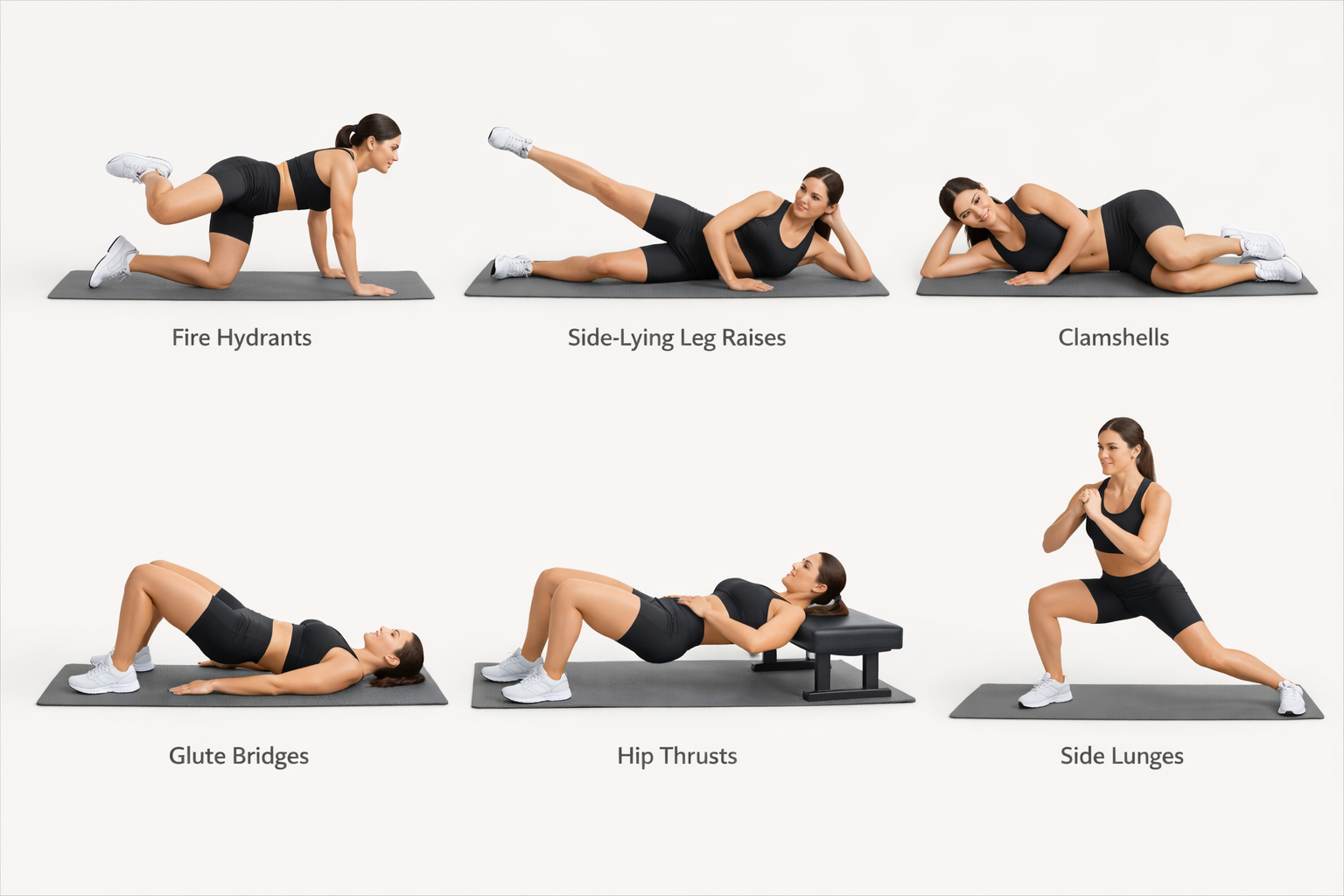
- Fire hydrants: Begin on all fours with a neutral spine. Keeping the knee bent at 90 degrees, lift one leg out to the side until the thigh is parallel to the floor, then lower slowly. Aim for 3 sets of 12–15 repetitions per side. Adding a resistance band above the knees increases the challenge.
- Side-lying leg raises: Lie on your side with legs stacked. Keeping the top leg straight, raise it to approximately 45 degrees, pause briefly, then lower with control. Perform 3 sets of 15 repetitions per side. Ankle weights can be added as strength improves.
- Clamshells: Lie on your side with hips and knees bent at roughly 45 degrees. Keeping the feet together, rotate the top knee upward like a clamshell opening, then close slowly. This isolates the gluteus medius effectively. Aim for 3 sets of 15–20 repetitions per side.
- Glute bridges: Lie on your back with knees bent and feet flat on the floor. Drive through the heels to lift the hips until the body forms a straight line from shoulders to knees. Squeeze the glutes at the top, then lower slowly. Perform 3 sets of 12–15 repetitions.
- Hip thrusts: Similar to glute bridges but with the upper back resting on a bench, allowing a greater range of motion. Adding a barbell or dumbbell across the hips increases resistance. This is one of the most effective exercises for overall gluteal development.
- Side lunges: Step one foot out to the side, bending that knee while keeping the other leg straight. Push back to the starting position. This targets the inner and outer thigh as well as the gluteus medius. Perform 3 sets of 10–12 repetitions per side.
Consistency and progressive overload — gradually increasing resistance or repetitions over time — are more important than any single exercise. Realistic expectations are important: exercise-based improvement in hip contour is gradual and may be subtle depending on individual anatomy.
Non-Surgical Treatment Options
For those who want a more immediate or pronounced change in hip contour without surgery, several non-surgical treatments can add volume to the trochanteric depression. These are body contouring approaches that work by temporarily or gradually increasing soft tissue volume in the lateral hip area.
Dermal Fillers (Hyaluronic Acid)
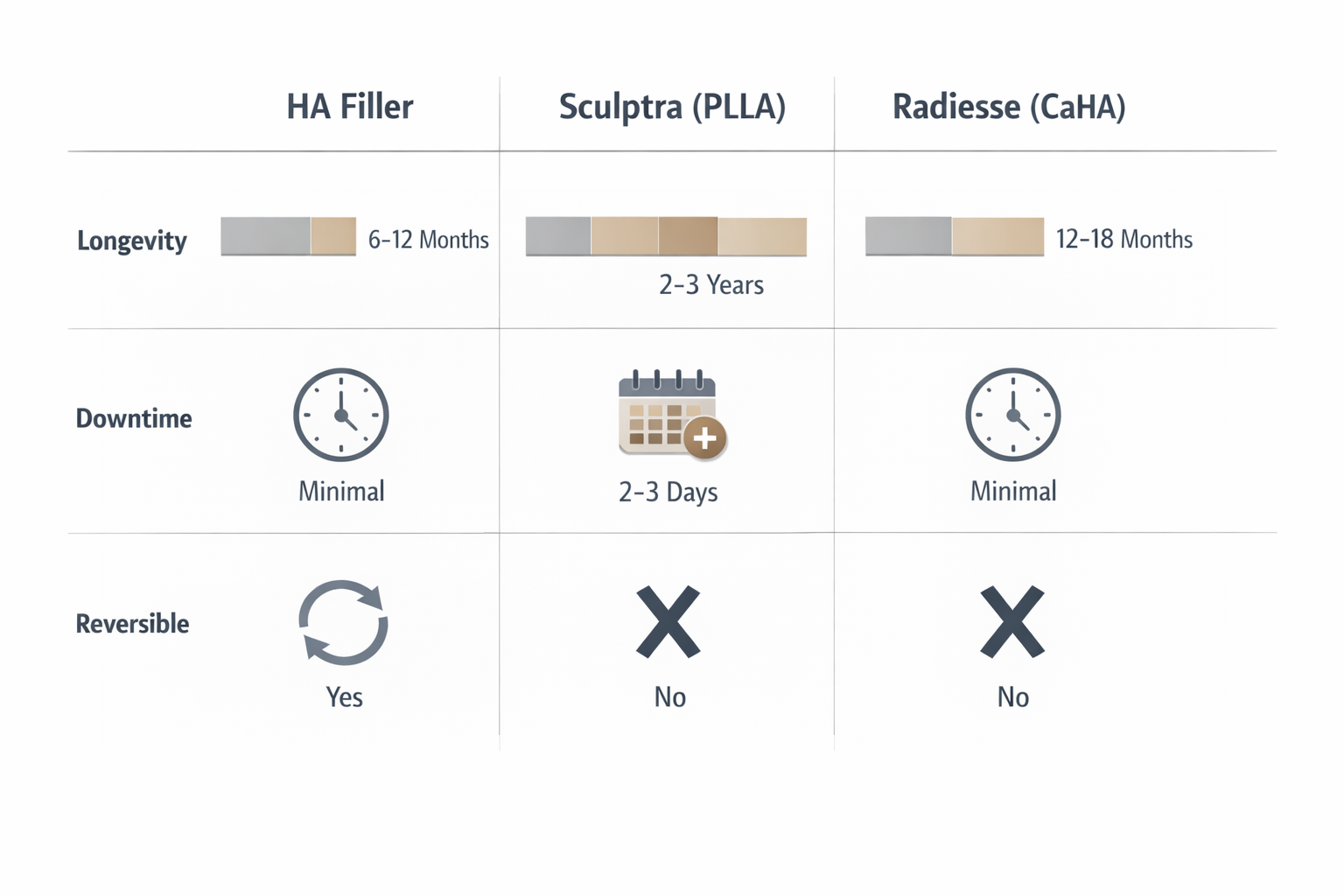
Hyaluronic acid (HA) filler can be injected into the hip dip area to add immediate volume and soften the lateral indentation. This is sometimes referred to as a liquid BBL or non-surgical hip augmentation. HA fillers used in this context — such as HYAcorp — are specifically formulated for body areas and have a thicker consistency than facial fillers. Results are typically visible immediately and may last approximately 12 to 18 months, after which the filler is gradually broken down by the body. Because hyaluronic acid is reversible with an enzyme called hyaluronidase, this option offers a degree of flexibility that surgical alternatives do not. It is worth noting that the use of HA filler in the hip area is considered off-label filler use in many countries, meaning it falls outside the product’s formally licensed indication, and this should be discussed openly during consultation.
Biostimulatory Fillers (Sculptra and Radiesse)
Sculptra, which contains poly-L-lactic acid (PLLA), works differently from HA filler. Rather than providing immediate volume, it stimulates the body’s own collagen production over several weeks and months. Multiple treatment sessions — typically two to three — are usually required, spaced several weeks apart. Results develop gradually and may last up to two years or longer in some patients. Radiesse, which contains calcium hydroxylapatite (CaHA), is another biostimulatory filler that provides both immediate volume and longer-term collagen stimulation. Both options are used off-label for hip augmentation and require an experienced practitioner familiar with body filler techniques. Potential risks include nodule formation, asymmetry, and injection-site reactions, and these should be discussed thoroughly before proceeding.
What to Expect from Non-Surgical Treatment
Non-surgical hip treatments typically involve a consultation, topical anaesthetic application, and the injection procedure itself, which may take 30 to 60 minutes. Downtime is generally minimal — some bruising, swelling, or tenderness at the injection site is common and usually resolves within a few days. Results are not permanent, and maintenance treatments will be needed to sustain the effect. The degree of improvement depends on the depth of the hip dip, the volume of filler used, and individual anatomy. Non-surgical options are best suited to patients with mild to moderate hip dips who want a subtle improvement without surgical risk or recovery time.
Surgical Treatment Options
Surgical approaches to hip dips offer more significant and longer-lasting changes to lower-body proportions, but they carry greater risks, longer recovery periods, and higher costs. Surgery should only be considered after thorough consultation with a qualified plastic or cosmetic surgeon.
Autologous Fat Transfer (Fat Grafting)
Autologous fat transfer — also called fat grafting — involves removing fat from another area of the body (commonly the abdomen, flanks, or thighs) via liposuction, processing it, and re-injecting it into the hip dip area. This approach has the advantage of using the patient’s own tissue, which reduces the risk of rejection or allergic reaction. Long-term volume retention from fat transfer to the hips is generally estimated at 60 to 80 percent, though individual results vary. Some of the transferred fat is naturally reabsorbed by the body in the months following the procedure. A second session may sometimes be needed to achieve the desired result. Recovery typically involves compression garments, restricted activity for several weeks, and some bruising and swelling. General anaesthesia or sedation is usually required.
Brazilian Butt Lift (BBL)
The Brazilian Butt Lift is a form of autologous fat transfer that targets both the buttocks and the lateral hips. Fat is harvested via liposuction, then injected strategically to enhance overall gluteal shape and reduce the appearance of hip dips. The BBL has become one of the most requested body contouring procedures globally, but it also carries a well-documented safety profile that patients must understand. The risk of fat embolism — where fat enters the bloodstream — is a serious concern associated with deep injection techniques, and the procedure should only be performed by surgeons with specific training and experience in this area. Choosing a qualified, experienced surgeon and a properly equipped facility is essential.
Silicone Hip Implants
Silicone hip implants are solid or semi-solid implants placed surgically beneath the skin or muscle to add permanent volume to the lateral hip area. They offer a more predictable volume outcome than fat transfer, as there is no reabsorption. However, implants carry risks including implant migration, capsular contracture (scar tissue forming around the implant), infection, and the possibility of revision surgery. Recovery is typically longer than with fat transfer, and the feel of implants may differ from natural tissue. Silicone hip implants are less commonly performed than fat transfer and are generally considered when a patient does not have sufficient donor fat for grafting.
Treatment Comparison: Non-Surgical vs Surgical Options
| Treatment | Longevity | Downtime | Reversible | Ideal Candidate |
|---|---|---|---|---|
| HA Filler (e.g. HYAcorp) | 12–18 months | Minimal (1–3 days) | Yes (hyaluronidase) | Mild–moderate dip; wants subtle, low-risk result |
| Sculptra (PLLA) | Up to 2+ years | Minimal | No | Gradual improvement preferred; multiple sessions acceptable |
| Radiesse (CaHA) | 12–24 months | Minimal | No | Moderate dip; collagen stimulation desired |
| Autologous Fat Transfer | Long-term (variable reabsorption) | 2–4 weeks | No | Sufficient donor fat; willing to undergo surgery |
| Brazilian Butt Lift (BBL) | Long-term (variable reabsorption) | 3–6 weeks | No | Wants combined buttock and hip enhancement |
| Silicone Hip Implants | Permanent (unless removed) | 4–6 weeks | Only by surgery | Insufficient donor fat; wants permanent volume |
Hip Dips vs Love Handles: Understanding the Difference
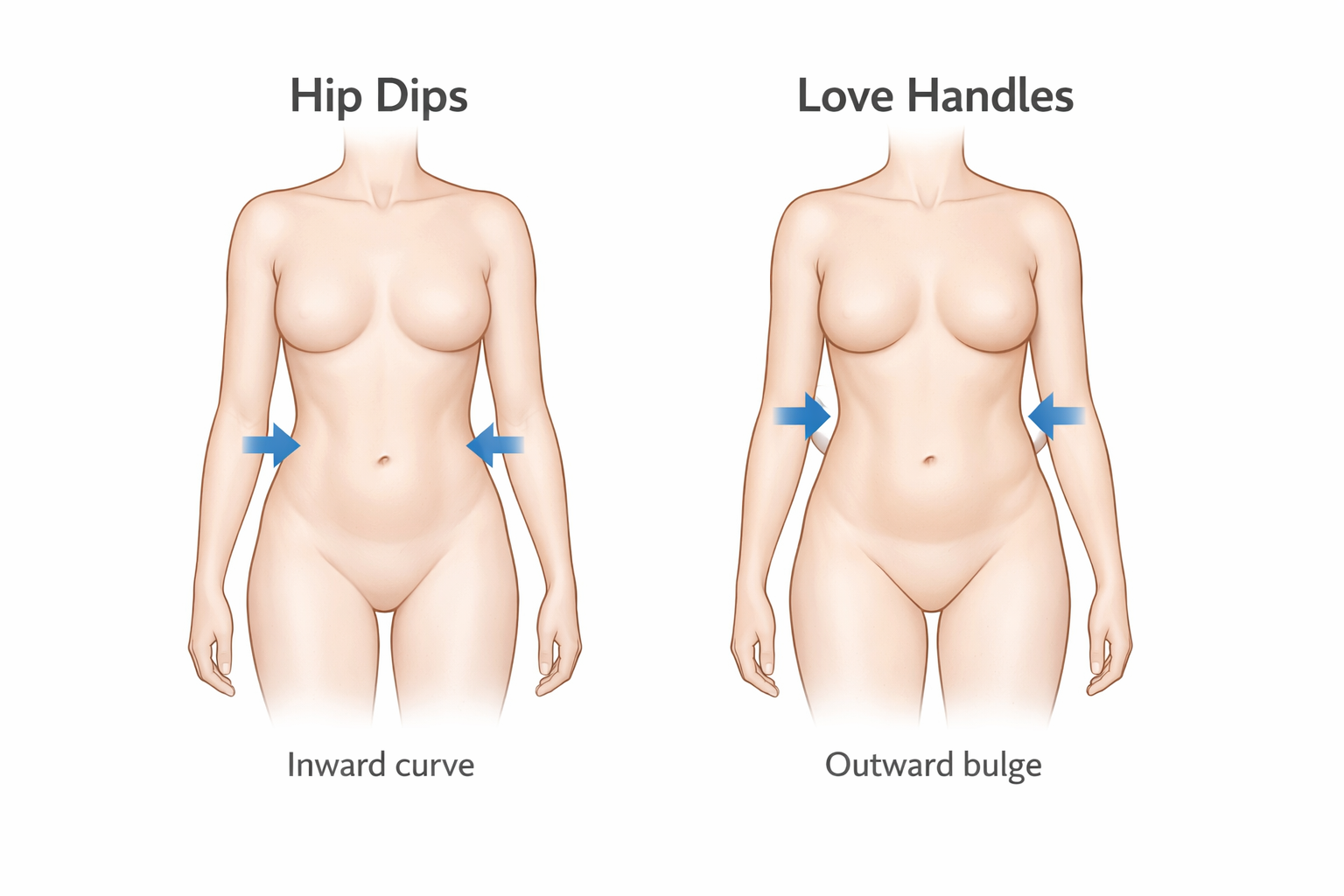
Hip dips and love handles are frequently confused but are anatomically distinct. Hip dips are inward curves on the outer hip caused by the skeletal structure — specifically the relationship between the ilium and the greater trochanter. They represent a depression or indentation in the lateral hip contour. Love handles, by contrast, refer to excess subcutaneous fat that accumulates above the hip bone, on the sides of the waist. Love handles create an outward bulge rather than an inward curve, and they are influenced by overall body fat levels rather than bone structure. The two concerns require different approaches: love handles may respond to fat reduction treatments such as CoolSculpting or liposuction, while hip dips require volume addition rather than fat removal.
Hip Dips, Body Image, and Social Media
The surge in searches for hip dips is closely linked to social media platforms, where idealized body shapes — often digitally altered — are presented as attainable norms. The body neutrality movement, which encourages people to appreciate their bodies for what they can do rather than how they look, offers a useful counterpoint to this pressure. Body neutrality does not require loving every aspect of your appearance; it simply encourages a less critical relationship with the body.
For adolescents in particular, hip dips can become a source of significant self-consciousness during a period when bodies are still developing and social comparison is heightened. Parents and carers who notice a young person expressing distress about hip dips may find it helpful to explain the anatomical basis — that hip dips are a feature of bone structure, not a reflection of health or fitness — and to seek support from a healthcare professional if body image concerns are affecting daily life or mental health.
Seeking cosmetic treatment for hip dips is a personal decision, and there is no right or wrong answer. What matters is that any decision is made from a place of informed choice rather than social pressure, and that realistic expectations are established before any treatment begins.
Frequently Asked Questions
Do hip dips go away with weight loss?
Not typically. Because hip dips are primarily caused by skeletal structure — the relationship between the ilium and the greater trochanter — losing weight does not change the underlying bone. Weight loss may actually make hip dips more visible in some people if subcutaneous fat that was softening the area is reduced. Gaining muscle in the gluteus medius through targeted exercise may have a more positive effect on appearance than weight loss alone.
Can men have hip dips?
Yes. Hip dips can appear in people of any gender. Men tend to have a narrower pelvis and a different gluteal fat distribution pattern compared to women, which means hip dips may be less pronounced on average, but they are still a common and normal anatomical feature in men.
How many filler sessions are needed for hip dips?
This depends on the filler type and the depth of the hip dip. Hyaluronic acid filler may achieve a noticeable result in a single session, though a follow-up appointment to assess symmetry and volume is common. Sculptra typically requires two to three sessions spaced several weeks apart, as results develop gradually through collagen stimulation. Your practitioner will advise based on your individual anatomy and goals.
Is hip dip filler safe?
When performed by an experienced, qualified practitioner using appropriate products and technique, injectable treatments for hip dips carry a manageable risk profile. Potential side effects include bruising, swelling, tenderness, asymmetry, and — less commonly — nodule formation or vascular complications. The hip area contains significant blood vessels, so practitioner experience and anatomical knowledge are important safety factors. Always ensure your practitioner has specific experience with body filler procedures.
Are hip dips the same as saddlebags?
No. Saddlebags refer to excess fat on the outer thighs, below the hip. Hip dips are an inward indentation on the lateral hip, above the thigh. They are different anatomical concerns in different locations, and they respond to different treatments.
Will hip dip treatments affect how I look in clothes?
Treatments that add volume to the hip dip area — whether through filler or fat transfer — may create a smoother lateral hip contour, which some people find makes fitted clothing sit differently. However, the degree of visible change through clothing varies depending on the volume added and individual anatomy. Styling choices such as high-waisted trousers, A-line skirts, and structured fabrics can also help create the appearance of a smoother hip line without any treatment.
Deciding Whether to Treat Hip Dips — or Leave Them
Hip dips are a normal feature of human anatomy rooted in skeletal structure, fat distribution, and muscle development. For most people, they require no treatment at all. Targeted exercise — particularly movements that develop the gluteus medius — may modestly improve the appearance of the lateral hip over time, and this is a reasonable first step for anyone who wants to explore non-invasive options.
For those who want a more noticeable change, non-surgical treatments such as biostimulatory fillers or hyaluronic acid filler offer a lower-risk route with minimal downtime, though results are temporary and the use of filler in this area is off-label in many countries. Surgical options including autologous fat transfer and the Brazilian Butt Lift can produce more significant and longer-lasting changes, but they carry meaningful risks and recovery demands that require careful consideration and thorough discussion with a qualified surgeon.
Whatever path you are considering, a consultation with a practitioner who can assess your individual anatomy, discuss your goals honestly, and set realistic expectations is the most important first step. The goal of any treatment should be a result that feels right for you — not one that conforms to a social media ideal.