
Quick Comparison
| Characteristic | Baby Botox | Regular Botox |
|---|---|---|
| Active ingredient | Botulinum toxin type A | Botulinum toxin type A |
| Dosing approach | Reduced units; hyper-localized micro-injections across more sites | Standard dosing concentrated in fewer injection points |
| Typical unit range (forehead + glabellar) | Approximately 10–20 units (varies by provider and patient) | Approximately 40–60 units for women; up to 70+ for men |
| Muscle effect | Partial muscle relaxation; movement preserved | More complete muscle relaxation |
| Primary goal | Preventative; subtle softening; natural-looking results | Corrective; meaningful reduction of established dynamic wrinkles |
| Results onset | 3–5 days; full effect at 7–10 days | 3–5 days; full effect at 7–14 days |
| Duration | Approximately 2–3 months | Approximately 3–4 months |
| Ideal candidate | Early fine lines; preventative patients; those who dislike frozen results | Established dynamic wrinkles; patients seeking meaningful correction |
| Downtime | None to minimal | None to minimal |
| Cost per session | Lower (fewer units used) | Higher per session; fewer sessions needed annually |
| Risk of frozen appearance | Lower | Higher if over-treated |
What Is Baby Botox — and Is It a Different Product?
Baby Botox is not a separate product or a different formula. It is a dosing philosophy and injection technique applied to the same botulinum toxin type A used in standard treatments — whether that is Botox (onabotulinumtoxinA), Dysport (abobotulinumtoxinA), or Xeomin (incobotulinumtoxinA). The term refers to using a smaller dose of the neuromodulator, distributed across more injection sites using hyper-localized micro-injections, with the specific goal of achieving partial muscle relaxation rather than complete muscle immobilization.
The distinction matters because patients sometimes arrive expecting a gentler or safer formula. What actually changes is the dosing approach and the clinical intention behind it. Baby Botox prioritizes natural facial movement and subtle, natural-looking results over the more complete wrinkle correction that standard dosing delivers. It is sometimes called micro-Botox, mini-Botox, or soft Botox, and the technique is also associated with the concept of prejuvenation — using conservative neuromodulator treatment to slow the progression of expression lines before they become deeply set.
Because the technique is not standardized across the industry, different providers may define baby Botox differently. What one clinic calls baby Botox may involve slightly different unit counts or injection patterns than another. This makes choosing a qualified, experienced injector particularly important when seeking this approach.
How Regular Botox Works
Botulinum toxin type A works by temporarily blocking the nerve signals that cause targeted facial muscles to contract. When those muscles cannot contract fully, the overlying skin stops being repeatedly folded, which reduces the appearance of dynamic wrinkles — the expression lines that form during movement, such as forehead lines, frown lines (also called glabellar lines or “11 lines”), and crow’s feet around the eyes.
Standard Botox treatment uses established dosing protocols designed to produce meaningful, visible correction of these dynamic wrinkles. For the forehead and glabellar region combined, clinical reference points suggest approximately 40 to 60 units for women and up to 70 or more units for men, though individual anatomy, muscle strength, and treatment goals all influence the appropriate dose. The aim is substantial muscle relaxation that smooths established lines and prevents them from deepening further during the treatment period.
Results from standard dosing typically last approximately 3 to 4 months, after which muscle activity gradually returns and maintenance sessions are needed to sustain the effect.
How Baby Botox Differs in Technique and Effect
Baby Botox uses a fraction of the units used in standard treatment — clinical references suggest approximately 10 units as a general starting point, though this varies considerably by provider and patient. Rather than concentrating the neuromodulator in a small number of injection sites, the reduced dose is distributed across a greater number of points using hyper-localized micro-injections. This spreads the effect more diffusely and at a lower intensity, producing partial muscle modulation rather than the more complete relaxation achieved with standard dosing.
The practical result is that treated muscles retain more of their natural range of movement. Patients can still express emotions through facial movement — raising their eyebrows, frowning, smiling — but the skin above those muscles is gently softened. This is the defining characteristic that distinguishes the baby Botox approach: movement preservation alongside subtle enhancement, rather than the more dramatic correction that full dosing provides.
Some providers describe the injection technique as more superficial than standard Botox, targeting the upper layers of tissue rather than penetrating deeply into the muscle belly. This approach may contribute to the softer, more diffuse effect, though technique varies between practitioners.
Preventative vs. Corrective: Understanding the Core Distinction
The clearest way to frame the difference between baby Botox and regular Botox is through the lens of preventative versus corrective treatment. Regular Botox is primarily corrective — it is used to meaningfully reduce dynamic wrinkles that are already visible at rest or during expression. Baby Botox is primarily preventative — it is used to slow the formation of those wrinkles before they become established, or to maintain a very subtle softening in patients who already have early fine lines.
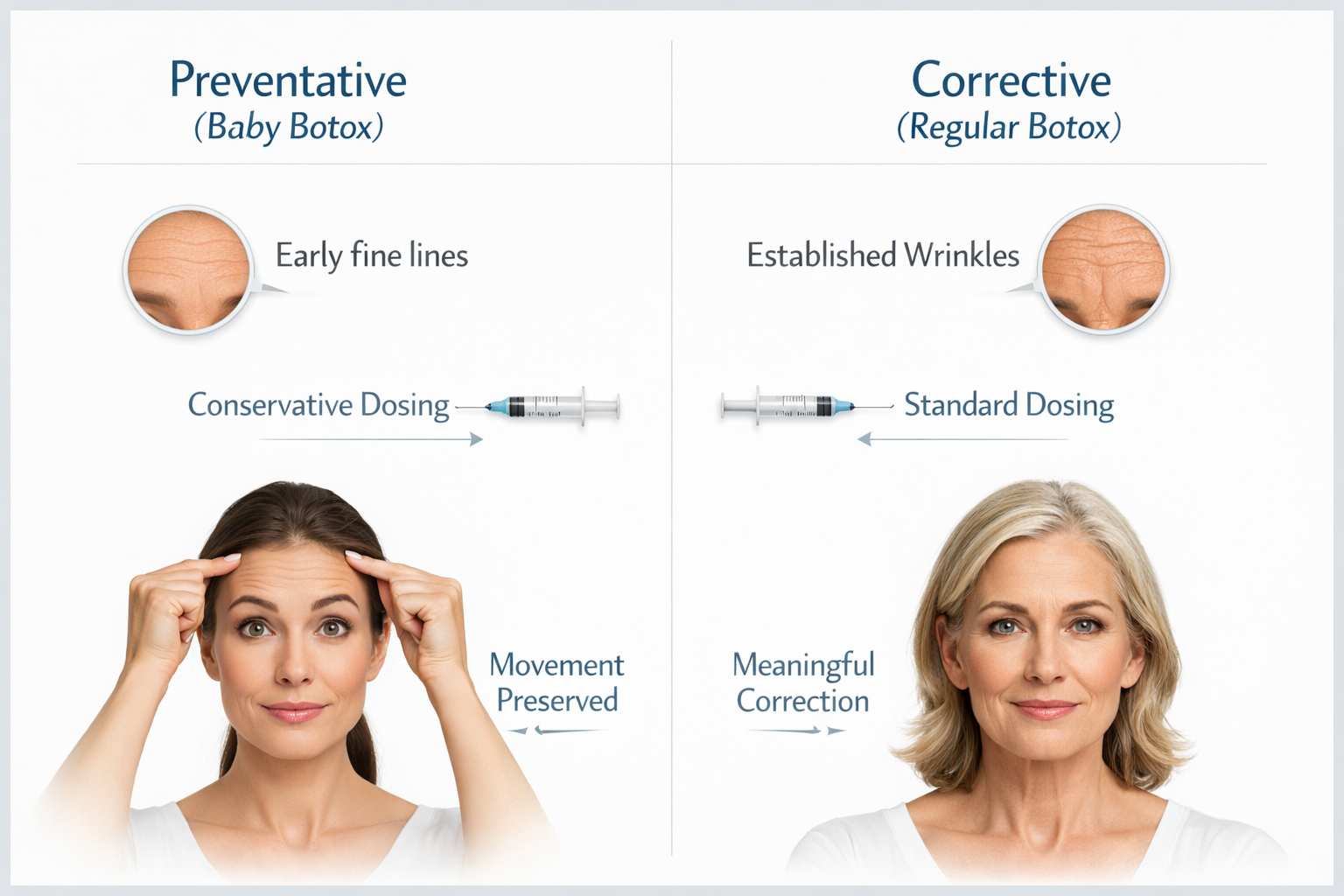
Dynamic wrinkles form because repeated muscle contractions fold the skin in the same place over years. Collagen and elastin in the skin gradually break down, and the lines that were once only visible during expression begin to appear at rest. Preventative neuromodulator treatment — sometimes called prejuvenation — aims to interrupt this cycle early, reducing the intensity of muscle contractions before the skin loses enough structural support for lines to become permanent.
This is why baby Botox has become particularly popular among patients in their mid-20s to mid-30s who have early expression lines but no deeply established wrinkles. It is also a useful option for patients who have previously experienced results from standard dosing that felt too frozen or unnatural, and who want to continue treatment with a lighter touch.
Treatment Areas for Both Approaches
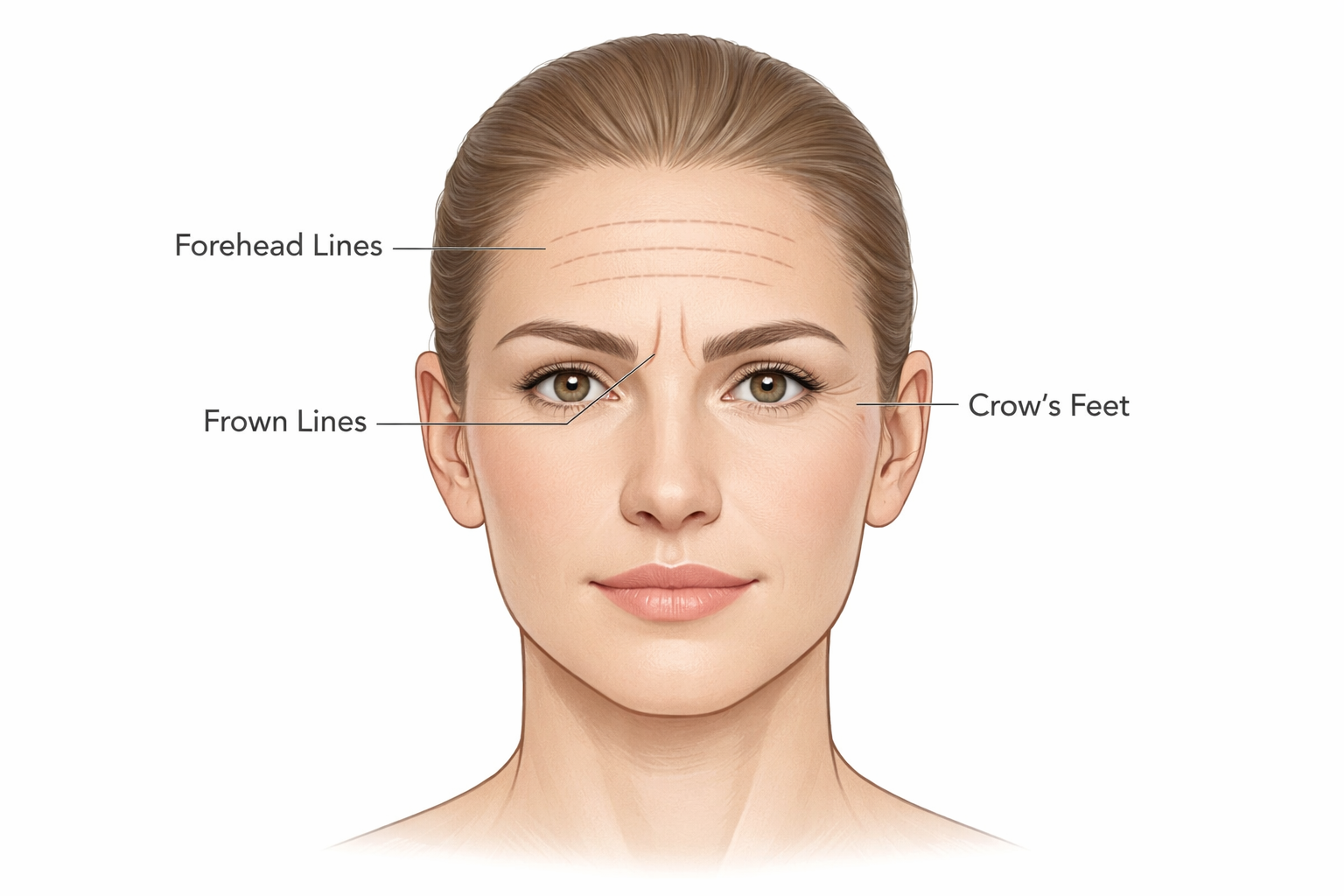
Both baby Botox and regular Botox can address the same facial areas. The most commonly treated regions for both approaches include the three classic sites: forehead lines (caused by the frontalis muscle), frown lines in the glabellar complex between the brows, and crow’s feet around the outer corners of the eyes caused by the orbicularis oculi muscle. These areas are targeted because they show the earliest and most visible expression lines in most patients.
Beyond these three primary areas, both techniques can be applied to bunny lines on the nose, the lip flip (a small dose near the upper lip border to create a subtle eversion), chin dimpling, and in some cases the neck or jawline. Baby Botox may be particularly well suited to delicate areas where preserving natural movement is especially important, such as around the mouth or eyes, where over-treatment can affect function as well as appearance.
For patients with larger or stronger facial muscles — which is more common in men — standard dosing is often necessary even in areas where a lighter approach might suffice for someone with less muscle mass. Muscle strength, not a fixed number on a treatment menu, is the more meaningful guide to appropriate dosing.
Results: What to Realistically Expect
Both baby Botox and regular Botox produce visible changes within 3 to 5 days of treatment, with full results typically apparent after 7 to 10 days. The nature of those results differs meaningfully between the two approaches.
With standard Botox dosing, patients typically see a clear reduction in the depth and visibility of targeted dynamic wrinkles. Lines that were visible at rest may soften significantly or become much less apparent. The trade-off is that some patients notice a reduction in the range of natural facial expressions, particularly in the forehead, which can contribute to the “frozen” look that many patients now actively want to avoid.
With baby Botox, the results are more subtle. Fine lines and wrinkles soften, but the change is designed to look like nothing has been done rather than like a treated appearance. Patients retain natural facial movement and expression. One practical benefit of the lighter dosing is that the fade at the end of the treatment period tends to be more gradual — because less product was used, the return of muscle activity is more incremental, so patients are less likely to experience a sudden “undone” transition.
It is important to understand that baby Botox may not produce meaningful correction in patients with established, deeper dynamic wrinkles. Under-dosing is one of the most common reasons patients report that a neuromodulator treatment was ineffective. If a conservative treatment produces little to no visible improvement, the answer is usually a reassessment of the dose rather than a change of product.
How Long Does Each Approach Last?
Duration is directly related to the amount of botulinum toxin used. Baby Botox, using fewer units, typically lasts approximately 2 to 3 months before muscle activity returns to baseline. Regular Botox with standard dosing typically lasts approximately 3 to 4 months, and in some patients with slower metabolism of the toxin, effects may persist slightly longer.
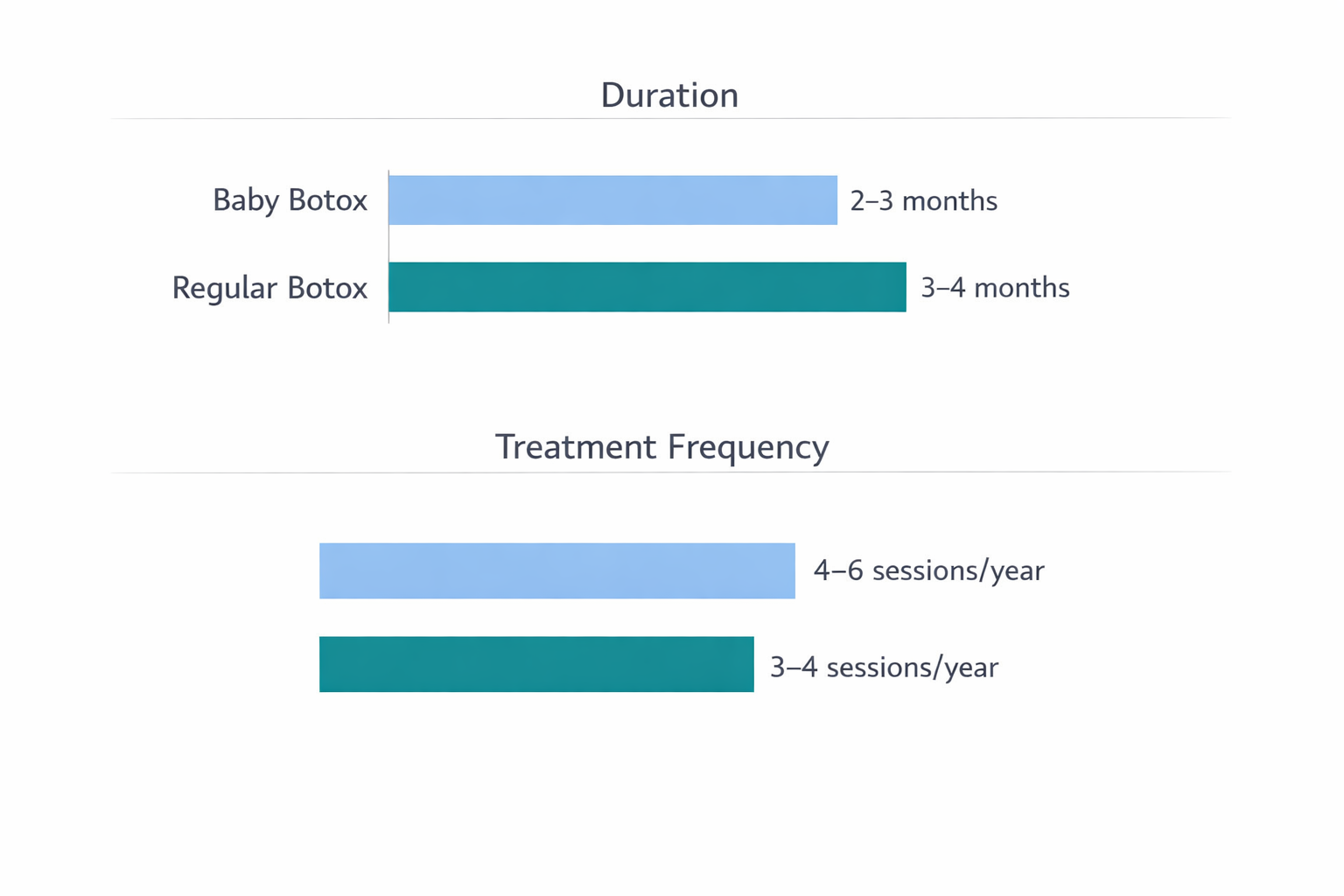
This difference in duration has a practical implication for treatment frequency and annual cost. Patients choosing baby Botox will generally need more maintenance sessions per year — typically four to six — compared to the three to four sessions that standard dosing usually requires. Over the course of a year, the lower cost per session of baby Botox (due to fewer units) may be partially or fully offset by the greater number of appointments needed. Patients considering baby Botox as a long-term approach should factor in this annual cost comparison when planning their treatment budget.
Cost Comparison
Baby Botox costs less per individual session because fewer units of botulinum toxin are used. Depending on the provider, location, and number of areas treated, baby Botox sessions may range from approximately £150 to £400 per appointment, while standard Botox sessions covering the same areas typically cost more due to the higher unit count involved.
However, the annual cost picture is more nuanced. A patient receiving baby Botox every 2 to 3 months may have four to six appointments per year, while a patient receiving standard Botox every 3 to 4 months may have three to four appointments. Depending on the specific pricing structure of the clinic, the annual spend for baby Botox may be comparable to or even exceed that of standard treatment. Discussing treatment frequency and annual cost with your provider before committing to either approach is a practical step that many patients overlook.
Who May Be a Suitable Candidate
Baby Botox may be worth discussing if you:
- Are in your mid-20s to mid-30s with early, fine expression lines but no deeply established wrinkles
- Want a preventative approach to slow the progression of dynamic wrinkles over time
- Have previously found standard Botox results too frozen or unnatural
- Prioritize preserving natural facial movement and expression
- Are new to neuromodulator treatment and want to start conservatively
- Are treating a delicate area where subtle enhancement is the goal
Regular Botox may be more appropriate if you:
- Have established dynamic wrinkles that are visible at rest or during expression
- Want meaningful, visible correction rather than subtle softening
- Have stronger facial muscles that require a higher dose to achieve any effect
- Prefer fewer annual appointments and a longer duration between sessions
- Have tried conservative dosing previously with insufficient results
Men are often better candidates for standard dosing even when seeking relatively natural results, because male facial muscles are typically larger and stronger than female facial muscles and require more units to achieve the same degree of relaxation. A qualified injector will assess individual facial anatomy and muscle strength rather than applying a fixed unit count regardless of the patient.
Side Effects, Risks, and Contraindications
Both baby Botox and regular Botox share the same safety profile because they use the same active ingredient. Common side effects include temporary swelling, redness, or bruising at the injection sites. These tend to be mild and resolve within a few days. Because baby Botox uses fewer units, the likelihood and severity of bruising and swelling may be somewhat lower, though this is not guaranteed.
Less common but possible side effects include headache, a feeling of heaviness in the treated area, and in rare cases, temporary drooping of the eyelid or eyebrow if the toxin migrates to an unintended muscle. These risks are present with both approaches and are minimized by choosing an experienced, qualified injector with a thorough understanding of facial anatomy.
Botulinum toxin treatment is not suitable for everyone. Patients with certain neuromuscular conditions, known allergies to botulinum toxin or any of its components, or active infection at the planned injection site should not receive treatment. The FDA advises that patients who are pregnant should pause botulinum toxin treatments unless a clinician determines that the potential benefit justifies the potential risk. Patients who are breastfeeding should also discuss this with their provider before proceeding. A thorough medical history review at consultation is essential before any neuromodulator treatment.
The Treatment Experience
Both baby Botox and regular Botox appointments follow a similar process. A consultation is conducted first to assess facial anatomy, discuss goals, review medical history, and determine the appropriate dosing approach. The treatment area is cleaned, and a topical numbing cream may be applied if the patient prefers, though many patients find the injections comfortable without it given the fine needles used.
The injection itself is quick — typically 10 to 15 minutes for a standard treatment covering forehead, frown lines, and crow’s feet. Baby Botox may involve more injection points due to the distributed dosing approach, but the overall appointment time is similar. There is no recovery time required after either treatment. Most patients return to normal activities immediately, though providers typically advise avoiding strenuous exercise, lying flat, and applying pressure to the treated area for a few hours after the appointment.
Results begin to appear within 3 to 5 days and reach their full effect at around 7 to 10 days. A follow-up review at two weeks is common practice, allowing the injector to assess the result and make any minor adjustments if needed.
Alternatives to Consider
Botox (onabotulinumtoxinA) is the most widely recognized brand, but the baby dosing philosophy can be applied equally to other botulinum toxin type A products. Dysport (abobotulinumtoxinA) and Xeomin (incobotulinumtoxinA) are both established neuromodulators used in aesthetic practice, and a conservative, movement-preserving approach can be taken with either. Daxxify is a newer botulinum toxin formulation with a longer duration of action in some patients. Units between these brands are not directly interchangeable, and dosing must be adjusted accordingly by the treating clinician.
For patients interested in skin quality improvement alongside wrinkle prevention, complementary treatments such as medical-grade skincare, chemical peels, or collagen-stimulating treatments may be discussed alongside neuromodulator treatment. These approaches address different aspects of skin aging and are not substitutes for botulinum toxin, but they can form part of a broader preventative skin health strategy.
Choosing a Provider
The outcome of both baby Botox and regular Botox depends heavily on the skill, experience, and clinical judgment of the injector. A board-certified or appropriately qualified aesthetic practitioner will assess your facial anatomy, muscle strength, skin quality, and goals before recommending a dosing approach. They will not apply a fixed unit count from a menu but will let your individual facial structure guide the treatment plan.
When choosing a provider, look for verifiable medical qualifications, specific training in facial anatomy and injectable treatments, and a willingness to discuss realistic outcomes, limitations, and risks openly. Be cautious of providers who offer very low prices without a proper consultation, who cannot clearly explain their dosing rationale, or who do not discuss contraindications and aftercare. The quality of the injector is a more meaningful predictor of outcome than the specific dosing approach chosen.
Frequently Asked Questions
Is baby Botox a different product from regular Botox?
No. Baby Botox uses the same botulinum toxin type A as standard treatment. The difference is entirely in the dosing approach and injection technique — fewer units distributed across more sites — not in the product itself.
Will baby Botox completely prevent wrinkles from forming?
Baby Botox can slow the progression of dynamic wrinkles by reducing the intensity of repeated muscle contractions, but it cannot guarantee that wrinkles will not develop. Skin aging is influenced by many factors including genetics, sun exposure, lifestyle, and skin quality. Preventative neuromodulator treatment is one tool within a broader approach to skin health.
Can I switch between baby Botox and regular Botox?
Yes. Many patients start with a conservative approach and adjust the dosing over time based on their results and goals. If baby Botox produces insufficient correction, a qualified injector can increase the dose at a subsequent session. Equally, patients who find standard dosing too strong can request a lighter approach at their next appointment.
Does baby Botox hurt less than regular Botox?
Both treatments use fine needles and are generally well tolerated. Baby Botox involves more injection points, which some patients find slightly more uncomfortable, while others find the lighter pressure at each point easier. Topical numbing cream is available for either approach if preferred.
How often will I need baby Botox treatments?
Because baby Botox uses fewer units, the effects typically last 2 to 3 months rather than the 3 to 4 months of standard dosing. Most patients require four to six maintenance sessions per year to sustain results, compared to three to four sessions with regular Botox.
Is baby Botox suitable for men?
Men can receive baby Botox, but because male facial muscles are typically larger and stronger, they often require more units than women to achieve any meaningful effect. A very conservative dose may produce little visible result in a patient with strong facial muscles. A qualified injector will assess muscle strength individually and recommend an appropriate dose rather than applying a standard baby Botox unit count regardless of anatomy.
What happens if baby Botox is under-dosed?
Under-dosing is one of the most common reasons patients report that a neuromodulator treatment produced no visible improvement. If a conservative treatment session produces little to no result, the appropriate response is usually to reassess the dose at the next appointment rather than to assume the treatment does not work for that patient. A follow-up review two weeks after treatment gives the injector an opportunity to evaluate the outcome and discuss adjustments.
Baby Botox or Regular Botox: Which May Better Match Your Goals?
The choice between baby Botox and regular Botox is not about which treatment is superior — it is about which dosing philosophy aligns with your current skin concerns, your aesthetic goals, and your tolerance for visible change. Baby Botox, with its emphasis on partial muscle relaxation and natural facial movement, is well suited to patients seeking a preventative approach, those with early fine lines, or those who want subtle, natural-looking results that do not announce themselves as treated. Regular Botox, with its standard dosing and more complete muscle relaxation, is the more appropriate choice for patients with established dynamic wrinkles who want meaningful, visible correction.
Both approaches use the same neuromodulator, carry the same safety considerations, and require the same commitment to choosing a qualified provider. The most important variable in either case is not the unit count but the clinical judgment of the injector — their ability to assess your facial anatomy, understand your goals, and recommend a dosing approach that is genuinely appropriate for you rather than one that fits a fixed template.
If you are considering either approach, a thorough consultation with an experienced aesthetic practitioner is the right starting point. A good injector will help you understand what each option can realistically achieve for your specific concerns, and will guide you toward a treatment plan that reflects your individual facial structure and long-term goals.