

The cupid’s bow is one of the most recognisable features of the human face, yet many people are uncertain about exactly what it is, why it varies so much between individuals, and what options exist when someone wants to refine or enhance it. Understanding the anatomy of the upper lip — including the structures that create the cupid’s bow shape — helps set realistic expectations before any aesthetic consultation and makes it easier to communicate clearly with a practitioner about your goals.
Key Takeaways
- The cupid’s bow is the double-curved edge of the upper lip formed by two peaks and a central dip, and its shape is determined by underlying anatomical structures including the vermilion border, the philtrum columns, and the orbicularis oris muscle.
- Natural variation in cupid’s bow shape is wide and normal; no single shape is medically superior, and aesthetic ideals differ across cultures and individuals.
- Lip filler, lip flip procedures using botulinum toxin, and surgical options such as lip lift can each address different aspects of upper lip shape, with distinct mechanisms, results, and limitations.
- A thorough clinical assessment is essential before any lip treatment, as individual anatomy, skin quality, and existing lip volume all influence which approach may be appropriate.
- Realistic expectations and an understanding of the risks involved are important before proceeding with any treatment intended to alter cupid’s bow definition or upper lip contour.
What Is the Cupid’s Bow?
The cupid’s bow refers to the double-curved shape formed by the upper edge of the upper lip — specifically the vermilion border, which is the boundary between the lip tissue and the surrounding skin. The name comes from the resemblance to the bow carried by Cupid in classical imagery: two upward peaks on either side of a central downward dip. This distinctive outline is one of the defining features of lip anatomy and plays a significant role in how the lips appear in proportion to the rest of the face.
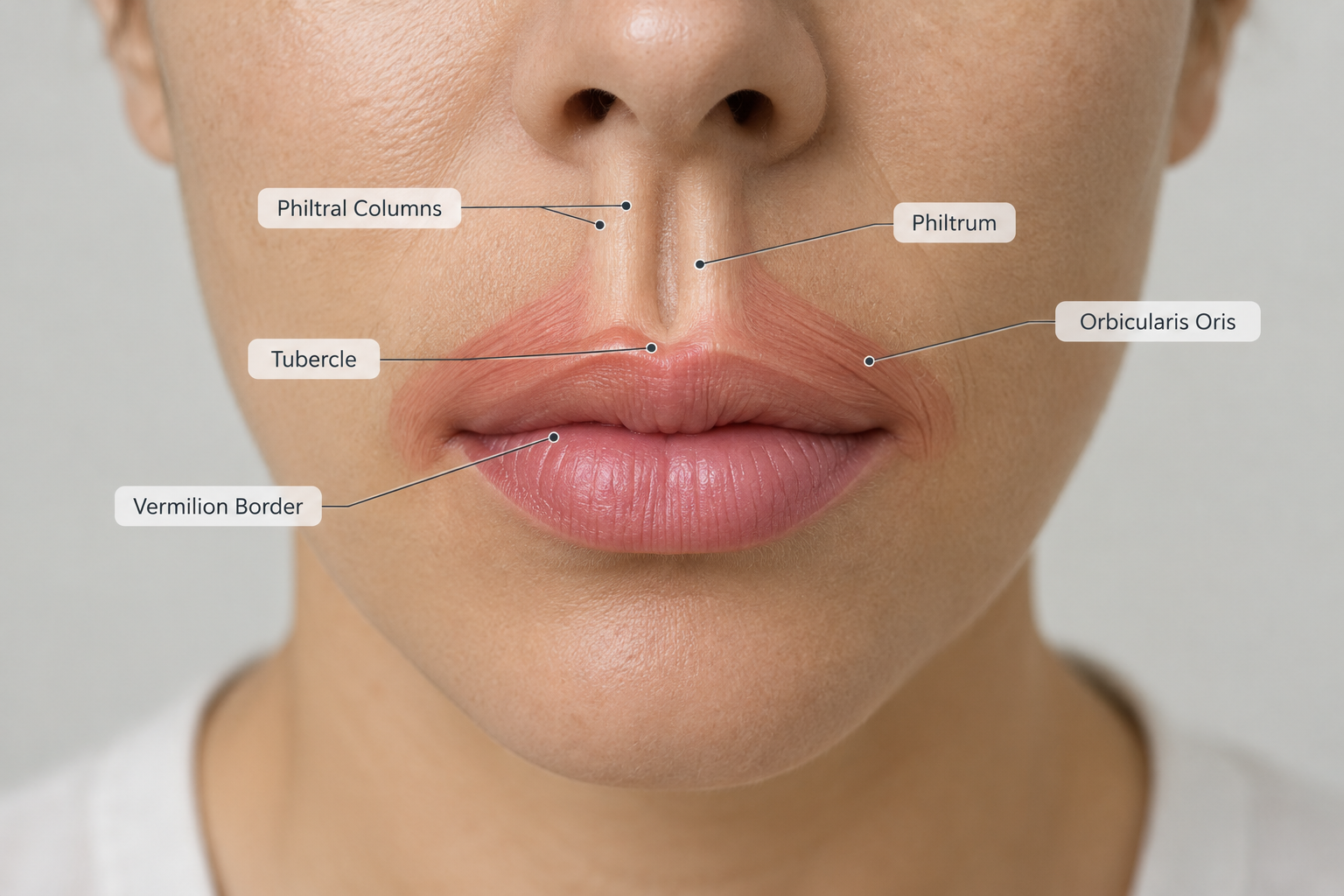
The two peaks of the cupid’s bow sit roughly above the philtral columns — the two raised ridges that run vertically from the base of the nose to the upper lip. Between these peaks, the vermilion border dips downward toward the centre, creating the characteristic M-shaped or bow-like profile when viewed from the front. The depth of this central dip, the height of the peaks, and the overall width of the bow vary considerably from person to person, and all of these characteristics are influenced by underlying anatomy.
The tubercle, a small central projection of the upper lip that sits just below the cupid’s bow dip, also contributes to the overall appearance of the lip. A well-defined tubercle can make the cupid’s bow appear more prominent, while a flatter central lip may soften the bow’s definition. These subtle structural differences account for much of the natural variation seen in upper lip shape across different individuals and ethnic backgrounds.
The Anatomy Behind Upper Lip Shape
Several distinct anatomical structures work together to create the shape of the upper lip and the cupid’s bow. Understanding these structures helps explain why lip shape varies so much and why different treatments target different aspects of lip appearance.
The Vermilion Border
The vermilion border is the edge that separates the coloured lip tissue (the vermilion) from the surrounding skin. Along the upper lip, this border traces the cupid’s bow outline. The sharpness or softness of this border affects how defined the cupid’s bow appears. A crisp, well-defined vermilion border creates a clear, visible bow shape, while a less distinct border can make the cupid’s bow appear blurred or indistinct — a change that often becomes more noticeable with age as collagen and structural support diminish.
The Philtrum and Philtral Columns
The philtrum is the vertical groove running from the base of the nose to the upper lip. On either side of this groove are the philtral columns — slightly raised ridges of tissue that terminate at the two peaks of the cupid’s bow. The prominence and spacing of the philtral columns directly influence the shape and definition of the bow. Wider-set philtral columns tend to produce a broader cupid’s bow, while closely spaced columns create a narrower, more compact bow shape. The depth of the philtral groove itself also affects how three-dimensional the upper lip appears.
The Orbicularis Oris Muscle
The orbicularis oris is the circular muscle that surrounds the mouth and controls lip movement. Its tone and volume contribute to the overall fullness and projection of the lips. With age, changes in muscle tone and the overlying soft tissue can cause the upper lip to thin, lengthen, and lose some of its natural eversion — the outward roll that makes lips appear full and youthful. These changes can flatten the cupid’s bow and reduce the visibility of the vermilion border.
Fat Compartments and Soft Tissue
The lips contain small fat compartments that contribute to their volume and shape. The distribution of fat within the upper lip affects how the cupid’s bow peaks project and how the central tubercle appears. Volume loss in these compartments — which can occur gradually with age — tends to flatten the lip profile and reduce the definition of the cupid’s bow. Conversely, the natural distribution of fat in younger lips often contributes to a more pronounced and defined bow shape.
Skin and Collagen
The skin overlying the upper lip, including its collagen content and elasticity, influences how sharply the vermilion border is defined and how well the lip holds its shape. Collagen loss associated with ageing, sun exposure, and smoking can cause the upper lip skin to thin and the vermilion border to become less distinct, which softens the appearance of the cupid’s bow over time.
Natural Variation in Cupid’s Bow Shape
Cupid’s bow shape varies enormously between individuals, and this variation is entirely normal. Some people have a pronounced, deeply curved bow with prominent peaks and a well-defined central dip, while others have a flatter, more subtle bow that blends more gradually into the surrounding lip tissue. Neither extreme is medically problematic, and aesthetic preferences for lip shape differ significantly across cultures, generations, and individuals.
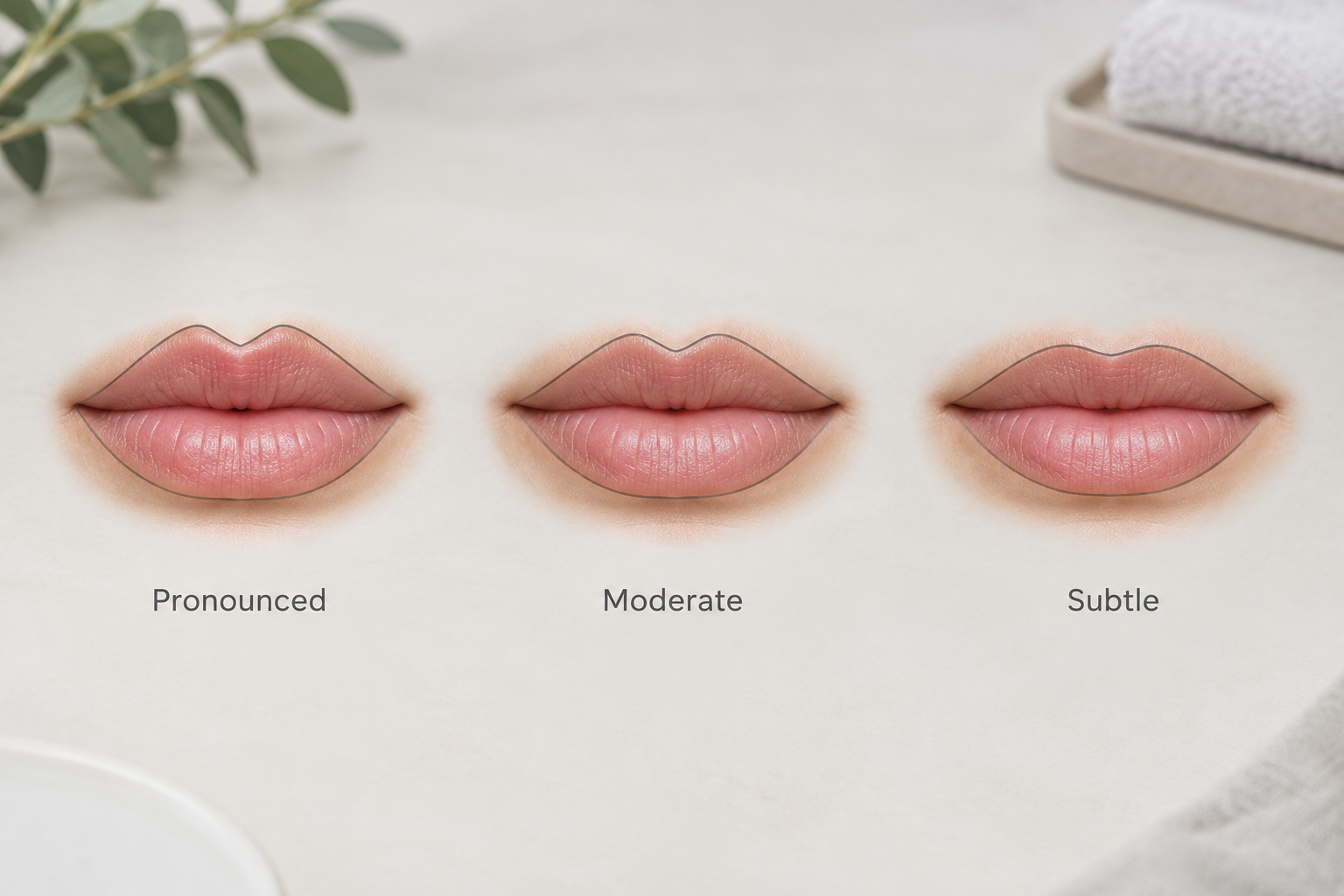
Genetic factors play the primary role in determining cupid’s bow shape. Ethnicity influences the typical proportions of the philtrum, the prominence of the philtral columns, the width of the vermilion, and the overall lip volume — all of which affect how the cupid’s bow appears. For example, lips with a wider vermilion and fuller central projection may display a different bow profile compared to lips with a narrower vermilion and more defined philtral columns, even when both are considered aesthetically balanced within their respective contexts.
Age-related changes also alter cupid’s bow appearance over time. The upper lip tends to lengthen as the distance between the nose and the lip increases, the vermilion border becomes less defined, and overall lip volume decreases. These changes can make the cupid’s bow appear less prominent or less sharply defined, which is one reason why some individuals seek aesthetic treatment as they age.
Aesthetic Ideals and Proportions
Aesthetic analysis of the lips often references classical facial proportion concepts, including the golden ratio and the relationship between upper and lower lip volume. In many Western aesthetic frameworks, the lower lip is considered ideally slightly fuller than the upper lip, with the upper lip contributing approximately 40% of total lip volume and the lower lip approximately 60%. However, these proportions are guidelines rather than universal standards, and a skilled practitioner will assess lip shape in the context of the individual’s overall facial anatomy rather than applying a fixed formula.
The cupid’s bow peaks are often considered aesthetically significant because they create visual interest and definition along the upper lip edge. A well-defined cupid’s bow can make the lips appear more structured and youthful, while a flatter or less distinct bow may give the lips a softer, less defined appearance. However, what constitutes an attractive lip shape is subjective, and treatment goals should always reflect the individual patient’s preferences rather than a standardised aesthetic ideal.
Practitioners trained in facial aesthetics typically assess the cupid’s bow in relation to the philtrum length, the overall lip-to-face ratio, the position of the lip relative to the teeth and chin, and the symmetry of the lip outline. This holistic assessment helps identify which aspects of lip shape, if any, a patient may wish to address and which treatment approach may be most appropriate.
Treatments That May Enhance or Refine the Cupid’s Bow
Several aesthetic treatments can be used to address the appearance of the cupid’s bow and upper lip shape. Each works through a different mechanism and is suited to different concerns. No treatment is universally appropriate, and individual anatomy, skin quality, and treatment goals all influence which option a practitioner may recommend following a thorough assessment.
Lip Filler (Dermal Filler)
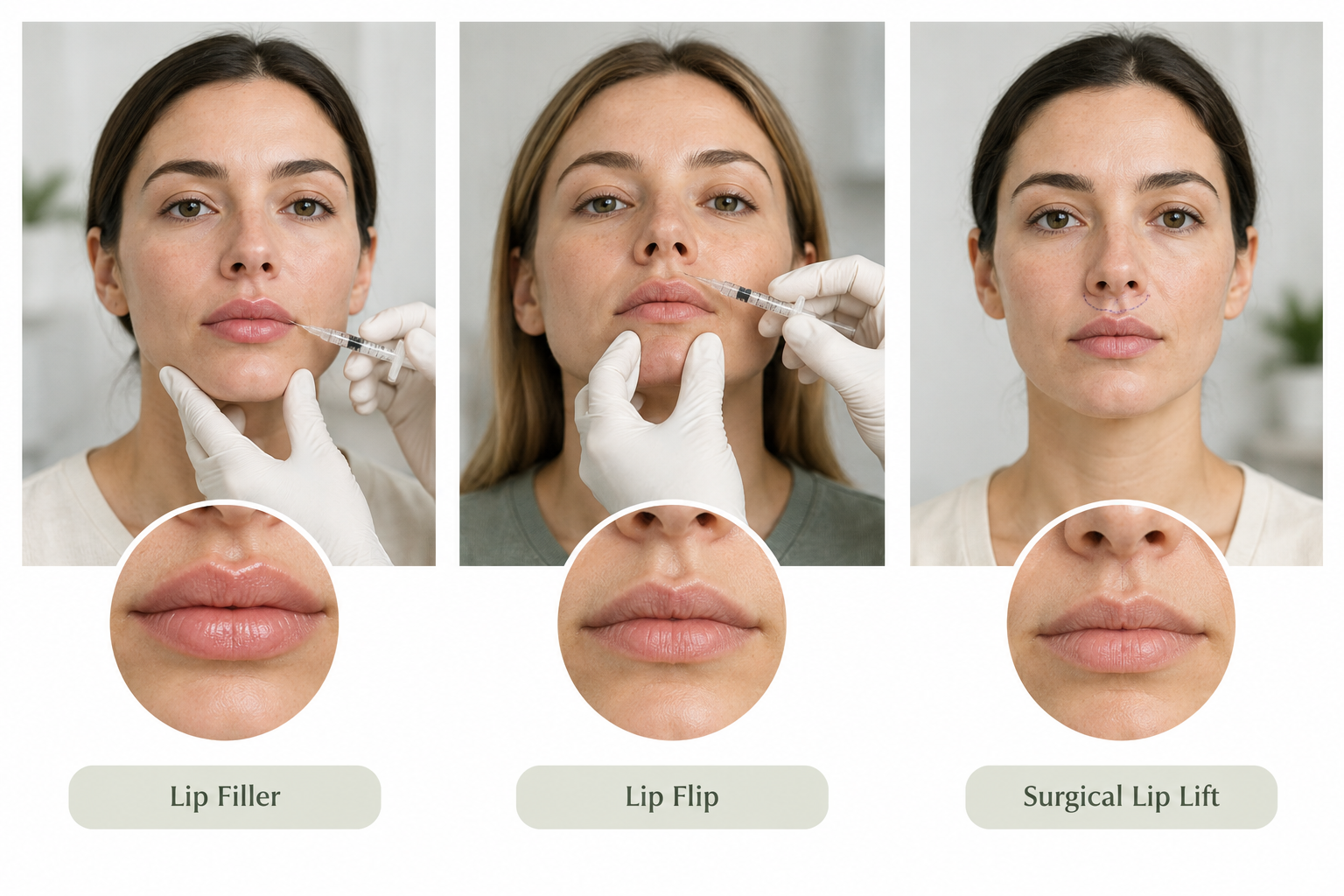
Hyaluronic acid lip filler is one of the most commonly used treatments for enhancing cupid’s bow definition and overall lip shape. Hyaluronic acid is a naturally occurring substance in the body, and when injected into the lip tissue, it adds volume, improves hydration, and can be used to accentuate specific structural features including the cupid’s bow peaks and the vermilion border.
A practitioner can use small, precise amounts of filler to sharpen the definition of the cupid’s bow, lift the peaks, or add subtle projection to the central tubercle. Filler can also be used to restore volume lost through ageing, which may indirectly improve the visibility of the cupid’s bow by restoring the lip’s natural fullness. Results from hyaluronic acid lip filler are temporary, typically lasting between six and twelve months depending on the product used, the amount injected, the individual’s metabolism, and the specific area treated.
Risks associated with lip filler include bruising, swelling, asymmetry, lumpiness, and — in rare but serious cases — vascular occlusion, where filler inadvertently enters or compresses a blood vessel. Choosing a qualified and experienced practitioner who understands lip anatomy in detail is important for minimising these risks. Hyaluronic acid filler has the advantage of being reversible using an enzyme called hyaluronidase, which can dissolve the filler if complications arise or if the patient is unhappy with the result.
Lip Flip Using Botulinum Toxin
A lip flip is a technique in which small amounts of botulinum toxin are injected into the orbicularis oris muscle along the upper lip border. By temporarily relaxing the muscle fibres, the upper lip edge rolls slightly outward and upward, which can make the cupid’s bow appear more visible and give the upper lip a subtly fuller appearance without adding significant volume.
The lip flip is not a substitute for lip filler and does not add volume to the lip. It is most suitable for individuals who want a subtle enhancement of the cupid’s bow outline or who feel their upper lip disappears when they smile. Results are temporary, typically lasting two to three months, and the treatment requires maintenance appointments to sustain the effect. Potential side effects include temporary difficulty with certain lip movements such as pursing, drinking through a straw, or playing wind instruments, and these effects resolve as the botulinum toxin wears off.
Lip Liner and Vermilion Border Definition
While not a medical treatment, it is worth noting that cosmetic techniques using lip liner can temporarily define or reshape the appearance of the cupid’s bow. Some patients use these techniques while considering whether a more lasting aesthetic treatment is appropriate for their goals. A practitioner may discuss the patient’s use of cosmetic contouring as part of understanding their aesthetic preferences during a consultation.
Surgical Lip Lift
A surgical lip lift is a procedure that shortens the distance between the base of the nose and the upper lip (the philtrum length), which causes the upper lip to roll upward and increases the visibility of the vermilion and the cupid’s bow. This procedure is typically considered when the philtrum has lengthened significantly with age or when non-surgical treatments have not achieved the desired result.
A lip lift is a surgical procedure performed under local anaesthesia and involves a small incision, usually concealed at the base of the nose. Recovery involves some swelling and bruising, and a fine scar forms at the incision site, which typically fades over several months. Results are long-lasting compared to injectable treatments, but the procedure carries surgical risks including scarring, asymmetry, and changes in sensation. Surgical lip lift is not appropriate for everyone, and a consultation with a qualified surgeon is necessary to assess suitability.
Who May Be Suitable for Cupid’s Bow Enhancement
Suitability for any lip treatment depends on individual anatomy, medical history, and treatment goals. A clinical assessment is always required before proceeding. Patients who may be suitable for non-surgical cupid’s bow enhancement include those who:
- have a naturally flat or indistinct cupid’s bow they would like to define more clearly;
- have experienced age-related loss of vermilion border definition or lip volume;
- want subtle structural enhancement rather than significant volume increase;
- are in good general health with no active infection or inflammatory skin condition in the treatment area;
- have realistic expectations about the degree of change achievable with non-surgical treatment;
- are not pregnant or breastfeeding.
Certain factors may affect suitability or require additional consideration, including a history of cold sores (herpes simplex), autoimmune conditions, blood-thinning medications, previous lip surgery, or existing lip filler that has not fully resolved. A thorough consultation allows the practitioner to identify any contraindications and discuss the most appropriate approach for the individual patient.
Risks and Limitations to Understand
All aesthetic treatments carry risks, and treatments targeting the cupid’s bow and upper lip are no exception. Common side effects of lip filler include temporary swelling, bruising, tenderness, and redness at the injection sites, most of which resolve within one to two weeks. Less common but more significant risks include asymmetry, visible lumps or irregularities, migration of filler beyond the intended area, and — in rare cases — vascular complications that require prompt medical attention.
Overfilling the upper lip or placing filler without careful attention to the natural cupid’s bow anatomy can distort the bow shape rather than enhance it, resulting in a flattened or unnatural-looking lip outline. This is one reason why practitioner skill and anatomical knowledge are particularly important when treating the upper lip. Patients should seek a practitioner who can demonstrate experience with lip anatomy and who takes a conservative, individualised approach.
It is also important to understand that non-surgical treatments have inherent limitations. They cannot replicate the results of surgery in cases where significant structural change is needed, and they require ongoing maintenance to sustain results. The degree of enhancement achievable with filler or botulinum toxin is constrained by the individual’s existing anatomy, and very dramatic changes to cupid’s bow shape may not be achievable or appropriate through non-surgical means alone.
Frequently Asked Questions
Can lip filler create a cupid’s bow if I don’t naturally have one?
Lip filler can be used to add definition to a flat or indistinct cupid’s bow by carefully placing small amounts of product along the vermilion border to create the appearance of peaks and a central dip. However, the degree of definition achievable depends on the individual’s existing anatomy, and very dramatic reshaping may not be possible or may look unnatural. A practitioner will assess your lip structure and discuss realistic expectations during a consultation.
Does a cupid’s bow change with age?
Yes. Age-related changes including collagen loss, reduced lip volume, and lengthening of the philtrum can cause the cupid’s bow to appear less defined over time. The vermilion border may become less distinct, and the upper lip may thin and lose its natural eversion. These changes are gradual and vary between individuals depending on genetics, lifestyle factors, and sun exposure history.
Is a lip flip the same as lip filler?
No. A lip flip uses botulinum toxin to relax the orbicularis oris muscle, causing the upper lip edge to roll slightly outward and making the cupid’s bow more visible. It does not add volume to the lip. Lip filler uses hyaluronic acid to add volume and can be used to directly enhance the shape and definition of the cupid’s bow. The two treatments work through different mechanisms and may sometimes be used together, depending on the patient’s goals and anatomy.
How long does lip filler last in the cupid’s bow area?
Hyaluronic acid lip filler typically lasts between six and twelve months in the lip area, though this varies depending on the specific product used, the volume injected, the individual’s metabolism, and how active the lip muscles are. The cupid’s bow area may metabolise filler at a similar rate to the rest of the lip. Maintenance appointments are usually needed to sustain the result.
Can the cupid’s bow be made less prominent?
Some individuals prefer a softer, less defined cupid’s bow. In these cases, a practitioner may use filler to add volume to the central upper lip in a way that softens the contrast between the peaks and the central dip, creating a fuller, rounder lip outline. This approach requires careful technique to avoid an unnatural result, and the outcome depends on the individual’s existing anatomy.
Are there non-injectable ways to enhance the cupid’s bow?
Cosmetic techniques such as lip liner and lip contouring can temporarily create the appearance of a more defined cupid’s bow without any medical treatment. For longer-lasting structural change, surgical options such as a lip lift may be considered in appropriate candidates. A practitioner can discuss the full range of options during a consultation based on individual goals and anatomy.
Understanding Your Lip Anatomy Before Seeking Treatment
The cupid’s bow is a structurally complex feature shaped by the interaction of the vermilion border, philtral columns, orbicularis oris muscle, soft tissue fat compartments, and overlying skin. Natural variation in these structures means that cupid’s bow shape differs widely between individuals, and there is no single anatomically correct or aesthetically superior form. Aesthetic ideals are subjective and culturally influenced, and any treatment decision should be guided by the individual patient’s preferences rather than a standardised template.
For those who wish to enhance or refine their cupid’s bow, non-surgical options including hyaluronic acid lip filler and botulinum toxin lip flip treatments can offer meaningful but temporary improvements when performed by a practitioner with detailed knowledge of lip anatomy. Surgical lip lift procedures may be appropriate for patients seeking more lasting structural change, particularly where philtrum lengthening has significantly reduced the visibility of the upper lip and cupid’s bow.
Before pursuing any treatment, a thorough consultation with a qualified aesthetic practitioner is essential. This allows for an honest assessment of your anatomy, a discussion of realistic outcomes, and a clear explanation of the risks and limitations involved. Understanding the anatomy behind your cupid’s bow is a useful starting point for that conversation — and for making an informed decision about whether treatment is right for you.