

Broken capillaries on the face are among the most common vascular skin concerns seen in aesthetic clinics. They appear as fine red, pink, or purple thread-like lines, most often across the nose, cheeks, and chin, and while they are not medically dangerous, many people find them cosmetically distressing. Understanding what causes them, which treatments are available, and what realistic results look like can help you decide whether a clinical assessment is worthwhile.
Key Takeaways
- Broken facial capillaries are permanently dilated superficial blood vessels, not vessels that have actually ruptured — they are visible because they have lost the ability to constrict normally.
- Common causes include sun damage, rosacea, genetics, temperature extremes, and skin trauma; addressing underlying triggers is an important part of long-term management.
- Laser therapy and intense pulsed light (IPL) are the most widely used clinical treatments and can significantly reduce the appearance of facial thread veins in suitable candidates.
- Results vary depending on the number, depth, and cause of the vessels, and maintenance treatments may be needed over time.
- No topical product can eliminate established broken capillaries, though some ingredients may help reduce redness and support skin barrier function.
What Are Broken Capillaries?
The term “broken capillaries” is widely used but slightly misleading. The vessels have not actually broken or ruptured in the way a burst pipe would. Instead, they are superficial blood vessels — capillaries and small venules — that have permanently dilated and lost their ability to contract back to a normal diameter. Because they sit close to the surface of the skin, particularly in areas where the dermis is thin, they become visible through the skin as fine red or pink lines. The medical term for this appearance is telangiectasia, and when the vessels form a web-like pattern they are sometimes called spider veins or thread veins.
Facial telangiectasia most commonly appear on the nose, the central cheeks, and around the nostrils, though they can also develop on the chin and forehead. They tend to be more noticeable in people with fair or thin skin, where there is less pigment to obscure the underlying vasculature. In some cases they are an isolated cosmetic concern; in others they are associated with an underlying skin condition such as rosacea, which causes chronic facial redness and vascular instability.
What Causes Broken Capillaries on the Face?
Several factors can contribute to the development of facial telangiectasia, and in most people more than one cause is involved. Identifying the relevant triggers is useful both for choosing an appropriate treatment and for reducing the likelihood of new vessels forming after treatment.
Sun Damage
Cumulative ultraviolet exposure is one of the most significant contributors to broken capillaries on the face. UV radiation damages the collagen and elastin fibres that support the walls of small blood vessels, reducing their structural integrity and making them more prone to permanent dilation. People who have spent significant time outdoors without adequate sun protection, or who have a history of sunburn, are more likely to develop facial thread veins over time. This is also why broken capillaries tend to become more noticeable with age, as the effects of UV exposure accumulate.
Rosacea
Rosacea is a chronic inflammatory skin condition characterised by facial flushing, persistent redness, and the development of visible blood vessels. Telangiectasia are a recognised feature of rosacea, particularly in the erythematotelangiectatic subtype. In people with rosacea, the vascular changes are driven by a combination of neurogenic inflammation, abnormal immune responses, and repeated episodes of flushing that gradually cause vessels to remain permanently dilated. Managing rosacea triggers — which can include heat, spicy food, alcohol, and certain skincare products — is an important part of preventing further vessel development.
Genetics and Skin Type
A tendency to develop broken capillaries can run in families. People with fair skin, particularly those of Celtic or Northern European heritage, are generally more susceptible because their skin is thinner and contains less melanin to protect the underlying vasculature from UV damage. Skin type also influences how vessels respond to temperature changes and inflammatory triggers.
Temperature Extremes and Environmental Factors
Repeated exposure to extreme heat or cold can stress the walls of superficial blood vessels. Frequent use of very hot water on the face, regular exposure to steam rooms or saunas, and working in environments with significant temperature fluctuations may all contribute to vessel dilation over time. Wind exposure can also be a factor, particularly in people who already have sensitive or reactive skin.
Skin Trauma and Lifestyle Factors
Physical trauma to the skin — including aggressive facial massage, vigorous rubbing, or repeated pressure — can damage superficial vessels. Chronic alcohol consumption causes repeated vasodilation and is associated with persistent facial redness and thread vein development, particularly across the nose and cheeks. Certain medications, including long-term topical corticosteroids, can thin the skin and make vessels more visible. Pregnancy-related hormonal changes can also cause temporary or lasting vascular changes on the face.
Clinical Treatments for Broken Capillaries
Established broken capillaries cannot be eliminated with skincare products alone. Clinical treatments work by targeting the abnormal vessels directly, causing them to collapse and be gradually reabsorbed by the body. The most commonly used approaches are laser therapy and intense pulsed light, though other options exist depending on the clinical picture.
Laser Treatment
Vascular laser treatments are among the most effective options for facial telangiectasia. These devices emit a specific wavelength of light that is selectively absorbed by oxyhaemoglobin — the pigment in red blood cells — while leaving the surrounding skin largely unaffected. This principle is known as selective photothermolysis. The absorbed energy heats the vessel wall, causing it to coagulate and collapse. Over the following weeks, the body gradually clears the treated vessel through its natural inflammatory and reabsorption processes.
The pulsed dye laser (PDL) operating at 585–595 nm and the Nd:YAG laser at 1064 nm are among the most widely used devices for facial vascular lesions. The pulsed dye laser is particularly effective for superficial fine vessels, while the Nd:YAG laser can reach slightly deeper vessels and is often better tolerated in people with darker skin tones. KTP lasers operating at 532 nm are also used for superficial facial telangiectasia. The choice of device depends on the size, depth, and distribution of the vessels, as well as the patient’s skin type and the practitioner’s clinical assessment.
Most people require between one and three treatment sessions to achieve a meaningful reduction in visible vessels, though this varies depending on the extent of the telangiectasia and the individual’s response. Sessions are typically spaced four to eight weeks apart to allow the skin to recover and the treated vessels to be reabsorbed before the next treatment.
Intense Pulsed Light (IPL)
Intense pulsed light devices emit a broad spectrum of light wavelengths rather than a single wavelength. By using filters, practitioners can select a range of wavelengths appropriate for targeting vascular lesions. IPL can be effective for diffuse facial redness and fine telangiectasia, and it has the additional benefit of addressing pigmentation irregularities and improving overall skin texture in the same session.
IPL is generally considered slightly less precise than dedicated vascular lasers for treating individual thread veins, but it can be a practical option for people with widespread facial redness or rosacea-associated flushing rather than discrete visible vessels. As with laser treatment, multiple sessions are usually required, and results depend on the individual’s skin type, the severity of the vascular changes, and the specific IPL device used. People with darker skin tones require careful assessment before IPL treatment, as the broader light spectrum carries a higher risk of pigmentation changes in those with more melanin.
Nd:YAG Laser for Larger Vessels
For slightly larger or deeper facial vessels — sometimes visible as blue-purple lines rather than fine red threads — the long-pulsed Nd:YAG laser at 1064 nm is often the preferred option. Its longer wavelength penetrates more deeply into the dermis and is less strongly absorbed by melanin, making it a more suitable choice for patients with medium to darker skin tones. The treatment can cause more discomfort than PDL and may require a topical anaesthetic cream applied before the session.
Sclerotherapy
Sclerotherapy — the injection of a chemical solution directly into a vessel to cause it to collapse — is the standard treatment for leg veins but is less commonly used on the face. The delicate anatomy of facial vessels and the proximity to important structures make facial sclerotherapy technically demanding, and it is not widely offered for facial telangiectasia in most aesthetic clinics. Laser and IPL remain the preferred approaches for the face.
Electrocautery and Diathermy
Electrocautery uses a fine probe to deliver a small electrical current directly to a vessel, causing localised heat damage that collapses the vessel wall. This technique can be effective for isolated, discrete thread veins but is less practical for treating large areas of diffuse redness. It carries a small risk of scarring if not performed carefully, and the treated area may remain red or crusted for several days after treatment.
What to Expect During and After Treatment
Before any laser or IPL treatment for broken capillaries, a qualified practitioner should carry out a thorough skin assessment. This typically includes reviewing your medical history, current medications, skin type, and any previous treatments. Certain medications — including blood thinners, photosensitising drugs, and some supplements — may need to be paused before treatment. Active skin infections, recent sun exposure, and certain skin conditions may mean treatment needs to be postponed.
During a laser or IPL session for facial telangiectasia, most people describe a sensation similar to a rubber band snapping against the skin. The level of discomfort varies depending on the device used, the treatment area, and individual pain tolerance. Topical anaesthetic cream can be applied beforehand to reduce discomfort, particularly for more sensitive areas such as around the nose. Sessions typically last between 15 and 45 minutes depending on the size of the area being treated.
Immediately after treatment, the skin in the treated area is likely to appear red and slightly swollen, similar in appearance to mild sunburn. Some people notice that treated vessels temporarily appear darker or more prominent in the days following treatment — this is a normal part of the process as the vessel wall breaks down before being reabsorbed. This darkening usually fades within one to two weeks. Bruising is possible, particularly with pulsed dye laser treatment, and may take up to two weeks to resolve.
Most people are able to return to normal daily activities immediately or within a day or two of treatment, though it is important to avoid direct sun exposure, heat, and vigorous exercise for at least 48 hours. Broad-spectrum sun protection should be applied consistently during the recovery period and beyond, as UV exposure can stimulate the development of new vessels and compromise treatment results.
How Long Do Results Last?
Successfully treated vessels are permanently destroyed and will not return. However, broken capillaries are not a one-time occurrence — if the underlying causes remain, new vessels can develop over time. This means that while a course of laser or IPL treatment can produce a significant and lasting improvement, it does not prevent new telangiectasia from forming in the future, particularly in people with rosacea, ongoing sun exposure, or a strong genetic predisposition.
Many people find that an initial course of treatment produces a substantial reduction in visible vessels, followed by occasional maintenance sessions — perhaps once a year or every couple of years — to address any new vessels that develop. The frequency of maintenance depends on the individual’s skin, lifestyle, and how well underlying triggers are managed. Consistent use of broad-spectrum SPF 30 or higher sunscreen, avoidance of known rosacea triggers, and gentle skincare practices can all help to slow the development of new vessels between treatments.
Risks and Limitations
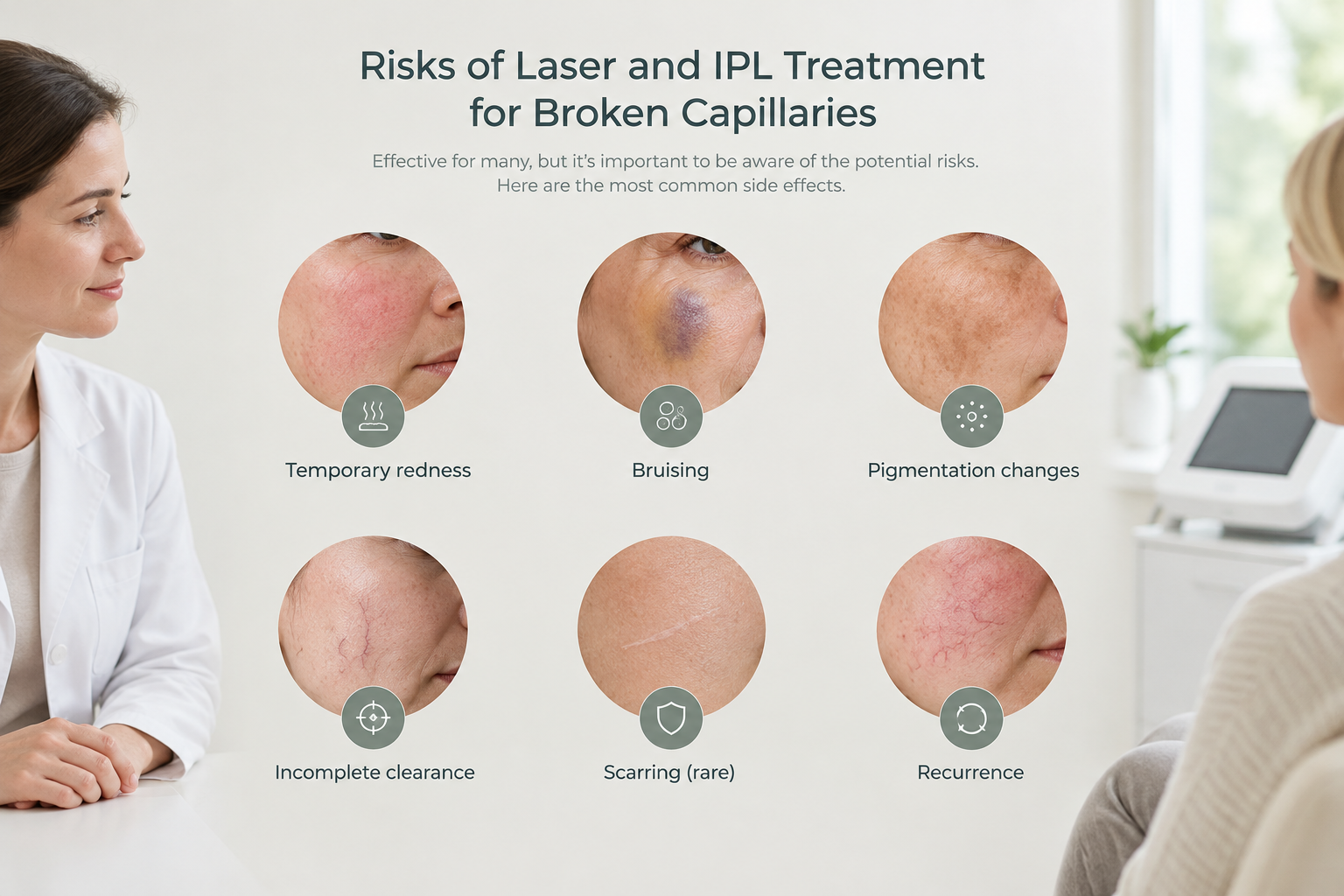
Laser and IPL treatments for broken capillaries are generally well tolerated when performed by a trained and experienced practitioner using appropriate settings for the patient’s skin type. However, as with any clinical procedure, there are potential risks and limitations that should be understood before proceeding.
- Temporary redness and swelling are expected after treatment and usually resolve within a few days.
- Bruising is more common with pulsed dye laser and typically resolves within one to two weeks.
- Pigmentation changes — either darkening (post-inflammatory hyperpigmentation) or lightening (hypopigmentation) of the skin — are possible, particularly in people with darker skin tones or those who have had recent sun exposure. These changes are usually temporary but can occasionally be persistent.
- Incomplete clearance is possible, particularly for deeper or larger vessels. Some vessels may require additional sessions or may not respond fully to treatment.
- Scarring is rare when treatment is performed correctly but is a recognised risk, particularly with electrocautery or if post-treatment care instructions are not followed.
- Recurrence of new vessels over time is likely if underlying causes are not addressed.
- Eye safety requires that appropriate protective eyewear is worn by both the patient and the practitioner during laser and IPL treatment.
People with very dark skin tones, active tanning, or certain skin conditions may not be suitable candidates for some devices. A thorough pre-treatment assessment by a qualified practitioner is essential to determine the most appropriate treatment and settings for each individual.
Skincare and Prevention
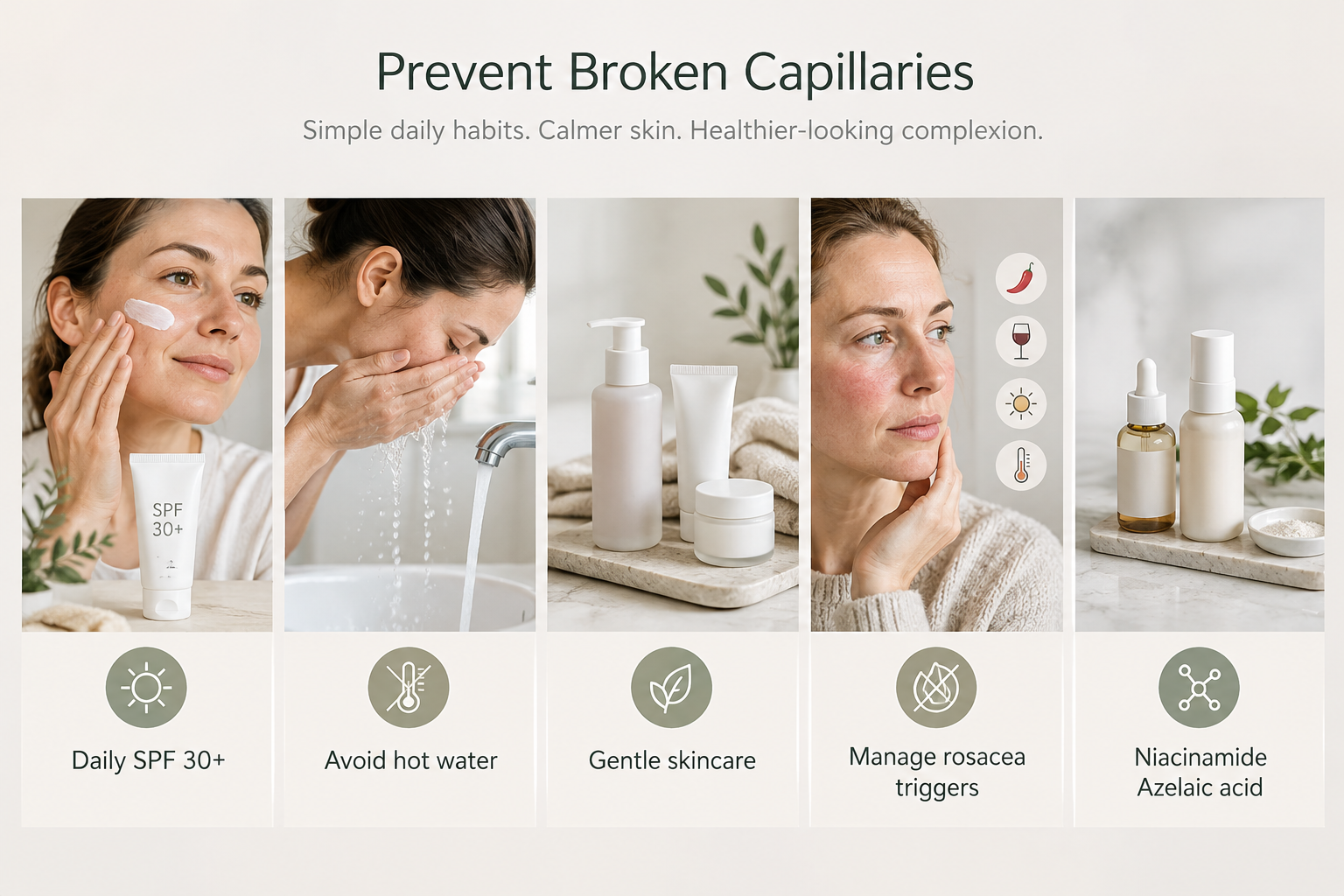
While no topical product can eliminate established broken capillaries, a thoughtful skincare routine can help to reduce facial redness, support the skin barrier, and slow the development of new vessels. Ingredients with evidence for reducing vascular-related redness include niacinamide, azelaic acid, and topical brimonidine (a prescription vasoconstrictor used in rosacea management). Green tea extract and centella asiatica are commonly included in products marketed for sensitive or redness-prone skin, though the clinical evidence for their effect on telangiectasia specifically is limited.
Broad-spectrum sunscreen with an SPF of at least 30 — applied daily, including on overcast days — is one of the most important preventive measures for people prone to broken capillaries. Mineral sunscreens containing zinc oxide or titanium dioxide are generally well tolerated by sensitive and rosacea-prone skin. Avoiding harsh exfoliants, very hot water, and known personal triggers for flushing can also help to reduce the rate at which new vessels develop.
Who May Be Suitable for Treatment
Laser and IPL treatment for broken facial capillaries may be worth discussing with a qualified practitioner if you have visible thread veins or persistent facial redness that is affecting your confidence or quality of life, and if you have realistic expectations about what treatment can achieve. Suitable candidates are generally those who:
- have clearly visible telangiectasia or diffuse facial redness caused by superficial vascular changes;
- have a skin type that is appropriate for the proposed device (assessed using the Fitzpatrick scale);
- are not currently pregnant or breastfeeding;
- do not have active skin infections or inflammatory conditions in the treatment area;
- have not had significant sun exposure or used self-tanning products in the weeks before treatment;
- are not taking medications that significantly increase photosensitivity or bleeding risk;
- understand that multiple sessions may be needed and that new vessels may develop over time.
People with rosacea may benefit from treatment but should be aware that managing the underlying condition — often with the involvement of a dermatologist — is an important part of achieving lasting results. A clinical assessment will help determine whether laser, IPL, or another approach is most appropriate for your specific situation.
Frequently Asked Questions
Can broken capillaries go away on their own?
Established broken capillaries — permanently dilated superficial vessels — do not resolve on their own. Once a vessel has lost its ability to constrict, it remains visible without clinical intervention. Temporary facial redness from flushing or irritation will subside, but fixed thread veins require treatment to be removed.
How many laser sessions will I need?
The number of sessions required varies depending on the extent and severity of the telangiectasia, the device used, and how your skin responds. Many people see a meaningful improvement after one to three sessions, but some cases — particularly widespread rosacea-associated redness — may benefit from additional treatments. Your practitioner should give you a realistic estimate after assessing your skin.
Does laser treatment for broken capillaries hurt?
Most people describe the sensation as a brief stinging or snapping feeling with each pulse of light. The level of discomfort varies between individuals and between devices. Topical anaesthetic cream applied before the session can reduce discomfort, and most people find the treatment tolerable without it.
Can broken capillaries come back after laser treatment?
Successfully treated vessels are permanently destroyed. However, new broken capillaries can develop over time, particularly if underlying causes such as sun exposure, rosacea, or genetic predisposition are not managed. Maintenance treatments and preventive skincare can help to slow the development of new vessels.
Is IPL or laser better for broken capillaries?
Both IPL and vascular laser treatments can be effective, and the better option depends on the individual. Dedicated vascular lasers such as the pulsed dye laser tend to be more precise for treating discrete thread veins, while IPL may be more practical for diffuse facial redness or when pigmentation concerns are also present. A practitioner experienced in both modalities can advise which is more appropriate for your skin.
Are there any skincare products that can remove broken capillaries?
No topical product can eliminate established broken capillaries. Some ingredients — including niacinamide, azelaic acid, and certain prescription topicals — may help to reduce associated redness and support skin barrier function, but they do not close or remove dilated vessels. Clinical treatment is required for visible thread vein removal.
Can I wear makeup after laser treatment for broken capillaries?
Most practitioners advise avoiding makeup for at least 24 hours after treatment to reduce the risk of irritation or infection while the skin is in an early recovery phase. After this period, gentle mineral-based products are usually well tolerated. Your practitioner will give you specific aftercare guidance based on the treatment performed.
Is Treating Broken Capillaries the Right Decision for You?
Broken facial capillaries are a common and treatable cosmetic concern. For many people, a course of laser or IPL treatment can produce a significant and lasting reduction in visible thread veins and facial redness, with a manageable recovery period and a low risk of serious complications when treatment is performed by a qualified and experienced practitioner. The results are not guaranteed to be complete, and new vessels may develop over time — particularly in people with rosacea or ongoing sun exposure — but for those who find broken capillaries distressing, treatment can make a meaningful difference to skin appearance and confidence.
The most important first step is a thorough consultation with a practitioner who can assess your skin type, the nature and extent of your telangiectasia, any underlying conditions such as rosacea, and which treatment approach is most appropriate for you. Managing contributing factors — particularly sun protection and known rosacea triggers — alongside clinical treatment gives the best chance of a durable result. If you are considering treatment for broken capillaries, a consultation with a qualified aesthetic practitioner or dermatologist is a reasonable starting point for understanding your options.